Nov 20, 2026
5 Factors When Specifying C17500 Beryllium Cobalt Copper Bushing
The five elements to consider when specifying a C17500 beryllium cobalt copper bushing are material condition and certification, load and wear match, dimensions and fit, temperature and environment, and supplier capabilities. I evaluate them in that sequence since an early error makes every subsequent option more costly. UNS C17500, when aged to the AT/TF00 temper, has a thermal conductivity of 200 to 245 W/m·K, an electrical conductivity of 45 to 60% IACS, and a yield strength of 550 to 690 MPa. But such values only safeguard your cycle time provided they comply with the design, the batch certificate, and the actual operating circumstances.
We have been machining copper alloys at JYDS since 1997. This is the question I hear most often from mold shops: The catalog value appears fine, but will the batch? From alloy inspections to supplier evaluation, the sections below address that for every C17500 beryllium-cobalt-copper bushing order.
Factor 1: Confirm C17500 Material Composition, Hardness, and Heat Treatment
Verify the Chemistry, Not Just the Name
UNS C17500 has 0.40 to 0.70 percent beryllium and 2.40 to 2.70 percent cobalt, the remainder being copper; however, this is not revealed by a simple label of “beryllium copper.” My recommendation is that you ask for optical emission spectroscopy findings for each batch of C17500 beryllium-cobalt-copper bushing with a heat number shown on the EN 10204 3.1 certificate. This connection allows a mold company to track a worn part back to its batch if a hot-spot issue occurs months after installation.
Specify the AT/TF00 Temper on the Drawing
Solution treatment followed by precipitation hardening gives a C17500 beryllium cobalt copper bushing its working properties: 680–850 MPa tensile strength, 550–690 MPa yield strength, and 95–102 HRB hardness. Write the AT or TF00 temper on the design so that the bushing comes ready to install. Aging can cause slight dimensional changes, so drawings should specify whether final machining occurs before or after aging. The clamping force is where a soft batch gives way. Include the yield range in the purchasing agreement, and a hardness limit.
Compare C17500 with C17200, Bronze, and Brass
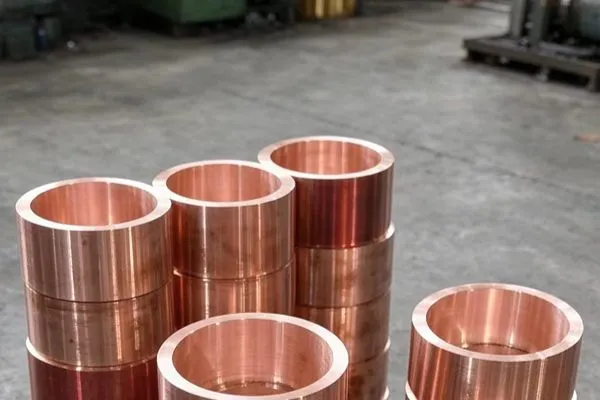
C17500 conducts heat at 200–245 W/m·K, about twice the 105 W/m·K typical of C17200. For severe mechanical use, C17200 is hardened to increased hardness, up to 38-42 HRC. Brass and bronze transmit heat less and soften sooner when clamped. I use C17500 beryllium cobalt copper for hot spot cooling and current routes and C17200 where wear and stress predominate. Those standards include mill forms. Specify the finished part as machined from qualifying stock such as ASTM B441 rod or bar (or the applicable wrought plate/strip standard) and aged to the drawing requirements.
Factor 2: Match Load Capacity, Friction, and Wear Resistance to the Application
Calculate Bearing Pressure Before Choosing Wall Thickness
First, estimate nominal bearing pressure from radial load divided by projected bearing area (mating diameter times effective length), then evaluate it alongside impact factors, PV limits, and the 550–690 MPa yield range rather than treating nominal bearing pressure as a direct 1:1 yield limit. Then add a margin for impact loads from mold closure or ejector movement. Thin walls save space, but are the first to distort under clamping. I consider wall thickness to be a critical load-bearing decision, not a packing afterthought. The oscillating motion and the PV conditions should be checked equally wherever the bushing travels.
Pair the Bushing with the Right Shaft
A C17500 beryllium cobalt copper bushing is galling- and fretting-resistant to steel for dry or slightly lubricated locations. But copper alloys still wear on soft shafts. The roundness and polish should be uniform across the length of the bearing. The mating pin or shaft should be honed and hardened. Lubrication grooves and oil holes may assist, but they take away bearing surface; therefore, install them outside the main load zone. Show them on the design.
See How Requirements Differ by Machine
Requirements shift by machine. A hot-spot bushing in a plastic mold is subject to clamping force and heat but minimal sliding. Die-casting plunger tip bushings are subject to heat, stress, and abrasion. Resistance welding electrode holders carry high current, require water cooling, and are typically RWMA Class 3. Sliding contact with hot strand in continuous casting applies only where actual operating temperature stays within our 400°C data limit or on cooled/low-temperature sections. You can only evaluate whether a C17500 beryllium cobalt copper bushing fits if you name the machine and duty cycle in your request.
Factor 3: Specify Dimensions, Tolerances, and Installation Fit Correctly
Define Every Critical Dimension
A comprehensive design of a C17500 beryllium cobalt copper bushing will include bore, outer diameter, length, wall thickness, flange features, grooves, oil holes, chamfers, surface polish, concentricity, and roundness. Precision CNC turning and grinding are used to hold tight tolerances. We machine exterior diameters from 10 to 500 mm and internal diameters from 5 to 450 mm to ±0.005 mm. Copper alloys change with heat during inspection. Mark the key dimensions, identify the datum, and indicate the temperature of measurement.
Plan the Press Fit with Housing and Shaft
An interference fit compresses the bushing and reduces the internal bore diameter (bore closure), so the pressed-in bore differs from the pre-press-fit machined bore. The outcome depends on the material of the housing, wall thickness, and operating temperature. Copper alloys expand roughly 50% more than typical tool steels, so a cold interference fit will change with temperature. We work to ISO standard tolerance classes g6 and h6 or to your design. Send us the housing and shaft data, and we will provide allowance recommendations.
Agree on First-Article Requirements
Most mold shops check sample bushings in a real tool over a period of one to two months before releasing project volume. Decide ahead of time what the first piece has to verify: dimensions, hardness, conductivity, and fit. Decide on the installation and removal procedure as well, since a bushing that can’t be pulled out without damaging it is an expensive replacement. Our engineers can certify drawing feasibility within 24 hours, which makes the sample timetable reasonable.
Factor 4: Evaluate Temperature, Corrosion, Conductivity, and Operating Environment
Set Temperature Limits and Thermal Cycles
Our data limits the maximum working temperature of C17500 to 400 °C. Keep a record of the continuous and peak temperatures and how frequently the part cycles. The alloy's thermal fatigue resistance makes it well suited for molds, dies, and welding tools which heat up and cool down frequently. Frictional heat contributes to process heat, and expansion variations between the bushing, shaft, and housing affect clearances with temperature; thus, verify clearance hot as well as at room temperature.
Specify Conductivity and Protect It
In metals, electrical and thermal conductivity correlate closely (related to the Wiedemann–Franz behavior), making eddy-current testing (% IACS) a practical batch-screening check for every C17500 beryllium cobalt copper bushing. For direct thermal reading, request laser-flash testing under ASTM E1461. Oxide layers, coatings, or lubricant on the faces in contact increase the thermal resistance; hence, maintain the heat-transfer surfaces clean and in full contact with the steel.
Check Environment, Safety, and Compliance
Consider exposure to moisture, coolants, hydraulic oil, chemicals, salt, dust, and abrasive-loaded resins. Solid completed pieces may be handled safely. Machining or grinding generates dust that contains beryllium. OSHA’s beryllium regulation (29 CFR 1910.1024) specifies an 8-hour permissible exposure limit of 0.2 µg/m³ and requires exposure controls. Our materials fulfill RoHS and REACH criteria. We ship parts in anti-rust and moisture-proof export packing.
Factor 5: Select a Qualified C17500 Bushing Manufacturer and Procurement Partner
Review Quality Systems and Records
Ask to examine the inspection path and look for ISO 9001:2015 certification. Our inspections include entering OES chemistry, hardness tests in process, final eddy current conductivity, ultrasonic testing for internal flaws, and dimensional checks with EN 10204 3.1 certifications for each batch. Before placing a trial order, ask any seller of a C17500 beryllium cobalt copper bushing to provide a sample certificate showing chemistry, hardness, and conductivity.
Judge Capability and Delivery
Precision copper-alloy machining means familiarity with deep bores, oil holes, flanges, and tight tolerances. Since 1997, JYDS has worked with copper alloys with in-house vacuum induction melting. We have over 500 tons of raw material and standard profiles in stock and ship stock products in 3-5 days and bespoke orders in 15-20 days, which is useful when a tooling or repair window is established.
Plan Commercial Terms Early
Once the sample is approved, agree on quantities of the prototype, minimum order, lead time, Incoterms, export documentation, and warranty. We provide CIF, FOB, DDP via ship, air, or express courier from a facility near the ports of Shenzhen and Hong Kong. If your C17500 beryllium cobalt copper bushing program requires cobalt-sourcing declarations or an NDA covering your designs, please let us know in the initial inquiry so we can provide the documentation.
How to Choose the Right C17500 Beryllium Cobalt Copper Bushing
Define Conditions and Rank Priorities
C17500 Beryllium Cobalt Copper Bushing: Write down load, speed, temperature, lubrication, shaft hardness, housing fit, conductivity goal, and chemical exposure. Then rank them in order of importance: heat removal, hardness, wear life, dimensional stability, or machinability. In a mold, a hot-spot bushing often values conductivity above yield strength, but a guide bushing under sliding stress may reverse that order. Providing a sorted list makes alloy choosing a brief discussion, not an argument.
Compare Alternatives Fairly
Add a C17500 beryllium cobalt copper bushing next to C17200, bronze, brass, steel-backed, coated, and composite alternatives with your own rating. C17500 leads when heat extraction and current flow are important, and C17200 leads where hardness and spring strength are important. Bronze and brass cost less but don’t transport as much heat. Light-load sliding locations with less heat generation can use coated or composite sleeves. Don’t just quote me. Compare on service life and cost of downtime.
Validate Before Volume Orders
Run bearing pressure calculation and thermal clearance assessment. Inspect prototypes against drawings. Install in a representative tool and record cycle time and hot-spot temperature and fit after removal. If findings are consistent with the design, release project volume under the same specification, certificate format, and acceptance restrictions that the prototype fulfilled, so each repeat C17500 beryllium cobalt copper bushing order matches the authorized sample.
Common Specification Mistakes to Avoid
Choosing by Alloy Name Alone
A callout of C17500 without temper, hardness, or conductivity leaves the door open for a soft or out-of-spec batch. The inclusion of the AT/TF00 temper, the yield range of 550- 690 MPa, and the objective of 200 – 245 W/m·K in the agreement bridges that gap. Another near relative of this problem is relying on catalog values without batch inspection data, which is one reason why a C17500 beryllium cobalt copper bushing might disappoint in a trial.
Ignoring Thermal Expansion and Press-Fit Stress
A bushing that fits at ambient temperature may not fit at operating temperature. Copper alloys expand more than steel; thus, verify clearance hot. Measure bore after pressing. A common cause of seizure and out-of-round bores in new tools is overlooking press-fit stress, and a few minutes of computation before cutting metal eliminates it.
Treating Alloys as Interchangeable or Buying on Price Alone
In fact, C17200 may increase hot-spot temperatures if placed in a cooling position, since its conductivity is about half that of C17500. C17500 will have reduced wear life under strong mechanical loads. A cheap quote that does not include certifications, inspection, or temper may typically cost more in downtime. If a supplier comes back with a different alloy than the C17500 beryllium cobalt copper bushing, you are protected, since the replacement criteria are included in the authorized design.
Conclusion
A C17500 beryllium cobalt copper bushing is the best practice for five checks agreed: chemistry and AT/TF00 temper confirmed, load and wear match, dimensions and fit complete, temperature and environment indicated, and a supplier whose records verify the claims. The alloy's thermal conductivity is 200–245 W/m·K, with 45–60% IACS and 550–690 MPa yield strength, making it suitable for hot-spot cooling and clamped situations. C17200 is suitable for greater mechanical loads. Many failures are caused by insufficient designs, disregarded thermal expansion, or unauthorized substitutes rather than the alloy itself. Prototype validation and batch certification transform catalog values into measurable outcomes, and a documented specification ensures that subsequent orders are the same as the certified sample.
FAQ
1. What separates C17500 from C17200?
C17500 conducts heat at 200–245 W/m·K, about twice the 105 W/m·K of C17200. C17200 is harder and stronger, so it suits heavy mechanical load.
2. Which documents come with each order?
Every batch ships with EN 10204 3.1 certificates showing chemistry, hardness, and conductivity.
3. Can C17500 run up to 400°C?
Our data set lists 400°C as the maximum operating temperature. Share your peak temperature and cycle pattern so our engineers can confirm suitability.
4. Is it safe to handle?
Solid finished parts are safe to handle. Machining and grinding create dust, so use ventilation and protective equipment.
5. How fast can I receive parts?
Stock items are dispatched within 3–5 days, and custom orders are delivered in 15–20 days.
Request a Custom C17500 Bushing Quote
Send your drawing, quantity, temper, and operating conditions to JYDS at js01@jstongcai.com.cn, and our engineers will confirm feasibility within 24 hours. As a C17500 beryllium cobalt copper bushing manufacturer with 25+ years of copper alloy experience, 500+ tons of stock, EN 10204 3.1 certificates for every batch, and replies within 2 hours, we support prototypes through volume orders.
References
1. ASM Handbook, Volume 2: Properties and Selection: Nonferrous Alloys and Special-Purpose Materials, ASM International, 1990
2. Copper and Copper Alloys, ASM Specialty Handbook, ASM International, 2001
3. ASTM B441, Standard Specification for Copper-Cobalt-Beryllium Alloys (UNS Nos. C17500 and C17510) Rod and Bar, ASTM International, 2018
4. ASTM E1461, Standard Test Method for Thermal Diffusivity by the Flash Method, ASTM International, 2013
5. Occupational Exposure to Beryllium and Beryllium Compounds, Final Rule, OSHA, 2017
6. How to Make Injection Molds, Hanser Publishers, 2001
Online Message