Nov 18, 2026
A Machinist’s Guide to C17500 Beryllium Cobalt Copper Bushing
C17500 Beryllium Cobalt Copper Bushing: a precipitation-hardened sleeve that conducts heat and current away from a hot contact point and nevertheless holds a clamping load. This alloy has a beryllium content of 0.40-0.70% and a cobalt content of 2.40-2.70%. It has a thermal conductivity of 200-245 W/m.K and a yield strength of 550-690 MPa in the aged (AT) condition. I prepared this guide for machinists, mold designers, and purchasers who have to figure out when the alloy works, how to machine it, and what to include in a purchase order.
C17500 Beryllium Cobalt Copper Bushing Material Composition and Core Properties
How the Chemistry Shapes a C17500 Beryllium Cobalt Copper Bushing
The C17500 beryllium cobalt copper bushing is based on a copper matrix containing 2.40–2.70% cobalt and 0.40–0.70% beryllium. As they age, small particles precipitate inside the grains and lock in the structure. This increases strength, but sacrifices little conductivity. Cobalt additionally refines the grain and increases the temperature at which the alloy starts to soften. The grade has a number of different designations, so I mention them to avoid confusion on drawings. UNS C17500 CuCo2Be EN CW104C DIN 2.1285 RWMA Class 3. When your team writes the callout, use one of these identifiers with the temper, not just the alloy name.
Mechanical and Physical Values to Put on the Drawing
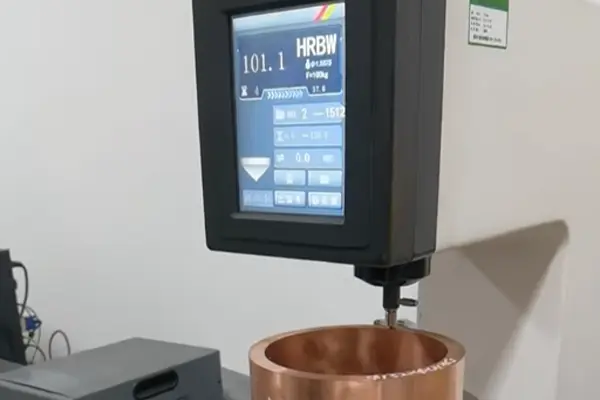
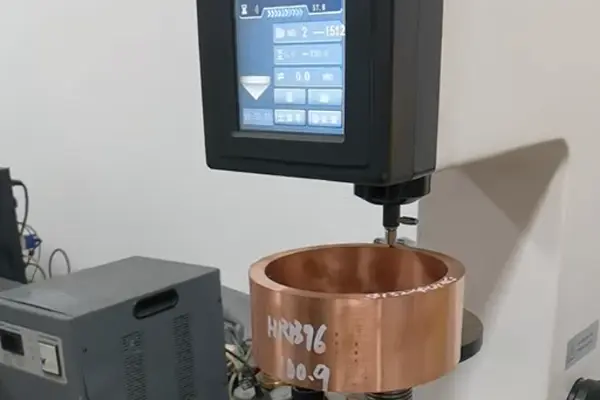
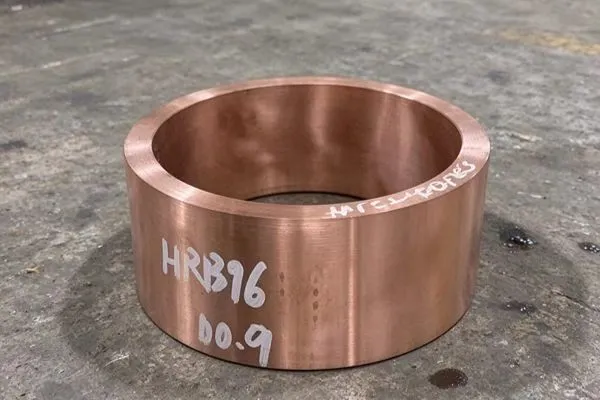
The aged AT (TF00) state has a tensile strength of 680–850 MPa, yield strength of 550–690 MPa, and hardness of 95–102 HRB. Electrical conductivity is 45-60% IACS, and thermal conductivity is 200-245 W/m·K. C17200 is ~105 W/m·K. C17500 transfers almost twice the amount of heat through the same wall. Maximum working temperature is 400 °C. The alloy is non-magnetic. These ranges provide the grade. This is not a substitute for an actual measured result for your lot, which is why I include certificates in the purchase part below.
Temper and Standards: Reading AT/TF00 Correctly
AT, also written TF00, means the material was solution heat-treated and then precipitation hardened, so a finished part can go straight into the mold or holder. The raw stock is covered by two ASTM standards. ASTM B441 for rod and bar and ASTM B534 for plate, sheet, strip, and rolled bar. Both describe initial material, not manufactured pieces. I thus advise wording the buy line as “machined from B441 or B534 stock and aged to AT, as per drawing." ISO 5182 pertains solely to resistance welding electrode applications, and the grade is also listed to SAE J463.
How a C17500 Bushing Performs in Service
Cooling Hot Spots with a C17500 Beryllium Cobalt Copper Bushing
Mold hot spots occur at locations where water lines cannot reach, such as thin core pins, tight corners, and hot runner tips. There, a C17500 beryllium cobalt copper bushing conducts heat to the closest cooling channel at 200–245 W/m·K, nearly double the rate of C17200. The faster the heat is removed, the less time it takes for a part to cool before ejection. That is where you save on cycle time. The yield range of 550–690 MPa is also important. The bushing must withstand hard clamping without distortion; the heat contact to the surrounding steel would be lost. I would suggest tracking cooling time and part temperature throughout the experiment so the increase shows up in your own figures.
Welding, Casting, and Power Uses
C17500 is a traditional RWMA Class 3 material for resistance welding electrode holders where the electrode shank is kept from overheating by rapid heat flow. In continuous casting guides, copper alloys are used to guide the strand without damaging it, but the 400°C limit implies you should validate the hot-face temperature at your site before selecting this grade. It is used in high-current connections for low-resistance pivot points that resist galling during quick switching. For each scenario, I consider the bushing as a system along with the shaft or electrode, the cooling flow, and the clamping arrangement.
What a C17500 Beryllium Cobalt Copper Bushing Will Not Do
Clear boundaries keep you out of trouble. A C17500 beryllium cobalt copper bushing is not self-lubricating; therefore, sliding duty still requires a lubrication plan, a firm and smooth shaft, and proper alignment. It will not gall on steel, but at speed, dry running will wear it. Data on strength is thin above 400°C and service requires further certification. Its strength is in the moderate range; therefore, heavy mechanical duty may choose C17200. For safety-critical equipment, I usually propose a prototype run before bulk procurement.
C17500 Beryllium Cobalt Copper Bushing vs C17200 and Other Materials
C17500 vs C17200: Conductivity or Strength
My rule is easy. C17200 is stronger and tougher and will survive longer under intense mechanical pressure. C17500 is superior in conducting heat and current, rated at 200-245 W/m.K compared with around 105 W/m.K for C17200. If the bushing is mostly a clamp and receives impact, start with C17200. If your application is for heat removal from a hot area, start with C17500. Most mold shops have both, and they allocate by location. Our beCu range goes to 38-42 HRC, and aged C17500 is 95-102 HRB. You can see the hardness discrepancy on a tester.
C17500, C17510, Bronze, and Self-Lubricating Options
C17510 is the nickel-beryllium cousin of C17500, and the two are commonly compared for conductive work. I suggest you examine the certified datasheets before you switch one for the other. Bronze is cheaper and machines readily. It is suitable for normal sliding at moderate temperatures, but it transmits significantly less heat than C17500. Composite or self-lubricating bushings are ideal for dry-running or maintenance-free use. These are suitable where a copper alloy would otherwise require grease. Unit pricing alone might be misleading. An inexpensive bushing that breaks in a hot area will cost more in downtime than the part ever saved.
A Short Decision Path
I guide the buyer through 4 questions. What moves: slide, clamp, or nothing? What is the temperature of the contact face, and is it kept below 400°C? Does the portion need to conduct heat or current? What if it doesn’t work? A wrecked mold? A line down? Then what? If heat or current is the goal and temperature remains below 400C, you may want to try a C17500 beryllium cobalt copper bushing. Test C17200 if load is the major factor. If you can't lubricate, maybe a self-lubricating material?
C17500 Bushing Design and Machining Guide
Choosing a Configuration and Size
This alloy machines well for plain sleeves, flanged bushings, grooved sleeves, and thin-wall rings. We create exterior diameters from 10 to 500 mm and internal diameters from 5 to 450 mm, according to your design. Consider heat flow and wall thickness together. I ask designers what the load situation is before making a modification, since a thinner wall reduces the heat route but loses clamping rigidity. Flanges, oil grooves, chamfers, and retention features should be shown on the design. State if ISO g6 or h6 fits are applicable to the shaft and housing.
Tolerances, Fits, and Machining Steps
We do CNC turning and grinding to ±0.005 mm as required per the design. The material is delivered in the aged condition; thus, we machine it as received. If your design requires a separate aging phase, we check final dimensions after that stage. Use sharp tools, solid workholding, and constant coolant to reduce heat, then bore, finish, and grind. Copper alloys have more expansion than steel. Running clearance should be established with thermal growth in mind. A heated section reads large. Control the temperature while measuring.
Safe Machining Under OSHA Rules
It's safe to touch solid bushings. The worry is dust, fumes, tiny chips. OSHA's beryllium regulation (29 CFR 1910.1024) normally applies to materials having 0.1% or more beryllium and specifies an eight-hour average permitted exposure limit of 0.2 µg/m³. 0.40-0.70% C17500: Use local exhaust ventilation, wet cutting, HEPA vacuuming instead of dry sweeping or compressed air, and suitable safety equipment. If you don’t have the capability in your shop, purchasing completed bushings machined to your design takes that job off of your floor.
How to Specify, Inspect, and Buy a C17500 Beryllium Cobalt Copper Bushing
What to Include in Your Drawing and RFQ
Send the grade (C17500), temper (AT/TF00), stock language from the standards section, dimensions, tolerances, surface finish, and quantity. Add operational conditions like load, temperature, and cooling technique. Put the acceptable values you care about in the agreement: 45–60% IACS conductivity, 95–102 HRB hardness, 550–690 MPa yield strength. Confirm with us the means of verifying each value. Ask for an NDA before we send you critical designs, and let us know if you require documentation on cobalt content. Our engineers will validate the feasibility within 24 hours.
Inspection and Batch Certificates
Every shipment is accompanied by actual measurement data, since a catalog value is not a test result. Each bushing is subjected to OES chemistry on entering stock, process monitoring with hardness testing, final eddy current conductivity measurement, ultrasonic inspection for internal flaws, and dimensional inspections. Each batch is provided with an EN 10204 3.1 certificate for chemical composition, hardness, and conductivity. Eddy current is used to test electrical conductivity. Thermal conductivity is in the range of 200 – 245 W/m·K. If you want a thermal figure measured immediately, add that test to the purchase agreement. Our quality system is accredited according to ISO 9001:2015, and our goods are RoHS and REACH compliant.
Lead Time, Stock, and Shipping to the US
JYDS (Jiaye Dingsheng) has produced copper alloys since 1997, and we run an in-house vacuum induction melting furnace for consistent alloy purity. We have more than 500 tons of raw material and standard profiles. Stock goods ship within 3-5 days; custom machined orders ship in 15-20 days. We are close to Shenzhen and Hong Kong ports. We pack in export-standard anti-rust and moisture-proof packaging, and provide quotations on CIF, FOB, or DDP by sea, air, or international express. I would start with samples for a one-to-two-month mold trial, then purchase batches per project.
Conclusion
A C17500 beryllium cobalt copper bushing is good for applications where heat or current has to go out of a point of contact, but the item must still retain its form. Its thermal conductivity is almost double that of C17200 at 200-245 W/m·K. Its yield strength is 550-690 MPa, which is resistant to deformation under clamping. C17200 is still used for strong mechanical loads, and bronze or self-lubricating materials are used for other jobs. The bushing is not self-lubricated, and the 400°C limit must be verified by actual contact temperatures. Aged material with tight tolerances and OSHA-compliant dust management is optimal for machining. The catalog ranges are confirmed by the findings obtained from the conductivity, hardness, and yield values written in the agreement, supported by the batch certificates.
FAQ
1. What is the main difference between C17500 and C17200?
C17200 is stronger and harder, so it suits heavy mechanical duty. C17500 conducts heat and current better, at 200–245 W/m·K against roughly 105 W/m·K, which makes it the better choice for hot-spot cooling.
2. What is the maximum operating temperature?
I recommend a ceiling of 400°C. For higher temperatures, request application-specific validation before approving the part.
3. Is a C17500 bushing self-lubricating?
No. Plan for lubrication, a hard shaft, and proper alignment in sliding duty.
4. What documents come with an order?
Each batch includes an EN 10204 3.1 certificate with chemical composition, hardness, and conductivity results.
Request a Custom C17500 Beryllium Cobalt Copper Bushing Quote from JYDS
Send your drawing to JYDS at js01@jstongcai.com.cn, and our team will reply within 2 hours. As a C17500 beryllium cobalt copper bushing supplier with 25+ years of experience, 500+ tons in stock, ±0.005 mm CNC machining, and EN 10204 3.1 certificates on every batch, we can quote samples and volume orders.
References
1. ASM Handbook, Volume 2: Properties and Selection: Nonferrous Alloys and Special-Purpose Materials, 1990
2. Copper and Copper Alloys, ASM Specialty Handbook, 2001
3. ASTM B441, Standard Specification for Copper-Cobalt-Beryllium Alloys (UNS C17500) and Copper-Nickel-Beryllium Alloys (UNS C17510) Rod and Bar, 2018
4. OSHA, Occupational Exposure to Beryllium and Beryllium Compounds, 29 CFR 1910.1024, 2017
5. Resistance Welding Manual, 4th Edition, Resistance Welder Manufacturers' Association, 2003
6. How to Make Injection Molds, 3rd Edition, Hanser Publishers, 2001
Online Message