Nov 25, 2026
C17000 Beryllium Copper Strip: Strength, Fatigue and Conductivity
In a thin, workable layer, C17000 beryllium copper strip has a long life, is very strong, and conducts electricity well. The tensile strength of mill-hardened TM tempers ranges from 690 to 1205 MPa, that of age-hardened strip ranges from 1030 to 1450 MPa, and the hardened conductivity ranges from 22 to 28% IACS. After 1,000 hours at 100°C, the alloy still has more than 90% of the stress it had at the start. It costs less and bends easier than C17200 because it has 1.60–1.79% beryllium in it. It is used for most connector and spring applications. For more than 25 years, JYDS has made beryllium copper. The sections that follow will help you choose the right alloy for your stamping line.
What Is C17000 Beryllium Copper Strip?
Alloy Identity and Chemistry
The C17000 beryllium copper strip is a copper alloy that hardens through precipitation. It's also known as CuBe1.7, Alloy 165, CDA 170, and DIN 2.1245, which buyers can see on the list. It's in line with ASTM B194, SAE J461, and SAE J463. 1.60–1.79% of beryllium is found. Cobalt plus nickel must be at least 0.20%, and cobalt, nickel, and iron must be at or below 0.60%. Iron stays at a maximum of 0.10%, aluminum and silicon stay at a maximum of 0.15% each, and lead stays at a maximum of 0.02%. The balance is copper. We use ICP-OES to check the chemistry because a narrow range of beryllium keeps the aging response steady and makes sure that all of your stamped parts have the same hardness.
How Precipitation Hardening Works
Solution annealing breaks down the beryllium into the copper matrix. This makes the strip soft and simple to shape. Rolling things cold makes them stronger. After some time, small particles rich in beryllium form. These particles stop dislocations from moving and make the material harder. In our product data, it says that annealed material should be held at 315°C for two to three hours to reach its hardest state. When alloys age too little, they lose strength, and when they age too much, they become soft and lose spring force. Heating also makes thin, fine-pitch parts more likely to warp. This path of hardening is what makes C17000 beryllium copper strip soft for heavy forming or hard for direct stamping.
Annealed, Mill-Hardened, and Age-Hardened Tempers
We offer tempers that have been annealed (TB00) and mill-hardened (TM00–TM06). An annealed strip has a tensile strength of 410 to 520 MPa, an HV of 110 to 135, and an IACS of 15 to 19%. There are 690 to 1205 MPa, 225 to 380 HV, and 22 to 28% IACS in mill-hardened strip. At the same 22–28% IACS, age-hardened tempers (TF00–TH04) can reach 1030–1450 MPa. The TM-temper C17000 beryllium copper strip stamps directly, without any heat treatment afterward. This cuts down on the time it takes to make the product and lowers the risk of distortion. If the part needs to be drawn very hard before it hardens, choose annealed strip. If you don't want to go through the furnace step, choose a TM temper.
Strength, Fatigue, and Conductivity in Detail
Tensile Strength and Hardness by Temper
Tensile numbers help you sort tempers, but they don't set the spring force on their own. The yield strength, thickness, and shape of the part also affect the spring force. The mill-hardened form of C17000 beryllium copper strip has a range of 690–1205 MPa across TM00 to TM06. This means that if the contact design needs more force, the stamper can raise the temper. The pattern of hardness stays the same from HV 250 to 380. When you buy a certain thickness and temper, make sure that the Mill Test Certificate has the exact tensile, yield, and hardness values written on it. Don't just ask for a range. After that, compare those numbers to your drawing before you make a die.
Fatigue Resistance and Stress Relaxation
How many deflections a contact can handle is called its fatigue resistance. Stress relaxation is the amount of force that a spring loses while it is hot and under load. Based on our product data, C17000 beryllium copper strip keeps more than 90% of its original stress after 1,000 hours at 100°C. This makes it better than stainless steel and regular phosphor bronze in this way. When compared to C17200, fatigue and relaxation performance for most connector and spring uses is pretty much the same. That qualifier is important. Do a side-by-side relaxation test on your most stressed springs at your own deflection and temperature before you switch them. Buyers and mold engineers can both use the result as proof.
Electrical and Thermal Conductivity
The annealed strip is 15–19% IACS. In both age-hardened and mill-hardened conditions, conductivity rises with age to 22–28% IACS. In hardened conditions, conductivity reaches 105 W/m·K. That balance works for contacts that carry current and need spring force. One thing that is not the same as contact resistance on a finished part is conductivity on a data sheet. It depends on the temperature, the geometry, the contact force, and the plating. For a relay blade or terminal, stamped samples are the best way to measure resistance. That test tells you for sure if the C17000 beryllium copper strip meets your real-world electrical needs.
How C17000 Compares with C17200 and Other Alloys
Cost and Performance Versus C17200
C17000 is less expensive than C17200 because it has less beryllium in it, and its fatigue and relaxation behavior stays pretty much the same for most connector and spring uses. A lot of stampers in the US do both grades. It makes sense to move the contacts with less stress to the C17000 beryllium copper strip first, then keep the C17200 on the springs with the most stress, and widen the switch as your data allows. Compare prices for the same thickness, width, temper, and tolerance to find out what the real price difference is. We sell directly from the factory and make sure that each batch is the same, so a cheaper grade doesn't mean that the coils aren't even.
Versus Phosphor Bronze and Stainless Steel
PS bronze costs less at first and works better for contacts that don't need to do as much work. Stainless steel is strong, but it can't compete with beryllium copper when a part needs to be strong and conduct electricity at the same time. After 1,000 hours at 100°C, our data shows that C17000 still has more than 90% of its original stress. This makes it stronger than both stainless steel and regular phosphor bronze. Should a phosphor bronze contact lose its power in the field or a stainless steel part add too much resistance, the C17000 beryllium copper strip is a step up that won't cost you as much as the C17200 grade.
Choosing Between C17000, C17200, and C17500
We can help you compare your options since JYDS also sells C17200 (CuBe2), C17500 (CuCo2Be), and C17510 (CuNi2Be). Ask four questions to begin with. How bad is the bend? How strong should the spring be? What kind of conductivity does the circuit need? What is possible with the money? C17000 beryllium copper strip is cheaper than C17200 and works well for parts that need to be bent sharply and be strong. Check the data sheet for C17500 to find out the exact temper. It tends to be more conductive than strong. Fill out the drawing with your answers, and we'll help you choose.
Forming, Dimensions, and Applications
Bending and Deep-Draw Formability
When beryllium content is low, microcracking is less likely to happen during sudden bending. This means that designers can make small springs and micro-connectors with tighter radii. As required by ASTM E112, we keep an eye on the grain size because big grains lead to orange peel and other surface flaws when deep drawing. If you need more room to shape the metal, use annealed strip. If you need parts with less severe draws, use TM tempers stamp directly. Mold engineers should let us know early on about the bend radius, the direction of the bend in relation to the rolling direction, and the depth of the draw. Because of these details, we can suggest a temper that forms well in C17000 beryllium copper strip and still gives you the spring force you need.
Slitting Precision and Thickness Control
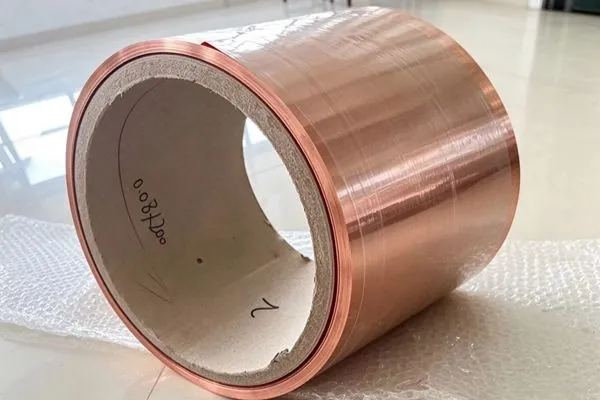
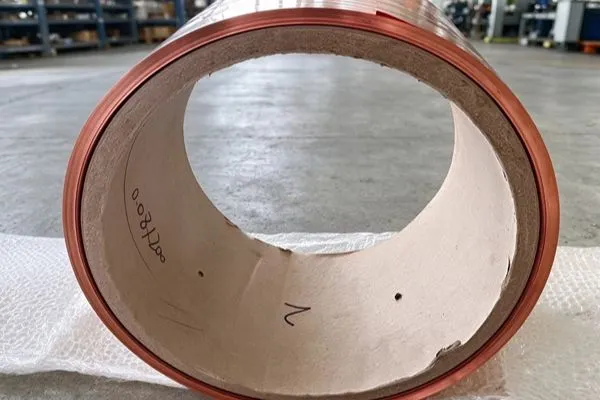
Thickness ranges from 0.05 mm to 2.5 mm, and width ranges from 5 mm to 400 mm. We can also make slit widths that are exactly the right size for your die. We cut the C17000 beryllium copper strip into pieces with a width of ±0.05mm and a thickness of ±0.002mm, which is measured with a laser micrometer. Those numbers are important for high-speed progressive stamping. A steady width keeps the strip in the middle of the guides, and a steady thickness makes sure that the spring force is the same all the way around a coil. Write down the maximum burr height, flatness, and camber in your RFQ so that we can check them against our process. For export, we wrap coils in waterproof material.
Typical Applications
Electrical switch contacts, relay spring blades, precision electronic connectors, automotive terminals, diaphragm plates, flexible couplings, and spring washers can all be made from C17000 beryllium copper strip. It keeps the contact force in automotive ECU connectors and sensor terminals even when the temperature and vibration change. It allows for long-cycle operation in microswitches. It can be found in EMI shielding parts of 5G and telecom equipment. It is also used in hydraulic parts for airplanes when both shape and conductivity are important. For each use, a different temper is needed, so make sure the strip fits the loads on your part and try out samples before placing large orders.
Quality, Compliance, and Buying Considerations
Testing, Traceability, and Certificates
For every order of C17000 beryllium copper strip, we check the raw materials, keep an eye on the production as it happens, and do a final full inspection. Finished goods are checked for their chemical make-up, hardness, size, and the integrity of their surfaces. Our quality system is certified by ISO 9001:2015, and every shipment comes with an EN 10204 3.1 Mill Test Certificate that lets us track back to the exact batch it came from. Our vacuum induction melting furnace helps keep the material pure, the gas content low, and the alloy consistent from the very first melt. Comparing certificates from different lots side by side can help you figure out if a lower-cost grade is stable from batch to batch. There, numbers that stay the same say more than any promise.
Safe Handling and Regulatory Compliance
This solid C17000 beryllium copper strip is safe and meets RoHS and REACH standards. When grinding, machining, welding, or abrasive finishing is done, dust and fumes need to be controlled in a specific way. This can be done by providing local ventilation, collecting dust, and wearing the right safety gear. Even though those methods are different from stamping solid strip, you should still look at the safety data sheet and do a risk assessment for your specific site. US shops should also look at 29 CFR 1910.1024 from OSHA, which is their beryllium standard and talks about beryllium in the air at work. Let us know if your process changes, like if you go from stamping to grinding, so that we can send you the right files.
RFQ Checklist and Supply Terms
Having a full RFQ for C17000 beryllium copper strip makes your quote go faster. Include the alloy and standard, the temper, the thickness, the width, the tolerances, the coil dimensions, the quantity, the destination, and any certificates that are needed. We have more than 500 tons of beryllium copper standard profiles and raw materials in stock. Items that are in stock will be sent out in 3–5 days, and custom orders will arrive in 15–20 days. We respond to questions in two hours and send official quotes within twenty-four hours. Because we are close to the ports of Shenzhen and Hong Kong and use export packaging that doesn't rust or get wet, we can ship by sea, air, or express courier under CIF, FOB, or DDP terms. Add the cost of shipping, scrap, and testing to the price of the material when you compare prices.
Conclusion
The C17000 beryllium copper strip is an alloy of copper and beryllium that has 1.60 to 1.79 percent beryllium. It gets stronger through a process called precipitation hardening. Its tempers range from annealed strip at 410–520 MPa to age-hardened strip at 1100–1300 MPa. After hardening, its conductivity goes up from 15–19% IACS to 22–28% IACS. After 1,000 hours at 100°C, it still holds more than 90% of its original stress. For most connector and spring uses, its fatigue and relaxation behavior is pretty much the same as C17200, but it's cheaper. However, highly stressed springs still need to be tested side-by-side. Grain size control, slitting tolerance, batch tracking, and dust control during machining are all things that can change the results, so buyers should make sure that the temper, tolerances, and documents are all right for each part.
FAQ
1. What is the difference between C17000 and C17200?
C17000 costs less, has less beryllium in it, and can be bent and shaped better. For most connector and spring uses, the fatigue and stress relaxation performance stays pretty much the same. Before you switch, test the high-stress springs.
2. Do I need heat treatment after stamping C17000 beryllium copper strip?
To reach its hardest point, annealed strip needs to be aged at 315°C for two to three hours. TM-temper strip stamps directly, so there's no need for extra heat treatment.
3. Can I solder or weld C17000 beryllium copper strip?
Yes. After you clean the surface and get rid of the oxide, you can use traditional electronic soldering and resistance welding.
4. Does the strip meet RoHS and REACH?
Both can be met with solid strip. The only dust that needs special ventilation is dust from machines.
5. What are the delivery terms?
Within 3 to 5 days, in-stock items are shipped. We can make it in any size you need, and we'll send you a formal quote within 24 hours of your inquiry.
Request a C17000 Beryllium Copper Strip Quotation from JYDS
Want to buy C17000 beryllium copper strip from a company that quotes directly from the factory and ships from stock? You can email JYDS at js01@jstongcai.com.cn with your alloy, temper, thickness, width, and annual volume. We respond in two hours, and every shipment comes with an EN 10204 3.1 Mill Test Certificate. Our products can also be seen at becualloy.com, where you can also talk about a C17200 comparison test for your stamping line.
References
1. ASTM International, ASTM B194: Standard Specification for Copper-Beryllium Alloy Plate, Sheet, Strip, and Rolled Bar, 2015
2. ASM International, ASM Handbook, Volume 2: Properties and Selection: Nonferrous Alloys and Special-Purpose Materials, 1990
3. J.R. Davis (ed.), Copper and Copper Alloys, ASM Specialty Handbook, ASM International, 2001
4. ASTM International, ASTM E112: Standard Test Methods for Determining Average Grain Size, 2013
5. European Committee for Standardization, EN 10204: Metallic Products — Types of Inspection Documents, 2004
6. Occupational Safety and Health Administration, Occupational Exposure to Beryllium and Beryllium Compounds, 29 CFR 1910.1024, 2017
Online Message