
Nov 13, 2026
C17200 Beryllium Copper Rod: Strength and Hardness Guide
The tensile strength of a C17200 beryllium copper rod in the TH04 temper is 1,280–1,480 MPa, the greatest of all copper alloys. The TH04 hardness is typically 37-44 HRC for rod and bar, depending on section size, while the 36-42 HRC range commonly cited applies to the TF00 (solution annealed + aged) temper, and the electrical conductivity is 22% IACS or more. Strength and hardness are functions of temper, diameter, and age; thus, statistics only make sense if you can relate them to the correct condition. In this post, I describe how I interpret those figures, compare tempers, and verify documentation before an order ships.
What a C17200 Beryllium Copper Rod Is and How It Gains Strength
Alloy Identity and Chemistry
C17200 Beryllium Copper rod is a precipitation-hardenable alloy, commonly known as UNS C17200, CuBe2, and Alloy 25. The balance is copper, with beryllium at 1.80–2.00% and cobalt plus nickel at a minimum of 0.20%. The copper base transports current and heat. The beryllium provides strength following heat treatment. Our rod meets ASTM B196, ASTM B441, AMS 4533, AMS 4534, and AMS 4651 specifications in diameters from 2.5 mm to 200 mm. The names change from standard to standard; thus, I advise customers to check equivalency on the certificate rather than rely on the name.
How Precipitation Hardening Works
The alloy becomes stronger in two stages. First, the rod is solution-annealed in the mill and then quenched, dissolving beryllium into the copper and leaving a soft, workable structure. Second, aging for 2 to 3 hours at roughly 315°C (600°F) produces fine precipitates that impede the migration of dislocations inside the grains. TH04 temper is the way of cold work before aging, which provides additional strength. This is the reason why a single C17200 beryllium copper rod may machine readily under one situation and wear-resist under another. Aging duration and temperature are important because under-aged or over-aged material will not meet the required hardness.
Where It Fits Among Copper Alloys
Alloy selection depends on which property matters most for your application. Pure copper, for example, is the most conductive and easiest to form. C17500 has stronger conductivity for heat dissipation, whereas C17200 has increased hardness for heavy-duty welding and contact stresses. Brass, bronze, and copper-chromium alloys cannot compete with the strength of a C17200 beryllium copper rod, and none can surpass its strength, non-magnetic properties, and spark safety. The steel is just as strong, but it doesn't conduct well, and it sparks when it hits. My suggestion is to compare alloys using temper-specific characteristic data, and not just by names.
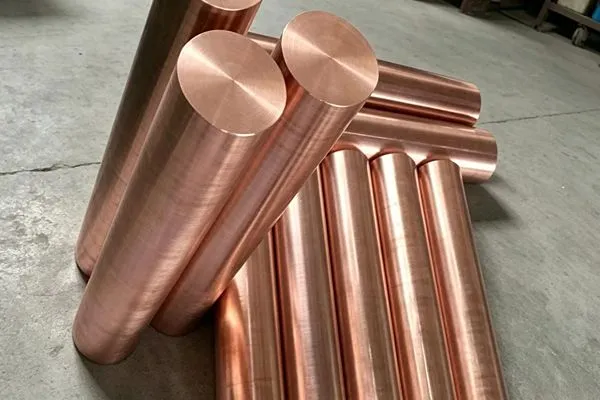
C17200 Beryllium Copper Rod Strength, Hardness, and Conductivity Data
Tensile Strength by Temper
The tensile strength varies with the amount of cold working and aging of the rod. Cold working and aging in the TH04 temper produce 1,280–1,480 MPa, the upper limit of what a C17200 beryllium copper rod can deliver. The age-hardened rod without cold working history is lower, and supplier data for aged material is in the range of 1,105-1,380 MPa. These are formed or machined first; thus, solution-annealed TB00 rod is much below these numbers. Tensile numbers are based on ASTM E8 testing; thus, I would suggest requesting yield strength and elongation on the same certificate, not only tensile strength.
Hardness: Standard Range Versus Mill Readings
Hardness produces more arguments than any other quantity, and hence I want to be specific. ASTM B196 and industry data sheets place TH04 rod and bar in the 37-44 HRC window for many section sizes. The 36-42 HRC range is the TF00 (AT) hardness range, not TH04. In our internal testing, well-aged TH04 may read higher, up to roughly 45 HRC depending on specification and heat treatment. Those readings are what the process is capable of, not what the standard mandates. If your entering inspection is to ASTM B196, a value over the range may be a failure, even if it seems difficult. Input the acceptability range in your PO and consider higher mill results as additional data. The testing following ASTM E18 ensures that both parties are using the same approach for each C17200 beryllium copper rod.
Conductivity, Fatigue, and Thermal Limits
Electrical conductivity of C17200 is a minimum of 22% IACS. Thermal conductivity is 105 to 135 W/(m·K). These are lower than pure copper, but are good for connections, welding tools, and mold inserts where heat has to travel. Eddy-current conductivity measurements also indicate if aging worked, since a low value frequently indicates an under-aged rod. The alloy is resistant to fatigue and stress relaxation, and hence is an excellent choice for springs and contacts in high-cycle use. However, one limitation should be mentioned: lengthy service at around 350°C weakens the material. Matching the water cooling to the job avoids such loss of hardness.
Temper Selection and Machining of C17200 Beryllium Copper Rod
The Four Tempers: TB00, TD04, TF00, TH04
Each temper has a place in the production process. TB00 (A), solution annealed, is the softest and is suitable for complicated geometry before hardening. Cold drawn TD04 (H) delivers moderate hardness and excellent dimensional stability. TF00 (AT) is age-hardened. This temper is produced by heat treatment alone, without prior cold work, and delivers the maximum hardness achievable without cold reduction. TH04 (HT) cold-worked and aged delivers the maximum strength up to 1,480 MPa for accurate parts in harsh service. JYDS has all four tempers of C17200 beryllium copper rod, allowing one source to meet multiple client requirements.
Machining and Aging Sequence
The normal practice is to machine in TB00, then age the completed part at 315°C (600°F) for 2 to 3 hours. Aging generates only minimal dimensional change, so tight tolerances are maintained. Soft-state cutting reduces tool wear. Complex bending also occurs before ultimate aging since material that has already been age-hardened splits more readily. If you acquire TH04 pre-hardened, be prepared with carbide tooling, strict workholding, consistent coolant flow, and controlled chip removal. Dense, pore-free structure polishes neatly. This is good for contact surfaces and precise instrument parts. On a C17200 beryllium copper rod, there is no cutting setting that is as critical as matching temper to process.
Safe Handling and OSHA Rules
The question I hear most from US customers is about beryllium safety. The usual storage and movement of solid C17200 beryllium copper rod in a warehouse does not usually trigger the complete requirements of OSHA 1910.1024. Turning, milling, and grinding generate dust or fumes, and these operations necessitate an exposure assessment against the OSHA allowable exposure limit of 0.2 µg/m³ as an 8-hour average. Shops should employ local exhaust ventilation and HEPA filtering and follow the safety data sheet. I urge that distributors include the SDS with every shipment to all downstream machine shops so that dust management responsibility is known from the first order.
Applications of C17200 Beryllium Copper Rod
Electrical and Electronic Components
Connector springs, switch contacts, and relay parts have to stretch thousands of times and return to form. C17200 has excellent elastic strength, resistance to stress relaxation, and conductivity of at least 22% IACS. Therefore, contacts maintain their force over time. The alloy is also used for high-current electrical connections where the temperature increase and contact wear would weaken normal copper. Precision instrument gears use the same fatigue resistance. A C17200 beryllium copper rod machined in TB00 and aged provides engineers with a spring-grade item without the distortion of forming hardened stock. Request conductivity in the precise temper specified since the figure is changed by age.
Welding, Molds, and Tooling
Heat, pressure, and repetitive contact are applied to resistance welding electrodes and holders. TH04 stock does not mushroom under such loads, and its thermal conductivity removes heat from the tip. Injection mold inserts, core pins, ejector sleeves and hot-runner parts all depend on the same combination of hardness and heat transfer. For EDM, wear resistance and edge stability maintain sharp edges. I talk about both hardness and eddy-current data together when I’m talking to purchasers about electrode stock, since a hardness measurement alone doesn’t tell you if aging is complete. Overaged or heated to over 350° C, any C17200 beryllium copper rod electrode will have a shortened life.
Non-Sparking, Oil and Gas, and Aerospace Uses
The alloy is nonmagnetic and will not ignite when struck; therefore, it is a good replacement for steel in hammers, wrenches, and chisels used around combustible gas or dust. It is used in components for oil and gas drilling for worn parts subject to galling and corrosion in seawater or industrial atmospheres. Aerospace bushings and bearings value strength and non-magnetic properties. Buyers in these areas frequently want paper records of composition, hardness, and traceability in advance of issuing an order. All C17200 beryllium copper rod we sell is supplied with a mill test certificate of chemistry, hardness, and conductivity. Please include your documentation requirements with your query.
Quality Checks and Buying Guide for C17200 Beryllium Copper Rod
Documents to Request with Every Batch
A good collection of documents protects you and your downstream consumer. Request an EN 10204 3.1 certificate for each batch indicating chemistry, hardness, and conductivity, with traceability from source material to finished rod. Each JYDS shipment includes a 3.1 MTC and data reporting in accordance with ASTM, AMS, and EN standards. We are ISO 9001:2015 certified and RoHS and REACH compliant. If a client re-tests a rod, distributors may transmit the certificate along to machine shops. Buyers are often concerned about cast material being offered as wrought. Batch-level chemistry, hardness, and traceability data provide a traceable history of a C17200 beryllium copper rod.
Tests Before Shipment and at Incoming Inspection
Before shipment, each JYDS lot is analyzed by optical emission spectroscopy for beryllium (1.80-2.00%) and for nickel, cobalt, and iron levels. Temper is confirmed by Rockwell or Vickers hardness and ASTM E8 tensile tests. Eddy current testing is conducted for IACS values. Ultrasonic testing is conducted for porosity and inclusions. Dimensional audit includes diameter and straightness following ASTM B196 requirements. I would propose that when it arrives, you examine the diameter, roundness, straightness, cut ends, and surface on your end. Run hardness on a sample from each batch. Later questions settle fast with a retained sample per heat number.
Building an RFQ and Planning Stock
A clear RFQ means a quicker, more accurate quotation. List alloy and standard, temper, diameter, length or cut size, quantity, tolerance, surface finish, certificate type, destination, and target date. A price per kg signifies nothing without such data, since pricing varies with raw material markets, order volume, heat treatment, testing, and freight. JYDS maintains an inventory of over 100 tons of C17200 beryllium copper rod. Stock goods ship in 3 to 5 days. Custom orders ship within 15 to 20 days. A lot of customers start with a test order to verify the chain of documents and batch homogeneity, then proceed to a framework contract with monthly release orders.
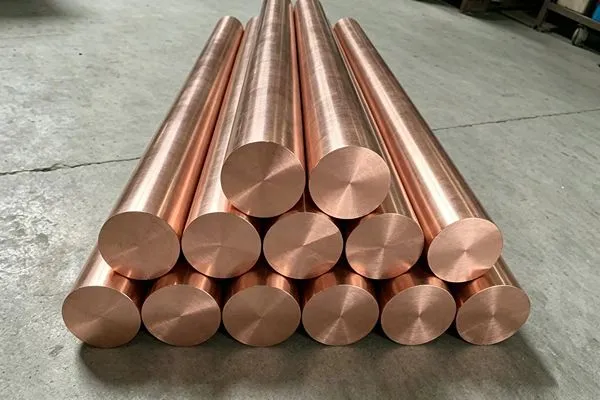
Logistics and Support from JYDS
With more than 25 years of expertise in beryllium copper, JYDS operates its own vacuum induction melting furnace, which provides low gas concentration and consistent composition from the initial melt. Close to Shenzhen and Hong Kong ports, we can export quickly. We bundle rods in anti-rust, moisture-proof export packaging and ship by sea, air, or international express, under CIF, FOB, or DDP conditions. Custom cutting, CNC finishing, and heat treatment advice are part of our free technical consultation. Any confirmed disparity in quality or dimensions will be replaced or re-machined.
Conclusion
The properties of a C17200 beryllium copper rod are derived via solution annealing, optional cold work, and controlled aging. Thus, strength and hardness are a function of temper rather than only the alloy designation. TH04 has a tensile strength of 1280 to 1480 MPa, TH04 hardness typically 37-44 HRC for rod and bar, and conductivity of at least 22% IACS. TB00 is used for machining before aging, whereas TD04, TF00, and TH04 are used for higher strength requirements. These qualities make it useful for electrical connections, welding electrodes, mold inserts, and non-sparking tools. Safe handling must follow OSHA 1910.1024, with exposure controls for machining dust. A buyer may verify that each lot conforms to the specification via batch-level EN 10204 3.1 certifications, as well as chemical, hardness, conductivity, and dimensional inspections.
FAQ
1. What is the maximum hardness of C17200?
TH04 rod typically falls in the 37-44 HRC range for many section sizes. The 36-42 HRC window is the TF00 temper range. Internal readings for TH04 can reach up to roughly 45 HRC depending on section size and heat treatment.
2. How does C17200 differ from C17500?
C17200 gives higher hardness for heavy-duty welding and contact loads. C17500 gives higher conductivity, which suits applications where heat dissipation comes first.
3. Is machining C17200 safe?
A solid rod is safe to handle. Grinding and fine machining need ventilation, dust removal, and an exposure assessment under OSHA 1910.1024.
4. Which documents come with each batch?
Each batch ships with an EN 10204 3.1 mill test certificate showing chemistry, hardness, and conductivity. RoHS and REACH compliance documents are also available.
5. Why does the material soften in service?
Long service above about 350°C causes thermal softening. Matched cooling in electrode holders and molds prevents it.
Request a C17200 Beryllium Copper Rod Quote from JYDS
Looking for a C17200 beryllium copper rod supplier with stock on hand? JYDS keeps 100+ tons ready, ships stock items in 3–5 days, and provides an EN 10204 3.1 certificate with every batch. Send your temper, diameter, length, and quantity to js01@jstongcai.com.cn, and our team will reply within 2 hours.
References
1. ASM Specialty Handbook: Copper and Copper Alloys, ASM International, 2001
2. ASM Handbook, Volume 2: Properties and Selection: Nonferrous Alloys and Special-Purpose Materials, ASM International, 1990
3. Occupational Exposure to Beryllium and Beryllium Compounds in General Industry, Final Rule (29 CFR 1910.1024), U.S. Occupational Safety and Health Administration, 2017
4. ASTM E8/E8M, Standard Test Methods for Tension Testing of Metallic Materials, ASTM International, 2022
5. ASTM E18, Standard Test Methods for Rockwell Hardness of Metallic Materials, ASTM International, 2022
6. EN 10204, Metallic Products: Types of Inspection Documents, European Committee for Standardization, 2004
Online Message