Nov 20, 2026
C17500 Beryllium Cobalt Copper Bushing: Tolerances and Fit Guide
You can get a good fit with a C17500 beryllium cobalt copper bushing if you determine tolerances from actual service circumstances, not just nominal size. Indicate bore, outer diameter, wall thickness, and roundness on the design. Select a running, transition or interference fit depending on load, speed, temperature and lubrication. JYDS produces these bushings from 10 mm to 500 mm OD and 5 mm to 450 mm ID with CNC precision as fine as ±0.005 mm. In this article, we’ll discuss how to choose the fit, verify the statistics, and create a concise RFQ.
Understanding C17500 Beryllium Cobalt Copper Before You Set a Fit
What C17500 Brings to a Bushing
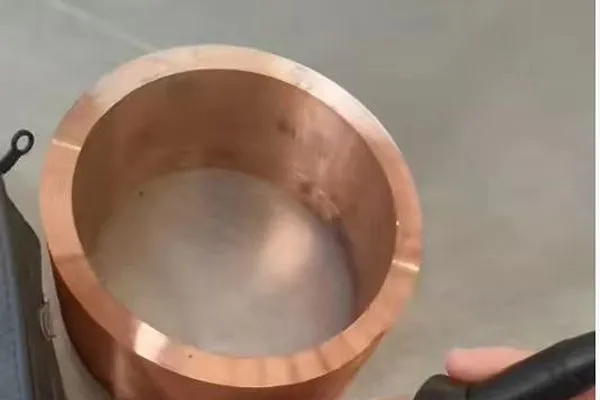
C17500 is a precipitation-hardenable copper alloy having 0.40 to 0.70 percent beryllium and 2.40 to 2.70 percent cobalt. You will also find it listed as UNS C17500, CuCo2Be, EN CW104C, DIN 2.1285, and RWMA Class 3. A C17500 beryllium cobalt copper bushing is used in mold shops and welding facilities because it rapidly takes heat away and yet retains a clamping load. We provide it in AT or TF00 state, which is solution-treated and aged, so it’s ready to install. In this condition, the hardness is 95 to 102 HRB. That’s important for fit because the bore you measure during inspection is the bore you’re putting into the assembly.
Properties to Verify on Every Batch
Catalog values are a starting point, not a guarantee. Typical aging parameters for a C17500 beryllium cobalt copper bushing include: electrical conductivity 45-60% IACS, thermal conductivity 200-245 W/m.K, tensile strength 680-850 MPa, and yield strength 550-690 MPa. The yield strength is important for clamped mold inserts. A bush has to maintain its size during intense clamping. Make these numbers part of your purchasing agreement. Each batch of JYDS is supplied with a certificate EN 10204 3.1 on chemical composition, hardness, and conductivity. Eddy current testing measures conductivity on the completed product. Ultrasonic examination detects interior problems.
How Hardness, Conductivity, and Temperature Interact
In most copper alloys, strength and conductivity work against each other. C17500, a beryllium cobalt copper bushing, remains in a practical range of 95 to 102 HRB and maintains conductivity up to 60% IACS. C17200 is stronger but has thermal conductivity approaching 105 W/m·K, roughly half the C17500 range. Temperature restricts, too. I would propose a max operating temperature of 400°C therefore compare continuous casting guides and hot runner sections to that ceiling. How long a bore holds size depends on everything from load and lubrication to environment and time at temperature. If a part is close to the limit, get test data for your circumstances.
C17500 Bushing Dimensions, Tolerances, and Critical Features
Define the Core Dimensions Clearly
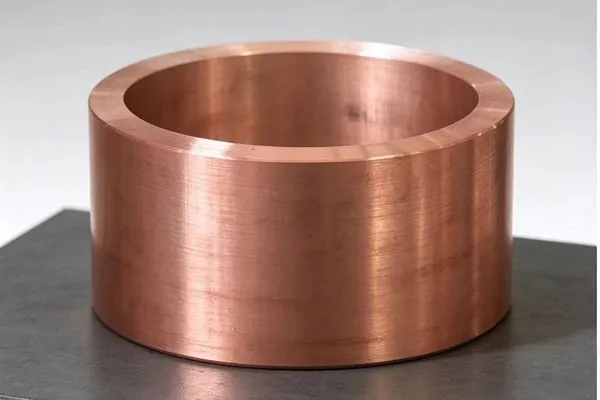
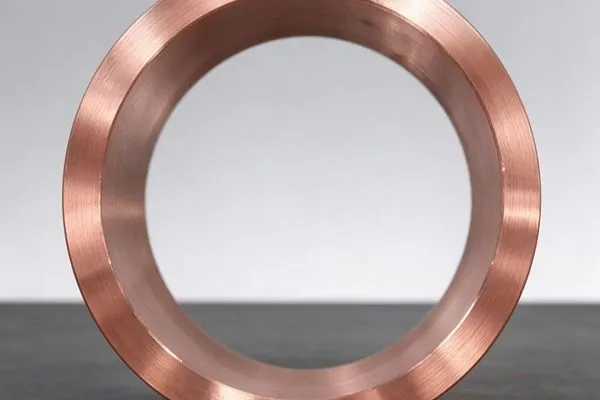
A full drawing shows the bore, outer diameter, length, wall thickness, chamfers, grooves, flange features, and any locating information. Wall thickness is (OD - ID) / 2. So a 60 mm OD and 40 mm ID gives a 10 mm wall. This is important for a C17500 beryllium cobalt copper bushing in a tight housing. The thin walls will distort more in the pressing operation. We machine OD from 10 mm to 500 mm and ID from 5 mm to 450 mm to your design. Flanged items need also flange diameter, thickness, face flatness and shoulder geometry. If you miss one callout you have to guess and a guess loses you a trial run.
Apply Geometric Tolerances Where They Count
Not every feature has to have the tightest constraint. Our CNC turning of a C17500 beryllium cobalt copper bushing is held to ±0.005 mm. Standard classifications include ISO g6 and h6, or whatever restriction you specify. Use that accuracy on the bore, on the outer diameter seating surface, and on the coaxiality between them. The roundness and cylindricity dictate the load distribution on the bearing surface. The runout generates vibration at speed. Flanges are sensitive to perpendicularity. Loosen the constraints on non-functional faces. Each additional tight callout increases machining and inspection time. Cite ISO 286-1 on the print, as most designs employ the tolerance grades and fit methodology defined in it.
Finish, Edges, and Mating Surfaces
Surface finish available on request. Specify the Ra value you want for the bore and shaft. A hard shaft will wear a bushing very fast while a soft shaft might score the bore. Ask for burr-free edges and a lead-in chamfer so the bushing begins square in the press. Oil grooves and flange features are machined to drawing and their edges demand the same burr control. Check the hardness of the shaft or pin against the C17500 beryllium cobalt copper bushing hardness of 95 to 102 HRB. The alloy does lessen adhesion to the steel shafts, but a clean, ground mating surface still delivers steady wear.
How to Select and Calculate the Correct Fit for a C17500 Beryllium Cobalt Copper Bushing
Match the Fit Type to the Job
It’s important to begin by providing a comprehensive operational picture: radial and axial load, shaft material, speed, duty cycle, temperature, lubrication, and contaminants. A clearance running fit is used for rotating or sliding shafts. The bushing is held in the housing by an interference fit to avoid fretting or axial creep. For assemblies that you expect to take apart, a transition fit is used. H7/g6 is a typical close-running fit in ISO language; H7/p6 and H7/s6 are mild and medium interference. A sleeve in the plate is an interference fit to prevent the sleeve from rotating and provide solid contact for heat transfer to a C17500 beryllium cobalt copper bushing in a mold.
Account for Thermal Expansion
Clearance is temperature dependent. Copper beryllium alloys will grow about 17 micrometers per meter per °C. Carbon steel will expand around 12. A 100°C increase on a 50 mm diameter gives around 0.025 mm space between a C17500 beryllium cobalt copper bushing and the steel shaft within it. The same increase is for a bushing forced into a steel bore. Aluminum housings expand more than copper alloys; therefore, they will loosen an interference fit when heated. Every cycle in hot runner and die casting parts experiences these fluctuations. The expansion coefficients of the major metals are given in Machinery's Handbook. Do the math for your temperature range and then verify it using a prototype.
Calculate and Verify Installed Clearance
A simple formula is diametral clearance = completed bushing ID – finished shaft OD. There are three distinct bore dimensions for a press-fit C17500 bushing: the provided bore, the installed bore, and the final reamed or honed bore. Pressing closes the bore, so measure after it is fitted. Add thermal change and tolerance stack-up to get worst-case clearance. Pressure-velocity readings are a first screen, but lubrication, alignment, contaminants, and duty cycle determine actual service life. Check: measure dimensions, press a sample, run it at temperature, check wear. It is wise to arrange for a trial installation of one to two months before volume release.
Comparing a C17500 Beryllium Cobalt Copper Bushing with Alternatives and Applications
C17500 Versus C17200 and C17510
C17200 is the stronger option for high mechanical duty. C17500 handles heat and current better. Thermal conductivity in a C17500 beryllium cobalt copper bushing is 200-245 W/m.K whereas C17200 is around 105 W/m.K. Choose C17200 when load and wear are the primary concern in the specification. Select C17500 where heat removal dictates cycle time. C17510 belongs to the same family but is a copper-nickel-beryllium alloy. Values may change with heat treatment, so be sure to check data for your precise temper and product shape before deciding. We may quote more than one alternative against your drawing; JYDS offers C17200, C17500, and C17510.
Bronze and Aluminum Bronze Alternatives
Standard bronze is less expensive and adequate for general sliding at moderate loads and temperatures. It has poorer thermal conductivity than C17500; therefore, it doesn’t draw heat from a mold hot spot in the same manner. Aluminum bronze takes severe loads and sea exposure effectively, but it also performs worse than C17500 in thermal conductivity. The price per kilogram of a C17500 beryllium cobalt copper bushing is higher, but in applications driven by heat it may reduce the overall cost by reducing cycle time or downtime. Compare maintenance period, shaft compatibility, and corrosion exposure, not simply material pricing.
Match the Bushing to the Application
Priorities vary for a C17500 beryllium cobalt copper bushing from task to job. Hot spot cooling bushings for plastic injection and die casting molds need good thermal conductivity and steady gripping strength over the thermal cycle. One traditional use for RWMA Class 3 material is for resistance welding electrode holders where rapid heat flow protects the electrode shank. The guides in continuous casting need to be heat resistant up to 400°C and have a non-stick surface. For high current connections, stable conductivity and anti-galling behavior of the contacts is required. The alloy is also non-magnetic and non-sparking, which assists in sensor-sensitive or explosive environments.
Manufacturing, Sourcing, and Avoiding Fit Problems
Manufacturing and Inspection Steps
Every C17500 beryllium cobalt copper bushing is turned and ground on CNC machines to the design, with bores, grooves, and flanges cut to your limits. We do a multi-step examination before we ship: OES chemical analysis of incoming material, hardness testing, eddy current conductivity, ultrasonic inspection for internal faults, and a dimensional check. In-house vacuum induction melting maintains gas content low and chemistry constant. Traceability: Each batch is supplied with an EN 10204 3.1 certificate. If you require conductivity or hardness limitations to be included in the agreement please let us know during the quotation stage.
Prepare an RFQ and Judge a Supplier
A good RFQ for a C17500 beryllium cobalt copper bushing will include a drawing or 3D model, alloy and temper, crucial dimensions, tolerances, surface finish, fit type, shaft and housing materials, operating load, speed, temperature, quantity, and certificate requirements. When comparing vendors, inquire about their expertise with beryllium copper, heat treatment controls, inspection equipment, and traceability. JYDS has over 25 years of experience in beryllium copper production, possesses ISO 9001:2015 certification, and is RoHS and REACH compliant. Stock goods ship in 3-5 days, bespoke orders in 15-20 days, and we respond to requests within 2 hours. We quote CIF, FOB, or DDP, and pack with anti-rust and moisture-proof materials.
Common Fit Problems and the Final Approval Checklist
Most C17500 beryllium cobalt copper bushing problems are system-related, not alloy-related. Tolerance build-up, poor roundness, thermal expansion, and press deformation can all eat into the clearance you calculated. Bores that are overly tight deprive the film of lubrication and induce seizure. Burrs, filthy housings, poor press tools, and too much force all harm parts. Runout, misalignment, and rough or soft shafts accelerate wear. Check material and temper, measured dimensions, installed clearance, mating parts, operating conditions, and function in a trial before releasing a repeat order. Then lock the authorized drawing, certificate, and sample as reference for each subsequent batch.
Conclusion
A C17500 beryllium cobalt copper bushing is a suitable choice when the drawing, the fit, and the operating circumstances are compatible. The alloy has 45–60% IACS conductivity, 200–245 W/m·K thermal conductivity, and 550–690 MPa yield strength, with a 400°C working limit. Tolerances are on the bore and seating surfaces, where ±0.005 mm is available when function requires it. Running, transition, and interference fits are each suitable for different purposes. Clearance calculation must include thermal expansion and press deformation. C17200 is used for strength, C17500 for heat and current flow, and bronze for lesser load applications. Inspection data, batch certifications, and a trial installation before repeat orders validate the decision.
FAQ
1. What separates a running fit from an interference fit?
A running fit leaves clearance so a shaft can turn or slide. An interference fit presses the C17500 beryllium cobalt copper bushing into the housing so it cannot spin or walk axially. Transition fits suit parts you plan to remove.
2. How do I calculate bushing clearance?
Subtract the finished shaft OD from the finished bushing ID. For press-fit parts, use the installed bore, then add thermal change and tolerance stack-up.
3. When should I choose C17500 over C17200?
Choose C17500 when heat removal sets your cycle time, since it reaches 200–245 W/m·K against about 105 for C17200. Choose C17200 when mechanical load is the main concern.
4. Which documents come with an order?
Each batch ships with an EN 10204 3.1 certificate that lists chemical composition, hardness, and conductivity.
5. Is the alloy safe to handle?
Solid finished parts are safe to handle. Machining and grinding create dust, so use ventilation and protective equipment, as OSHA's beryllium standard requires.
Request a C17500 Beryllium Cobalt Copper Bushing Quote from JYDS
Send your drawing, temper, tolerances, and fit details to JYDS at js01@jstongcai.com.cn, and our engineers will review them within 24 hours. As a C17500 beryllium cobalt copper bushing manufacturer with 25+ years of beryllium-copper experience, we offer EN 10204 3.1 certificates, stock dispatch in 3–5 days, and custom delivery in 15–20 days.
References
1. ASM International, ASM Handbook, Volume 2: Properties and Selection: Nonferrous Alloys and Special-Purpose Materials, 1990.
2. ASTM International, ASTM B441 Standard Specification for Copper-Cobalt-Beryllium Alloys (UNS C17500) and Copper-Nickel-Beryllium Alloys (UNS C17510) Rod and Bar, 2018.
3. International Organization for Standardization, ISO 286-1 Geometrical Product Specifications (GPS) — ISO Code System for Tolerances on Linear Sizes, 2010.
4. Industrial Press, Machinery's Handbook, 31st Edition, 2020.
5. Resistance Welding Manufacturing Alliance, Resistance Welding Manual, 4th Edition, 2003.
6. Occupational Safety and Health Administration, Occupational Exposure to Beryllium, 29 CFR 1910.1024, 2017.
Online Message