
Nov 20, 2026
C17500 Beryllium Cobalt Copper Plate: Electrical Conductivity Explained
C17500 beryllium cobalt copper plate generally has an electrical conductivity of 45% to 60% IACS, or approximately one-half that of annealed pure copper or slightly higher. Aging generates this range. The fine cobalt-beryllide precipitates increase hardness to HRB 95-100, while retaining a sufficient amount of clean copper matrix to transport current and heat. The actual value you get on your plate will vary with heat, thickness, and test procedure; therefore, ask for batch-level statistics. Below I describe what drives the number, how it relates to C17200 and C17510, where it counts in molds and welding gear, and how to draft a clean order.
What Is C17500 Beryllium Cobalt Copper Plate?
Composition and Designations
C17500 is a precipitation-hardening copper alloy containing 0.4–0.7% beryllium and 2.4–2.7% cobalt, with the remainder copper. It is designated as UNS C17500, CuCo2Be, Alloy 10, CW104C, or DIN 2.1285. It is also rated RWMA Class 3 for resistance welding. The conductive matrix is copper. During aging, cobalt and beryllium generate permanent precipitates that lock the grain structure, such that the plate retains its hardness after repeated heating. That’s why C17500 beryllium cobalt copper plate doesn’t perform like normal copper, which softens fast as the temperature increases. Plate goods are covered by ASTM B534. The alloy family is also covered by SAE J461 and SAE J463.
Plate Sizes and Supply Form
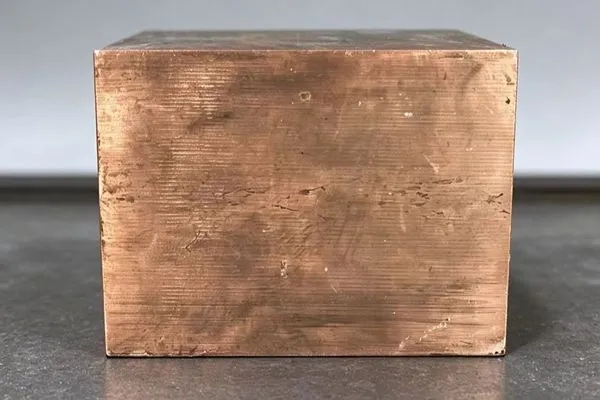
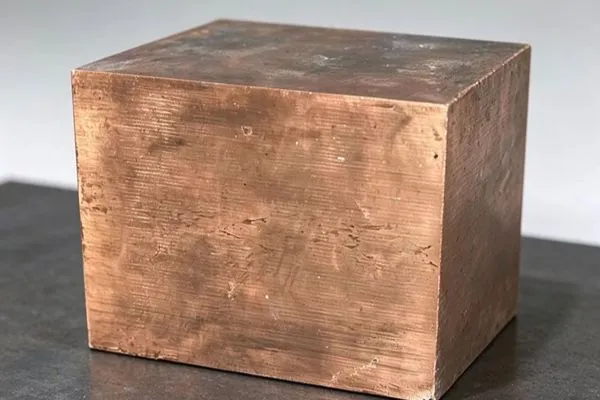
At JYDS, we provide C17500 plate in thicknesses from 10 mm to 200 mm, widths from 100 mm to 1000 mm, and lengths from 1000 mm to 3000 mm. Send us a design, and we can provide precision cut-to-size blanks, surface grinding, and CNC finishing. Available in two tempers: solution annealed (A) and precipitation hardened (AT). Stock goods ship in 3-5 working days. Custom orders take 15-20 days. Our beryllium copper range has more than 500 tons of raw material and conventional profiles, which might be useful if a mold project is short on time. Quote the size ranges mentioned on your designs so we all work from the same values.
How the Plate Is Made
Plate quality starts at the melt. We employ vacuum induction melting followed by hot forging or rolling, solution heat treatment, and precise aging at 450-480°C. Vacuum melting maintains minimal gas concentration, which assists in creating thick, pinhole-free material that grinds smoothly and takes a mirror finish. We use OES spectrometry to evaluate our raw materials, and our team has been producing beryllium copper for over 25 years. The plant is running on an ISO 9001:2015 quality system, and our goods are RoHS and REACH compliant. Every lot of C17500 beryllium copper plate ships with an EN 10204 3.1 certificate so your incoming inspection team can match test results to the heat.
C17500 Electrical Conductivity: Key Performance Factors
Reading % IACS Correctly
IACS is the International Annealed Copper Standard, which establishes annealed pure copper at 100%. A C17500 beryllium cobalt copper plate with a 50% IACS test result means that it will conduct current about half as well as annealed copper of the same cross-section. Suppliers may also provide conductivity in MS/m and resistivity in microhm-cm; these are straight conversions. Eddy current testing is often used for non-ferrous plate; that is covered in ASTM E1004. Readings are affected by temperature; therefore, compare data at the same temperature, often approximately 20°C. An honest report shows the test procedure and location, not just one headline statistic.
What Moves the Number
There are a number of factors that drive conductivity up or down. The composition is most important because the copper keeps different amounts of beryllium and cobalt dissolved in it. These elements are dissolved by solution treatment. Aging pushes them into precipitates, which increases conductivity while creating hardness. Cold working somewhat decreases conductivity, while over-aging or under-aging affects both hardness and conductivity. Another factor is plate thickness. Heavy C17500 plate cools at various speeds in quenching; therefore, the core may not be the same as the surface. I would recommend you verify readings at more than one site. Our QC involves hardness mapping and conductivity testing on completed plate and ultrasonic examination for interior faults.
From Electrical to Thermal Conductivity
For metals, heat and electricity are conducted by the same free electrons. So, greater IACS generally means better thermal conductivity. Our C17500 beryllium cobalt copper plate has a thermal conductivity of about 200–245 W/m·K, vs around 390 W/m·K for pure copper and a fraction of that for tool steel. For a mold shop, that gap provides quicker heat dissipation from the cavity. We have application comments that refer to cooling-time savings of 20% to 50% compared to steel inserts. Actual gain relies on insert size, cooling channel arrangement, and part shape. So rather than take it as a guarantee, validate it in a sample mold.
C17500 Properties and Comparison with Other Copper Alloys
Mechanical and Thermal Properties
The plate should be strong and conductive to endure clamping, machining, and thermal cycling. Typical C17500 properties in the AT (TF00) condition include tensile strength 690 to 900 MPa, yield strength 550 to 690 MPa, and hardness HRB 95 to 100 (HB 170 to 230). The precipitate’s structure is stable up to approximately 500°C; therefore, the plate will not soften and creep when subjected to typical heating. That matters for big cooling inserts pressed against hot resin or molten metal day after day. Never look at these numbers alone; look at the conductivity. A C17500 beryllium cobalt copper plate that has strength but not conductivity may not do the task it was purchased for.
C17500 vs. C17200 and C17510
C17200 (CuBe2) is the stronger member of the family used in springs and contacts. Its conductivity is substantially lower, at typically around 22% IACS in the aged condition. C17510 (CuNi2Be) replaces Co with Ni and gives conductivity in a comparable range to C17500, with its own strength balance. We found C17500 fits resistance welding well due to its steady behavior throughout electrical cycles. With mold inserts, you usually have to choose between removing heat or strength. Our metallurgical staff is happy to consult with you, free of charge, to help you decide between C17500, C17510, and C17200. We can compare conductivity, strength, and pricing side by side for your project.
Versus Pure Copper and Chromium Zirconium Copper
Pure copper (C11000) has a conductivity of ~100% IACS but is soft and deforms under clamp strain. Chromium zirconium copper, such as C18150, often conducts better than C17500, and generally costs less, but provides less hardness and strength. If your insert is subject to strong clamp pressure, resin abrasion, or die-casting heat cycles, the extra hardness of C17500 beryllium cobalt copper plate may be worth the price. If the component is mostly used in a low-load region to transfer heat, chromium zirconium copper could be adequate. Look at verified values at the same thickness before you decide. Think about tool life vs. material cost.
C17500 Plate Applications and Engineering Use Cases
Plastic and Blow Mold Cooling
The most obvious advantage for mold purchasers is with large cooling inserts and hot runner manifold plates. Instead of only cooling a hot spot in one place, you could put a full-face plate into the cavity wall and disperse the heat load across a greater region. The stable hardness resists the wear of the resin, and the quicker heat evacuation helps decrease the warpage of the part. Plates are cut to 200mm thick; thus, a deep channel may be machined into one block of C17500 beryllium cobalt copper plate. Many designs do not need a second heat treatment before final machining, as the AT plate comes aged. Annealed stock is good for extremely tight tolerances.
Resistance Welding and Electrical Parts
RWMA Class 3 is for materials with high hardness and moderate conductivity for electrode holders, seam wheels, and welding dies, such as C17500. Plate also functions for electrode backing plates, platens, and fixture plates. The alloy finds use in high-current switch contacts, heavy conducting plates, busbars, and terminals for switchgear and power equipment where load capacity and heat transfer are required. The RWMA Class 3 statement shall be confirmed in writing, and the order should specify a minimum of 45% of IACS. Test a sample for bent or pressed parts, as aged C17500 beryllium cobalt copper plate has reduced formability.
Die Casting, Heat Sinks, and Aerospace
Die-casting plunger tips and thermal transfer plates absorb multiple heat impacts from molten metal, and C17500 resists thermal wear during such cycles. The same feature is used for heat dissipation plates in thermal management. The alloy is also required for several aircraft heat exchangers and structural plates, often with stringent traceability and inspection records. Do a prototype or pilot trial under actual load before using it in a new design. Working on solid plate is safe. In compliance with OSHA beryllium regulations, dust extraction with HEPA filtration and respiratory protection is necessary for grinding, welding, or heavy machining of any beryllium-containing alloy.
How to Specify, Buy, and Evaluate C17500 Beryllium Cobalt Copper Plate
Writing a Clear Specification
A suitable buy order for C17500 beryllium cobalt copper plate will specify thickness, breadth, length, tolerances, flatness, surface polish, and edge condition. Add the temper (A or AT), hardness goal, minimum conductivity, and governing standard (ASTM B534 and RWMA Class 3 when applicable). Stay with the sizes we quote: 10-200 mm thick and 100-1000 mm broad, or request precise cutting. Request documentation in advance. Request chemical analysis, mechanical and hardness findings, conductivity data, heat treatment information, ultrasonic results for thick plate, and dimensional reports. For mold work, request hardness mapping throughout the plate surface to verify consistent aging. Also specify your freight terms. We quote CIF, FOB, and DDP.
Judging a Supplier
Checks should cover process control and paperwork. Look for in-house melting, documented heat treat records, hardness mapping, conductivity testing, and ultrasonic inspection. Batch traceability should connect a heat number to the certificate and shipping documents. We provide chemical and mechanical data on each batch with EN 10204 3.1 certifications and provide replacement or re-machining if a quality or size fault is confirmed. Check packing for export. We dispatch our C17500 plate in anti-rust, moisture-proof packing by sea, air, or fast courier. We are close to Shenzhen and Hong Kong ports, and we can reply within 2 hours to inquiries.
Common Mistakes and a Quick Checklist
The most common error is comparing conductivity statistics measured at various tempers, thicknesses, or test techniques. Another is to choose C17500, C17200, C17510 by name only and not with verified data. Buyers chasing the lowest unit pricing also ignore scrap and rework expenses. Six things to verify before you order: alloy and standard, dimensions, temper and hardness, minimum conductivity, documents, and lead time. Please add your annual volume. It assists us in planning supply and pricing. Before you place a project order, do a trial of C17500 beryllium cobalt copper plate on your own. Most customers allow 1-2 months from sample to release.
Conclusion
The electrical conductivity of C17500 beryllium cobalt copper plate is 45–60% IACS, a conscious exchange for hardness of HRB 95–100 and tensile strength of 690–900 MPa. When comparing data, you must match temper, thickness, and test technique so you have matching aging controls. Thermal conductivity changes similarly, and that’s why the alloy is used in mold cooling inserts, welding fixtures, die-casting parts, and current-carrying plates. It's much better than C17200. It holds its shape better than pure copper. It could cost more than chromium-zirconium copper, which is good for low-stress projects. The sound purchase relies on precise specification, confirmed batch data, consistent hardness tests, and safe handling in grinding and welding.
FAQ
1. What conductivity should I expect from C17500 plate?
Expect 45–60% IACS. Confirm the exact value on the certificate for the temper and thickness you order.
2. Can I machine hardened C17500 plate?
Yes. Use carbide tools and cutting fluid. Machining in the annealed state before aging gives tighter tolerances, while AT plate suits finish work.
3. Which documents come with an order?
Every batch ships with an EN 10204 3.1 certificate showing chemical and mechanical data. Our products meet RoHS and REACH requirements. You can also request hardness mapping, conductivity, and ultrasonic results.
4. How fast does stock ship?
Stock items ship in 3–5 working days. Custom orders take 15–20 days.
Request a C17500 Beryllium Cobalt Copper Plate Quote from JYDS
Send your drawing, thickness, width, length, temper, conductivity target, and annual volume to JYDS at js01@jstongcai.com.cn, and our team will reply within 2 hours. As a C17500 beryllium cobalt copper plate manufacturer with more than 25 years of beryllium copper experience, we hold over 500 tons in stock, ship standard items in 3–5 days, and attach an EN 10204 3.1 certificate to every batch.
References
1. ASTM International, ASTM B534 Standard Specification for Copper-Cobalt-Beryllium Alloy and Copper-Nickel-Beryllium Alloy Plate, Sheet, Strip, and Rolled Bar, 2007
2. ASM International, ASM Handbook, Volume 2: Properties and Selection: Nonferrous Alloys and Special-Purpose Materials, 1990
3. ASM International, ASM Specialty Handbook: Copper and Copper Alloys, 2001
4. ASTM International, ASTM E1004 Standard Test Method for Determining Electrical Conductivity Using the Electromagnetic (Eddy-Current) Method, 2017
5. Resistance Welding Manufacturing Alliance, Resistance Welding Manual, 4th Edition, 1989
6. Occupational Safety and Health Administration, Occupational Exposure to Beryllium and Beryllium Compounds, Final Rule, Federal Register, 2017
Online Message