
Nov 16, 2026
C17500 Beryllium Cobalt Copper Plate: Properties and Applications
C17500 beryllium cobalt copper plate is a precipitation-hardening copper alloy of 0.4–0.7% beryllium and 2.4–2.7% cobalt, with copper as the balance. In the aged (AT) form, it has an electrical conductivity of 45–60% IACS, a thermal conductivity of 200–245 W/m·K, and a hardness of HRB 95–100. These values are applicable for big cooling inserts, resistance-welded parts, and heat dissipation plates. In this tutorial, I talk about how the alloy behaves, where it fits, how it compares with C17200, C17510, and C18150, and what to include in a purchase request.
Introduction: Why Choose C17500 Beryllium Cobalt Copper Plate?
What C17500 Beryllium Cobalt Copper Plate Is
UNS C17500 is also known as CuCo2Be, Alloy 10, CW104C, and DIN 2.1285. With age, cobalt precipitates as thin particles of cobalt-beryllide. These particles are not broken down by the repeated heating and cooling of a tool. Beryllium is the key to the age-hardening reaction, and copper maintains conductivity significantly better than steel. At JYDS we melt the alloy in a vacuum induction furnace, hot forge or roll, solution treat, and age the alloy. That approach creates a thick plate that machines and polishes neatly. But the final values vary with thickness, temper, heat treatment, and test procedure; therefore, I always check the mill certificate and not simply the grade designation.
Questions Buyers Ask About C17500 Beryllium Cobalt Copper Plate
Mold shops normally want four items. What is the thermal conductivity of plate? Is the core of a thick block on a level with the surface? Is it delivered aged? How does the pricing compare to other grades? Welding and switchgear engineers are asking about conductivity per batch, the RWMA Class 3 rating, and flatness. Distributors inquire about stocks and certificates. I address each of them below with statistics we can document. Plates are available in hefty thicknesses from 10 mm to 200 mm. That means batch testing and ultrasonic inspection are part of the dialog from the first email.
Define the Specification Before You Request a Quote
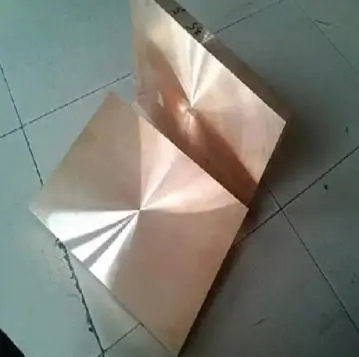
A quotation is only as accurate as the request made before it. You should decide on the grade, standard, temper, thickness, breadth, length, tolerance, and kind of certificate before writing to a provider. Our C17500 beryllium cobalt copper plate is produced to ASTM B534 for plate with SAE J461, SAE J463 and RWMA Class 3 specifications where applicable. Standard plate is 10- 200 mm thick, 100- 1000 mm broad, and 1000- 3000 mm long. We can cut to customer measurements. Putting these constraints in one place makes all the quotes consistent. That is very important when you are comparing bids from other vendors or re-selling plate in smaller chunks.
C17500 Plate Properties: Hardness, Conductivity, and Mechanical Performance
Hardness and Strength of C17500 Beryllium Cobalt Copper Plate
In the aged (AT) condition, the plate is HRB 95-100 or around HB 170-230. Tensile strength is typically 690-900 MPa and yield strength is 550-690 MPa in the AT (TF00) condition. These values are mid-high. They reside above pure copper but below the maximum strength of C17200. Always look at the Rockwell scale on a certificate. The technique is defined by ASTM E18. A reading on the B-scale cannot be compared to the C-scale. The hardness prevents deformation of the electrode backing plates under strain and denting of the cooling inserts at the clamp faces. I would advise asking for hardness mapping over the face of the plate, since it reveals whether the aging was uniform.
Conductivity and Thermal Performance
Electrical conductivity: 45-60% IACS; thermal conductivity 200-245 W/m·K The alloy draws heat out of a cavity far quicker than tool steel, so big faces remain closer to the desired temperature. A single cooling pin only makes contact with a small portion of the cavity wall, but a full-face insert contacts much more of the wall surface, distributing heat removal across the whole surface. Read conductivity using the test technique and temperature. Two laboratories may give different results on the same plate. Conductivity is tested on the final plate, and the numbers are shown on the batch certificate. When dealing with big slabs of C17500 beryllium cobalt copper plate, I would suggest asking for readings in more than one place.
Heat Treatment, Temper, and Heavy-Section Uniformity
Two tempers are available: solution annealed (A) and precipitation hardened (AT). Aging at 450–480 °C increases hardness but retains conductivity; hence the typical cycle is a compromise of both. The beryllium cobalt copper plate from AT C17500 arrives aged, so you can mill to size without an extra heat cycle. If you want to do rough machining in A temper, anticipate some dimensional change during later aging and leave stock for finishing. Large areas are a major concern when you have thick blocks because they might age unevenly. To verify heavy-section quality, we provide OES composition, hardness mapping, conductivity, dimensions, and ultrasonic defect tests. So you see surface hardness and interior soundness on paper, before shipping.
C17500 Plate Applications Across Industrial Markets
Mold Cooling Inserts and Hot Runner Heat Dissipation Plates
A full-face cooling insert or heat dissipation plate next to a hot runner manifold for injection and blow molds may be machined from a big C17500 beryllium cobalt copper plate. A mold maker may produce deep channels and pockets from one solid block rather than combining sections, with plate thickness up to 200 mm. The thick, pinhole-free structure is suitable for cavity facing surfaces. It gets a mirror finish by means of precise CNC machining. Stable hardness also prevents resin wear around hollow parts and core pins. The part cools more uniformly since heat is removed faster, thereby reducing warpage. Discuss channel pattern and wall thickness with your toolmaker, since the design is just as important as the choice of metal.
Resistance Welding and High-Current Electrical Parts
RWMA Class 3 material is a popular choice for electrode holders, seam wheels, welding dies, backing plates and fixture plates when parts carry electricity as well as pressure. The alloy is also suitable for busbars, terminals and switch contacts in plate form. A conductivity floor of 45% IACS offers the designers a number to write on a drawing. Thermal fatigue resistance allows these parts to maintain their hardness after repeated heating and cooling, and the precipitate structure remains stable up to roughly 500°C. In design review, compare your duty cycle, cooling, and clamp force to the tested attributes of the plate.
Die Casting Parts, Heat Sinks, and Handling Safety
Die casting teams employ the plate for plunger tips and thermal transfer plates. Aerospace customers require it for heat exchangers and structural plates, pending their own approvals. The solid plate is safe for normal use. Use local exhaust with HEPA filtration and respiratory protection for grinding, welding, or heavy machining that may emit beryllium-bearing dust or fume. The OSHA beryllium regulation 29 CFR 1910.1024 in the US defines exposure limits and work standards. I would suggest your safety officer look at it before processing. Joining is restricted by electron beam welding and regulated TIG welding to the heat-affected zone.
C17500 vs. Alternative Copper Alloys and Pure Copper
C17500 vs. C17200 and C17510
C17200 is the hardest and strongest of the beryllium coppers, yet it is substantially less conductive. C17500 beryllium cobalt copper plate gives up part of the peak strength for conductivity in the 45-60% IACS region, which is why designers use it for heat and current pathways. C17510 is in a similar family, but employs nickel instead of cobalt. It is dependent on your thermal profile and your design. We have free selection help from our metallurgists between C17500, C17510, and C17200. I propose you transmit your duty cycle and load. For each part, small changes in conductivity, hardness, and pricing select the winner; therefore, compare figures from the same temper.
C17500 vs. C18150 Chromium Zirconium Copper
Many mold shops are caught between beryllium-bearing C17500 and beryllium-free C18150. Chromium zirconium copper is generally a superior conductor. C17500 is tougher and is capable of retaining its hardness through rigorous cycles. It is a selection on three axes: conductivity, strength, and pricing. I would suggest a side-by-side sheet made from verified batch data for both grades in the same thickness and then a trial insert into your own tool. And, a beryllium-free grade also makes it easier to handle in a shop, which is a genuine advantage for certain establishments. Price gaps move with the market, so get a current price for each grade rather than depend on a rule of thumb.
C17500 vs. Pure Copper
Pure copper is the finest conductor, but is soft. With clamping force it bends; at points of contact it wears; with heat it softens. C17500 gives up some of that conductivity, but increases hardness, strength, and thermal fatigue resistance, so it holds its form in tools that cycle hard. If the item is lightly loaded mechanically, pure copper can be good enough and cheaper. If it is against a cavity wall, taking electrode stress, or has to retain flat tolerance for years, the tougher plate generally compensates for its greater price with extended service life.
How to Buy C17500 Beryllium Cobalt Copper Plate
Standards, Sizes, and Certificates to Request
Refer to RWMA Class 3 and SAE. If your design requires it, ask for ASTM B534 for plate. We provide plate from 10-200 mm thick, 100-1000 mm wide, 1000-3000 mm long, with precise cut sizes, surface grinding, and CNC finishing. Each C17500 beryllium cobalt copper plate is supplied with an EN 10204 3.1 mill test certificate showing the chemical and mechanical data. Quality system accredited to ISO 9001:2015. Products are RoHS and REACH compliant. Ask for the certificate to be linked to the batch number on your order. If your client needs cobalt source documentation, ask for it early in the transaction so you have the paperwork ready to go at the time of shipping.
Build a Clear RFQ for C17500 Beryllium Cobalt Copper Plate
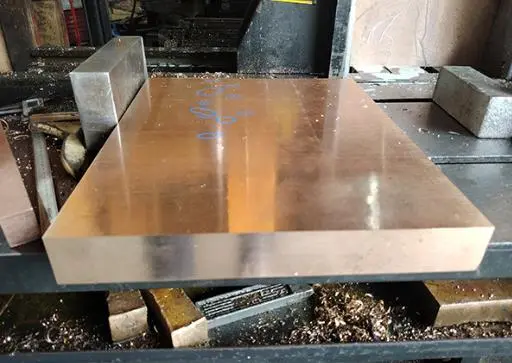
A suitable RFQ will include UNS C17500, plate form, temper (AT or A), thickness, width, length, tolerances, surface condition, hardness and conductivity objectives, certificate type, quantity, destination, and Incoterm. Mold shops often go from sample to trial mold to project order in one to two months. I would get a sample cut first to confirm the hardness, conductivity, and machining behavior, and then release the whole project. Stock goods are sent within 3–5 days, bespoke orders within 15–20 days. We provide CIF, FOB, and DDP by sea, air, or express carrier, wrapped in rust-proof, moisture-resistant export packaging from close Shenzhen and Hong Kong ports.
Procurement Mistakes That Cost Time and Money
There are four common errors. Buyers choose first on grade alone; however, temper does affect hardness and conductivity. Secondly, they compare conductivity numbers obtained using various testing methodologies. Thirdly, they exclude the thickness, flatness, and surface restrictions from the purchase order, which creates problems during milling. Fourth, they purchase at unit pricing with an incomplete certificate. Cut resellers should also have one thickness and width range for every quotation. We have 10- 200 mm thick and 100- 1000 mm broad. When purchasing C17500 beryllium cobalt copper plate for resale, mixed ranges in listings result in inaccurate quotations downstream.
Conclusion
C17500 beryllium cobalt copper plate is an age-hardenable copper alloy having 0.4 to 0.7 percent beryllium and 2.4 to 2.7 percent cobalt. In AT temper, it has a hardness of HRB 95 to 100, a tensile strength of 690 to 900 MPa, an IACS conductivity of 45 to 60 percent, and a thermal conductivity of 200 to 245 W/m·K. This combination is excellent for cooling inserts for big molds, heat dissipation plates for hot runners, resistance welding parts, and high-current parts. It is a better conductor than C17200, tougher than C18150, and holds its form under load better than pure copper. Batch data, hardness mapping, and ultrasonic inspections are required for heavy sections. Quotes may be compared when the standard, temper, size, tolerance, and EN 10204 3.1 certificate are clearly specified. When grinding or welding, beryllium safety standards apply.
FAQ
1. What is C17500 beryllium cobalt copper plate?
It is a precipitation-hardening copper alloy with 0.4–0.7% beryllium and 2.4–2.7% cobalt. It is recognized as an RWMA Class 3 material for resistance welding.
2. Is it harder than pure copper, and how does conductivity compare?
Yes. Aged plate reaches HRB 95–100, far above pure copper. Its conductivity of 45–60% IACS is lower than that of pure copper.
3. Can I machine aged plate?
Yes, with carbide tools and coolant. Machining in annealed temper before aging gives better accuracy.
4. What should an RFQ include?
Include the grade, ASTM B534, temper, thickness, width, length, tolerances, hardness and conductivity targets, certificates, packaging, and delivery terms.
5. Do you supply EN 10204 3.1 certificates?
Yes. Each batch ships with a 3.1 mill test certificate showing chemical and mechanical data.
6. Is the plate safe to handle?
Solid plate is safe to handle. Use dust extraction and respiratory protection when grinding or welding.
Request a C17500 Beryllium Cobalt Copper Plate Quotation
Send your drawing, annual demand, temper, size, and destination to JYDS at js01@jstongcai.com.cn, and our team will reply within 2 hours. As a C17500 beryllium cobalt copper plate supplier with over 25 years of experience, we ship stock plate in 3–5 days, deliver custom sizes in 15–20 days, and give free material selection advice.
References
1. ASM Handbook, Volume 2: Properties and Selection: Nonferrous Alloys and Special-Purpose Materials, ASM International, 1990
2. Copper and Copper Alloys, ASM Specialty Handbook, ASM International, 2001
3. Occupational Exposure to Beryllium, 29 CFR 1910.1024, U.S. Occupational Safety and Health Administration, 2017
4. EN 10204: Metallic Products — Types of Inspection Documents, European Committee for Standardization, 2004
5. ASTM E18: Standard Test Methods for Rockwell Hardness of Metallic Materials, ASTM International, 2022
6. ISO 9001:2015 Quality Management Systems — Requirements, International Organization for Standardization, 2015
Online Message