
Nov 26, 2026
C17510 Beryllium Nickel Copper Sleeve: Properties and Applications
A C17510 beryllium nickel copper sleeve is a hollow, precipitation-hardened copper alloy part that carries current and resists wear at the same time. The alloy contains 0.20–0.60% beryllium and 1.40–2.20% nickel. After aging, it reaches 45–60% IACS conductivity and HRC 30–38 hardness. Unlike C17500, it contains no cobalt. Engineers use it for current-carrying bearings, electrode arm sleeves, mold bushings, and anti-galling guide sleeves. In this guide, I cover the properties, specifications, applications, and sourcing points that matter when you draft a drawing or compare suppliers.
What Is a C17510 Beryllium Nickel Copper Sleeve?
Alloy Basics and Designations
C17510 gains its strength through precipitation hardening. Nickel and a small amount of beryllium dissolve in the copper during solution treatment, then form fine particles during aging. Buyers meet this alloy under several names: UNS C17510, CuNi2Be, and CW110C. The correct DIN material number is 2.0850. Please check this number on your drawing, because 2.1285 belongs to CuCo2Be, which is C17500. Mixing the two codes is an easy mistake that can delay a submittal. A C17510 beryllium nickel copper sleeve is a hollow, finished component machined from this alloy to your specified ID, OD, and wall thickness.
Composition and Temper Options
Our batch chemistry holds beryllium at 0.20–0.60% and nickel at 1.40–2.20%, with copper as the balance. Copper plus named elements totals at least 99.5%. Each C17510 beryllium nickel copper sleeve leaves our plant in one of two tempers. TB00 is the soft, annealed condition. It suits press-fit assembly and finish machining, followed by aging on your side. TF00/TH04 arrives pre-aged, so the part is wear-ready and needs no second heat treatment. Aging can shift dimensions slightly, so plan your finishing steps around the temper you choose.
Standards and Documentation
We work to ISO 9001:2015, EN 12167, and ASTM B196/B194, and our products meet RoHS and REACH requirements. Each C17510 beryllium nickel copper sleeve ships with an EN 10204 3.1 certificate that lists chemical and mechanical test data per ASTM/AMS and EN standards. Batch-level traceability ties every part to its melt, and our in-house vacuum induction melting furnace supports low gas content and consistent chemistry. Because the alloy is cobalt-free, cobalt does not appear on the material declaration. That shortens the paperwork for buyers who track cobalt sourcing.
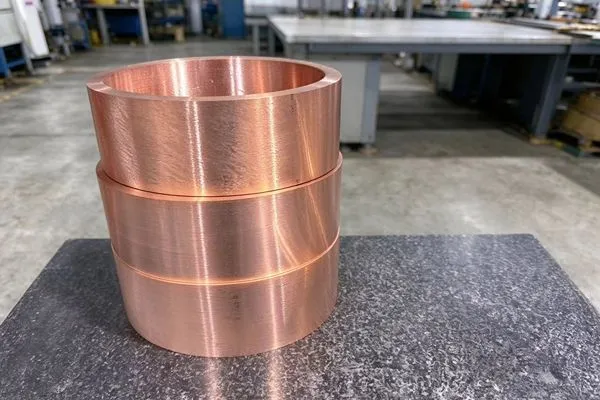
C17510 Beryllium Copper Sleeve Properties and Performance
Conductivity and Hardness Together
The main reason engineers choose this alloy is the balance. A C17510 beryllium nickel copper sleeve in the aged condition delivers 45–60% IACS conductivity and HRC 30–38 hardness, roughly HB 280–350. Pure copper conducts better but softens and wears quickly under load. C17200 is harder but conducts less, and it falls in RWMA Class 4, while C17510 meets the RWMA Class 3 requirements. For a current-carrying bushing, that means the bearing surface can pass current without galling or deforming. Final inspection covers conductivity, hardness, and dimensions, so your certificate shows measured values.
Strength, Thermal Conductivity, and Temperature
In the aged condition, tensile strength runs from 700 to 1000 MPa and thermal conductivity is about 180 W/m·K. Hardness stays stable through repeated heating and cooling, and our data lists a maximum operating temperature of up to 480°C. These numbers explain why the alloy appears in welding and molding, where parts cycle between hot and cool. For any C17510 beryllium nickel copper sleeve, properties still depend on temper, section size, and heat treatment, so confirm values against the certificate for your lot. Short-term peaks and continuous service temperatures also differ, so share your duty cycle with us.
Anti-Galling, Non-Magnetic, and Non-Sparking Behavior
Against steel shafts, the C17510 beryllium nickel copper sleeve resists seizing, which matters for oscillating motion with little lubrication. The alloy is non-magnetic, so it will not disturb magnetic-sensitive instruments. It is also non-sparking on impact, a property used in explosive-atmosphere equipment and oil and gas downhole tools. Silver or nickel plating is available for sliding electrical surfaces. Long-term temperature rise depends on your current, contact pressure, cross-section, and cooling path. I recommend a type-validation test under your own duty cycle, and we supply material certificates and conductivity data to support it.
C17510 Beryllium Copper Sleeve Applications
Current-Carrying Bearings and Electrode Arm Sleeves
Switchgear, busbar systems, and rotating electrical contacts need a sleeve that passes current and survives sliding motion. A C17510 beryllium nickel copper sleeve fits current-carrying bearings, power transmission bushings, and electrode arm sleeves. Its 45–60% IACS conductivity limits resistive heating at the joint, while HRC 30–38 resists wear. In resistance welding, the alloy works as electrode cooling sleeves and adapters. Heat leaves the tip quickly, and the sleeve keeps its shape under clamping pressure. That can reduce how often you replace electrode sleeves.
Injection Mold and Die-Casting Bushings
Mold shops need a material that moves heat away from the cavity and still resists wear at guide and ejector positions. A C17510 beryllium nickel copper sleeve works as a thermal transfer bushing, heat sink sleeve, or cooling core in injection molds. It also works as a plunger tip bushing in die-casting machines. The soft TB00 temper machines easily, and aging then brings the hardness up. If you stock several beryllium copper grades, a simple rule helps. Choose C17200 for maximum hardness, C17500 where cobalt is acceptable, and C17510 when heat transfer and wear both matter.
Hydraulic, Oil and Gas, and Electronics Uses
Pump shaft sleeves and guide bushings in low-lubrication, high-frequency swing service benefit from anti-seizure behavior against steel. Oil and gas downhole bushings use the non-magnetic, non-sparking character, and the alloy resists salt-water corrosion, which suits marine and subsea instrument parts. In electronics manufacturing, C17510 forms heat dissipation components. Price-focused buyers often compare a C17510 beryllium nickel copper sleeve with aluminum bronze C95400. That alloy costs less per kilogram, but anti-galling life against steel can decide total cost. I suggest a side-by-side trial on your own shaft before you switch.
Specifications, Tolerances, and Machining
Custom Dimensions and Tolerances
We cut each C17510 beryllium nickel copper sleeve to your inner diameter, outer diameter, and wall thickness. Precision honing holds ID and OD tolerances up to ±0.005 mm, with concentricity of 0.01 mm or better and a surface finish of Ra 0.4–0.8 µm. Flanges, oil grooves, and holes follow your drawing. Tight limits add machining and inspection time, so apply them only to bearing and fit surfaces. A 2D drawing or 3D CAD model lets us check manufacturability and quote accurately. State the material condition, standard, heat treatment, roughness, and edge condition on the drawing.
Machining and Heat Treatment Sequence
We turn, bore, ream, groove, drill, and hone sleeves on CNC equipment. Order of operations matters. Rough machining in TB00, aging, and then final honing gives the tightest bore, while pre-aged TF00/TH04 skips the aging step. We agree on this sequence with you at the quoting stage. Stock rod is available up to Ø200 mm × 1000 mm. Beryllium-containing dust needs control during machining and grinding, and OSHA's beryllium standard, 29 CFR 1910.1024, sets the rules in the United States. A finished solid C17510 beryllium nickel copper sleeve is safe to handle.
Quality Control and Traceability
Inspection runs in three stages. We verify raw material composition by optical emission spectroscopy, monitor process parameters during production, and test final dimensions, hardness, conductivity, and internal defects. Every C17510 beryllium nickel copper sleeve ships with an EN 10204 3.1 certificate, so your incoming inspection team can match certified values to what they measure. If a verified quality or dimension discrepancy appears, we replace or re-machine the parts. This record helps when type validation requires a documented material history, especially in OEM programs where you must trace a part back to its lot.
Choosing Between C17510 and Alternatives, and Selecting a Supplier
C17510 vs. C17200 and C17500
Choose by duty, not by label. C17200 reaches higher hardness, up to 38–42 HRC across our beryllium copper range. It suits heavy structural loads and spring service, but it conducts less. C17500 contains cobalt. C17510 replaces cobalt with nickel and delivers comparable performance, while avoiding cobalt price swings on bulk bushing orders. A C17510 beryllium nickel copper sleeve therefore suits buyers who want Class 3 conductivity without cobalt. Copper-chromium alloys, phosphor bronze, and aluminum bronze may also fit some jobs. Compare conductivity, hardness, wear behavior, corrosion resistance, and total cost in the specified temper.
What to Check in a Supplier
Look for certified material, precision CNC machining, custom tempers such as TH04 aging, dimensional inspection, and prototype support. We have produced beryllium copper for over 25 years. We hold more than 500 tons of raw material and standard profiles in stock at direct factory pricing. Stock items dispatch within 3–5 days, custom orders deliver in 15–20 days, and we answer inquiries within 2 hours. A good quotation for a C17510 beryllium nickel copper sleeve states unit price, tooling, minimum order, lead time, and shipping terms, so you can compare offers fairly.
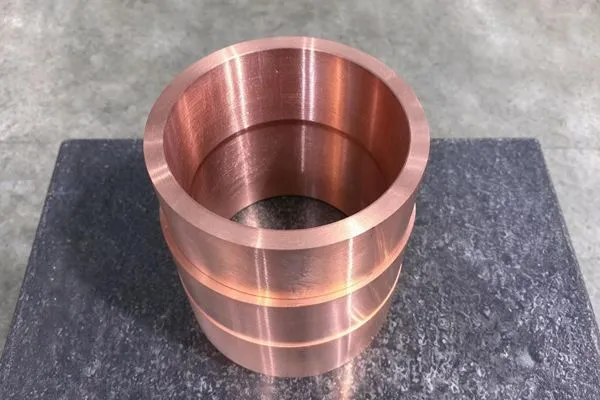
Logistics and Procurement Checklist for US Buyers
Our location near the Shenzhen and Hong Kong ports shortens the path to sea and air freight. We pack in export-standard anti-rust and moisture-proof materials, and we quote CIF, FOB, or DDP by sea, air, or major express carriers. Before you request a quote, collect the alloy and temper, standard, conductivity and hardness targets, dimensions and tolerances, surface requirements, certificate level, annual quantity, prototype needs, delivery address, and target date. A complete package cuts clarification rounds and makes quotes easy to compare.
Conclusion
A C17510 beryllium nickel copper sleeve pairs 45–60% IACS conductivity with HRC 30–38 hardness, so it fits parts that must carry current or move heat while resisting wear. Its cobalt-free chemistry delivers performance comparable to C17500, and the correct designations are CW110C and DIN 2.0850. The TB00 and TF00/TH04 tempers let designers choose between finish machining after assembly and ready-to-use hardness. Typical uses include electrode arm sleeves, current-carrying bearings, mold and die-casting bushings, and non-magnetic downhole bushings, while C17200 remains the choice for maximum hardness. Honed tolerances, batch certificates, and type-validation tests under real duty cycles decide whether a sleeve fits a given design.
FAQ
1. How is C17510 different from C17200?
C17510 conducts electricity and heat better and meets the RWMA Class 3 requirements. C17200 reaches higher hardness for heavy structural loads.
2. Does a C17510 beryllium nickel copper sleeve need aging after machining?
Not if you order TF00/TH04, which arrives pre-aged. TB00 arrives soft and needs aging after press-fit or finish machining.
3. What is the maximum operating temperature?
Our data lists stable properties up to 480°C. Share your continuous and peak temperatures so we can review them.
4. Which DIN number is correct?
Use CW110C and DIN 2.0850. The number 2.1285 belongs to CuCo2Be, which is C17500.
5. Are finished sleeves safe to handle?
Yes. Machining and grinding create dust, so those steps need ventilation, collection, and protective measures.
Request a C17510 Beryllium Nickel Copper Sleeve Quote from JYDS
JYDS is a C17510 beryllium nickel copper sleeve supplier with 25+ years of beryllium copper experience, 500+ tons of stock, and EN 10204 3.1 certificates with every batch. Email your drawing, temper, tolerances, and annual quantity to js01@jstongcai.com.cn, and our team replies within 2 hours. Visit becualloy.com for product details and to start your type-validation samples.
References
1. ASM Handbook, Volume 2: Properties and Selection: Nonferrous Alloys and Special-Purpose Materials, 1990
2. ASM Specialty Handbook: Copper and Copper Alloys, 2001
3. Resistance Welding Manual, 4th Edition, Resistance Welding Manufacturing Alliance, 2003
4. Occupational Exposure to Beryllium and Beryllium Compounds, Federal Register, 2017
5. EN 10204: Metallic Products – Types of Inspection Documents, 2004
6. EN 12167: Copper and Copper Alloys – Profiles and Rectangular Bars for General Purposes, 2016
Online Message