
Nov 26, 2026
C18150 Chromium Zirconium Copper Plate: Custom Cutting Guide
First decide what the finished part will be, then match the cutting procedure, tolerances and test records to it. This is the key to achieving optimal performance from a C18150 chromium zirconium copper plate. This guide illustrates the method we use to schedule orders for mould inserts, switchgear parts and welding parts cut to order. We can supply plates from 5 mm up to 200 mm thick. They are 80% or better IACS conductivity and 75 HRB hardness and 100% ultrasonic tested. I also mention quality inspections and queries for the supplier throughout the way. Get a quote that you can go through and compare line by line and take these procedures to reduce waste and prevent drawing disagreements.
What Is C18150 Chromium Zirconium Copper Plate?
Alloy Basics and Grade Names
C18150 is a precipitation hardened alloy for chromium zirconium copper plate. It has 0.5-1.5% chromium, 0.05-0.25% zirconium and copper in similar proportions. It is available as UNS C18150, CuCr1Zr, DIN 2.1293 or CW106C in EN 1652. The solution treatment dissolves the alloying elements. Then aging precipitates fine chromium and zirconium particles within the copper matrix. Those particles stop the movement of dislocations, and that makes the plate hard, while pure copper would soften. Our plate is created via vacuum melting, precision rolling and controlled ageing processes. It is treated with a solution and then aged, before it is delivered to you.
Key Properties You Can Verify
The numbers on a data sheet are only useful if you can check them. Our C18150 chromium zirconium copper plate needs to have a conductivity of at least 80% IACS, a thermal conductivity of close to 320 W/m·K, a hardness of at least 75 HRB, and a tensile strength of at least 400 MPa after being aged. Pure copper starts to soften around 200°C, while softening resistance goes up to about 500°C. The ASTM E1004 eddy-current test verifies the material's conductivity, and we record that on the certificate. You should ask for readings by lot because the results depend on the thickness and aging practice.
Why Choose CuCrZr Over Pure Copper, C18200, or Beryllium Copper
Pure copper conducts electricity better, but when it's loaded, it bends and softens. In exchange for a little less conductivity, C18150 is much harder and less likely to wear down. Because it lacks zirconium, C18200 chromium copper is more prone to sticking to galvanized steel compared to C18150 electrodes. The other choice is beryllium copper. Our range of beryllium copper reaches up to 38–42 HRC, but its thermal conductivity is only around 105 W/m·K, so it's good for parts where hardness is important. The three things that most mold buyers look at are strength, price, and heat transfer. A C18150 chromium zirconium copper plate usually wins on price and heat transfer at about 320 W/m·K. Also, it doesn't have any beryllium in it, which takes one thing off of an EHS review.
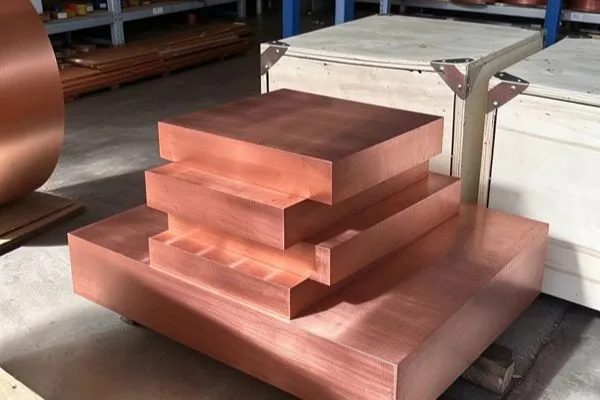
How to Plan a Custom Cutting Order for C18150 Chromium Zirconium Copper Plate
Define the Finished Part First
Begin with a graphic showing the difference between the finished dimensions and the raw-plate dimensions. Indicate coordinates, check points, holes, slots, edge condition and surface requirements. This will allow us to know how much stock a large plate has to contain before it can be machined. Add the amount and the steps of machining that follow it because each step removes material and can reduce stress. The provider can look at the full part and recommend a technique to cut it and nest the sections so that there is no waste. We will provide an estimate once our staff reviews the drawings. We will cut the plate to exact specifications for free on every order of C18150 chromium zirconium copper plate.
Choose a Cutting Method That Fits the Geometry
Each is ideal for a particular job. Band and circular saws can make square blanks and smooth cuts in a short time. Waterjets can carve intricate forms with minimum heat. Copper alloys reflect laser energy and dissipate heat quickly, so make a test cut beforehand. It only works for specified thickness with laser cutting. With CNC milling and drilling, you have better control over edges, slots, holes, pockets and slots. Wire and sinker EDM can hold tight tolerances and make difficult forms, but rough cutting a lot of metal costs more. A popular practice for thick mould plates is to cut the blank too large and finish on a CNC machine. If the geometry is new, check parameters on a test cut.
Thickness, Size Range, and Machining Stock
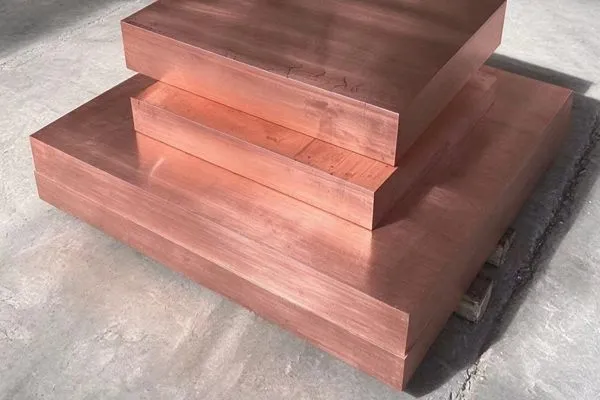
This is our C18150 chromium zirconium copper plate. It comes in 5 mm to 200 mm thick, 100 mm to 1000 mm wide, and 1000 mm to 3000 mm long. Sizes that are made to order are based on your drawing, and sizes that are already in stock ship within 3 to 7 days. Since the plate is already aged when it ships, you usually don't need to heat treat it after cutting it. Still, don't machine any stock on any face. If you mill a deep pocket in a thick plate, you can release stress inside the plate and move the part. To do this, rough mill first and then finish mill. Make sure that the thickness marks on the drawing and the purchase order are the same.
Quality Control for Custom-Cut C18150 Chromium Zirconium Copper Plate
Batch Testing for Large Plates
People often worry that thick C18150 chromium zirconium copper plates have a core that acts differently than the surface. Before we ship, we look for it. Every plate is tested using ultrasonic waves to see if it has any holes or other things inside it. As per ASTM E1004, eddy current testing shows that the material is at least 80% conductive, and Rockwell testing shows that it is at least 75% hard. Metallographic inspection checks the size of the grains and how evenly the chromium and zirconium particles spread. If the particles don't spread evenly, they can leave weak spots when the temperature is changed. Pieces are heated to 500°C for two hours as part of a softening test. The hardness loss must stay at 10% or less. For important blocks, you should get hardness readings at both the surface and the middle of the block.
Certificates and Traceability
The test numbers only matter if they match your parts. We provide C18150 chromium zirconium copper plates with EN 10204 3.1 inspection certificate for chemical composition, hardness and conductivity of the plates. This is our quality system, accredited to ISO 9001:2015 and the materials are safe for RoHS & REACH. Make sure to keep the lot number and heat on the plate as it is being sliced. Back traceable to its origin is each finished insert or blank. Add a certificate of compliance or a report on the dimensions when your quality plan tells you to do so. We wrap our plates for export in a rust-proof, water-tight plastic.
Common Cutting Problems and Fixes
Most of the time you’ll see burrs, rough edges, warping, scratches, and size drift. Most of them are due to worn blades, high or low feed rates, improper clamping, lack of support and residual stress. The problem is aggravated by the heat build-up as copper alloys expand and readily conduct heat. Fixes help. Put the edge and surface condition in the purchase order, replace worn tools, clamp the plate evenly, leave stock for the last pass. Check the alloy name, thickness, temper and certifications before you start cutting. A incorrect temper on a plate is far more expensive after it has been machined. If you leave tolerances, deburring, or packaging details out of the drawing it can throw the timetable off.
Applications of C18150 Chromium Zirconium Copper Plate
Injection Mold Inserts and Hot-Spot Plates
When it comes to molds, cooling usually takes the longest time. Getting the heat out of the cavity faster can cut that time down. C18150 is much better at transferring heat than most tool steels, at about 320 W/m·K. It is also very hard, at least 75 HRB, so it can handle clamping loads and repeated cycles. Core and cavity inserts, cooling inserts, manifold plates, and large hot-spot conduction plates are all common parts. Up to 200 mm thick C18150 chromium zirconium copper plates let you mill a whole block instead of putting together pieces that aren't quite the same size. Mold shops also use it to make EDM electrode blanks because it lasts longer and has a better finish than pure copper. First, run a test insert. Then, let volume orders go out by mold project.
Switchgear, Busbar, and Motor End Ring Blanks
The C18150 chromium zirconium copper plate is used by electrical OEMs to make motor end ring blanks, busbar connection plates, and switchgear contact seats. It's important for these parts to have a conductivity of at least 80% IACS and a softening resistance up to roughly 500°C. One rule for drawing that saves time is to list one standard family on the drawing. We suggest that you use EN 1652 with grade CW106C and DIN 17666 as a guide for the composition. If inspectors mix in standards that were written for different alloys, they end up with requirements that don't match up. Before you finalize the design, get conductivity readings by batch and make sure you know how thick the plates are. We cut from 5 mm to 200 mm and to the drawing.
Resistance Welding Electrodes and Seam Wheel Blanks
The most common way is to use resistance welding. The C18150 chromium zirconium copper plate we sell to RWMA Class 2 is easy to cut into electrode backings, platens, fixture plates, and seam welding wheel blanks. The zirconium helps keep the electrode from sticking to galvanized and coated steels, and it also stops the zinc contamination that breaks down chromium copper electrodes. It is important that the hardness is even here because a soft spot wears down faster and changes the quality of the weld. Let us know the diameter of the wheel and the thickness allowance, and we'll plan the cuts from the right plate thickness so that your blanks fit perfectly.
Choosing a C18150 Chromium Zirconium Copper Plate Supplier
What to Check in a Supplier
Price doesn't tell you much by itself. Find out if the business makes things, trades, or holds stocks, and ask about the tools it uses for melting, rolling, aging, cutting, and inspecting. When you buy C18150 chromium zirconium copper plate from JYDS, you're buying from a factory that has been making copper alloys for more than 25 years and has been around since 1997. Stock also affects the schedule, and it takes 3 to 7 days to ship standard sizes. Check how quickly we answer technical questions: we do so within two hours. Last, ask the supplier what they do when they get a bad lot. We replace or re-machine any quality or size problem that has been proven.
Reading the Quote and Shipping Terms
You should ask for a quote that breaks up the costs of materials, cutting, machining, testing, packaging, and freight into separate lines. With that split, you can compare suppliers based on their total landed cost instead of just their main price. We ship by sea, air, or international express on CIF, FOB, or DDP terms and have prices that are the same as the factory. Being close to the ports of Shenzhen and Hong Kong helps with exporting. Under DDP, we take care of everything from delivery to your door to duties. This means that your landed cost is set from the start. That helps US buyers who need a single number before they start a mold project.
RFQ Checklist for Your Order
Every time I ask for something, buyers must send this:
- Material and testing Specify the grade as C18150, CuCr1Zr or CW106C and mention the standard on your drawing such as EN 1652 or RWMA Class 2. Add temper, minimum conductivity, hardness and tensile strength and state if you want conductivity and hardness measurements by lot on each certificate.
- Geometry and cutting . . . Send CAD file and drawing showing finishing size, raw-plate size, tolerances, flatness, holes, slots, edge condition, deburring and chamfers. Mark out the datums and crucial inspection points and tell us what machining processes follow cutting so we can leave the proper stock on each face of the plate.
- Commercial details: Order quantity, projected annual volume, delivery location, desired ship date, packaging requirements and trade term, CIF, FOB or DDP. List records you expect. e.g. EN 10204 3.1 certificates, dimensional reports or initial article approval. Please provide your drawing revision number so we quote the correct version.
These things let us look over your drawing, make sure we have what you need, and give you a clear quote.
Conclusion
C18150 chromium zirconium copper plate is suitable for parts that need to move heat or current and remain hard over many cycles. This CuCr1Zr chemistry provides at least 80% IACS conductivity, thermal conductivity of ~320 W/m.K, hardness of at least 75 HRB and resistance to softening up to ~500°C. C18200 lacks zirconium and is more prone to sticking during welding. Pure copper conducts better but is softer. Beryllium copper is harder but has much lower thermal conductivity. C18150 offers superior heat transmission, contains no beryllium, and is usually cheaper than beryllium copper. Good custom cutting is based on a clear drawing, a fitting manner of shape and cutting stock on massive plates. Every completed part is connected to the performance of the plate by batch testing, 100% ultrasonic inspection and trackable certificates.
FAQ
1. What thickness range can you cut?
Our plate thickness ranges from 5 mm to 200 mm, width from 100 mm to 1000 mm, and length from 1000 mm to 3000 mm. We can cut to any length you want for free, and we can also make sizes to fit your needs.
2. Does the plate need heat treatment after machining?
Most of the time, no. When we deliver it, it has already been solution treated and aged, so its hardness and conductivity are already at the right levels.
3. How can I verify the quality of a plate?
Ask for your batch's EN 10204 3.1 certificate. It shows the chemistry, hardness, and conductivity of each plate, and all of them pass ultrasonic testing.
4. Is a C18150 chromium zirconium copper plate better than pure copper?
It depends on the specific application. Pure copper is better at conducting electricity and shaping, but C18150 is tougher, wears less, and doesn't soften at high temperatures.
5. What do you need to quote a custom order?
Send the grade, the drawing, the tolerances, the quantity, the destination, and the due date. We give you a quote in 24 hours.
Request a Custom C18150 Chromium Zirconium Copper Plate Quote from JYDS
Want to find a company that can cut C18150 chromium zirconium copper plate to your exact specifications and send it to you with EN 10204 3.1 certificates? To get a quote from JYDS, email us at js01@jstongcai.com.cn with your drawing, the number of items you need, and where you want them sent. We'll get back to you within two hours. We are a factory-direct seller of copper alloys that has been in business for more than 25 years. We keep standard sizes in stock and ship them within 3 to 7 days. To find out more, go to becualloy.com.
References
1. ASM Handbook, Volume 2: Properties and Selection: Nonferrous Alloys and Special-Purpose Materials, ASM International, 1990
2. Copper and Copper Alloys, ASM Specialty Handbook, ASM International, 2001
3. EN 1652: Copper and Copper Alloys — Plate, Sheet, Strip and Circles for General Purposes, European Committee for Standardization, 1997
4. DIN 17666: Wrought Low Alloyed Copper Alloys, Deutsches Institut für Normung, 1983
5. ASTM E1004: Standard Test Method for Determining Electrical Conductivity Using the Electromagnetic (Eddy Current) Method, ASTM International, 2017
6. Injection Molding Handbook, Rosato, D.V., Rosato, D.V., and Rosato, M.G., Kluwer Academic Publishers, 2000
Online Message