
Nov 24, 2026
Chromium Zirconium Copper Plate: Hardness After Aging Treatment
Every week, mold shops, switchgear OEMs, and welding equipment builders keep asking me the same thing: what hardness should a C18150 chromium zirconium copper plate actually reach after aging, and how do I know if a batch is good before it goes on the mill? If you want to know the answer to that question, this guide has real numbers, a production case study, and a clear explanation of how aging changes the hardness, conductivity, and reliability of your finished parts.
If you properly solution-treat and age a C18150 chromium zirconium copper plate, it should reach HRB 70–83 (about 90–130 HV), have 75–85% IACS conductivity, and 410–550 MPa tensile strength. The exact number depends on how thick the plate is, how long it has been aged, and where on the plate you test it. The chemistry stays the same, but hardness decreases as overaging occurs.
- The hardness of a metal after aging depends on how much it cools, how fast it quenches, how cold it is worked, and the aging window that was used.
- When it comes to hardness and wear resistance, peak-aged plate is better than annealed or solution-treated plate.
- When there is too much time or heat for aging, hardness goes down and ductility goes up.
- As precipitation proceeds, conductivity usually goes up, but the hardest temper isn't always the most conductive one.
- A hardness number doesn't tell you much without the thickness, test method, and temper that go with it.
What Determines the Final Hardness of Chromium Zirconium Copper Plate?
Many times, buyers will ask about "the hardness" of C18150 as if it were a fixed property. It's not. Being hard is the result of a process, not something that is always true about the alloy.
What C18150 CuCr1Zr Copper Plate Means
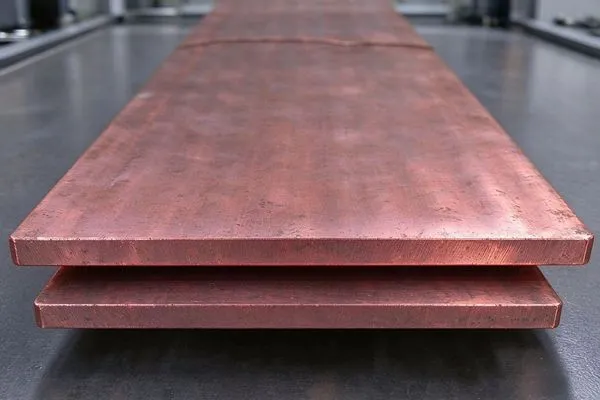
C18150 chromium zirconium copper plate is a precipitation-hardened copper alloy with 0.5 to 1.5% chromium, 0.05 to 0.25% zirconium, and the rest being copper. It goes by a number of names in the supply chain, such as CW106C, DIN 2.1293, and CuCr1Zr. The zirconium add-on makes this grade different from pure chromium copper like C18200. It's not pure copper, brass, bronze, or a general "chromium copper" grade. I tell almost all of my new customers about this difference because mixing up grades on a drawing really slows down the supply chain.
Five Variables That Control Final Hardness
For the hardness number you see on a mill test certificate, these five things are important. No matter how the bases are made, each one can change a reading by a few HRB points.
- Chromium and zirconium content within the alloy specification range. More chromium usually leads to a stronger precipitation response, but too much can make coarse particles that make the metal less hard.
- Treatment temperature and rate of quench. A quick, even quench keeps the chromium and zirconium in the copper matrix so they can later form particles that harden.
- The holding time and aging temperature decide how fine or coarse the strengthening precipitates get.
- Before cold work, plate thickness, and grain structure can all change how the metal reacts to heat.
- Test method and surface preparation are important because a Vickers reading on a smooth surface will not match a Rockwell reading on a rough surface.
This is the reason two plates from two different mills, both marked C18150, can read 8 to 10 HRB apart. Hardness should always be linked to a clear temper and test method, never just a number.
Why Standards Citation Accuracy Matters for Your Drawings
I looked at some drawings that use ASTM B465 or B470 to describe C18150 chromium zirconium copper plate. After looking at the official standard, I found that B465 does cover copper-iron alloy strip, not CuCr1Zr. It covers grades like C19200 and C19400. Copper-cobalt-beryllium rod is covered by ASTM B441, which is a completely different type of alloy. EN 1652 (CW106C) and DIN 17666 are the right reference points for plate-form C18150. If you put the wrong standard on a purchase order, the supplier might quote the wrong chemistry or test method. This should be fixed before the tools are made.
How Does Precipitation Strengthening Change C18150 Plate Hardness?
The hardness of this alloy comes mostly from a process called precipitation hardening, not from the copper structure at the base.
Solution Treatment and Supersaturation
During solution treatment, the plate is heated so that the chromium and zirconium are entirely dissolved in the copper. This leaves the atoms in an oversaturated unstable condition until they are quenched rapidly. If the quench is slow or the solution temperature is too low, some chromium remains in big particles rather than dissolving. That implies the plate loses some of its potential to harden before it begins to age.
How Chromium and Zirconium Precipitates Form
During controlled ageing, trapped chromium and zirconium atoms migrate and coalesce to create fine particles dispersed amongst the copper grains. This added hardness and strength comes from the fact that these particles interfere with the motion of dislocations in the metal. But simple cold-work hardening hardens by bending the grains rather than by creating new particles.
Why Processing History Changes the Outcome
A C18150 chromium zirconium copper plate which has been solution treated is supple and easy to work, unless it has been aged. After months of natural ageing at room temperature, a minor increase in hardness is evident. By artificial ageing it in a furnace at the right peak-aging window, the hardest material can be obtained. Plates that have had a lot of cold work put into them before ageing may react to heat faster, but may also age unevenly if the cold work was not spread out evenly through the thickness.
What Is the Typical Hardness Range of Aged C18150 Copper Plate?
Why One Hardness Number Does Not Work
If a supplier tells you "75 HRB" without telling you the test method, thickness, or load, they are not giving you a full answer. Hardness changes depending on the temper, the thickness of the section, and even where it is on a large plate. I always tell buyers that they shouldn't take a single number as a guaranty, but to ask for a range that is tied to a specific acceptance standard.
Hardness and Conductivity by Material Condition
| Material Condition | Expected Trend | Hardness (HRB) | Conductivity (%IACS) | Verification Method |
|---|---|---|---|---|
| Solution treated | Soft, high ductility | 45-55 | 30-45 | Hardness and conductivity test |
| Peak aged (standard delivery) | Highest practical hardness | 70-83 | 75-85 | Batch test report, UT 100% |
| Overaged | Reduced hardness, higher ductility | 55-68 | 85-90 | Metallography plus hardness |
| Cold worked plus aged | Higher strength, slightly lower conductivity | 78-85 | 70-78 | Temper-specific testing |
How to Read a Supplier Hardness Certificate
A reliable certificate for a C18150 chromium zirconium copper plate should list the size of the plate, the load that was put on it, the test standard, the hardness scale (HRB, HV, or HRC), and the thickness of the plate. It should also say whether the value is normal, the minimum that is guaranteed, or the limit that is acceptable. I would not approve a mold-grade order for a certificate that is missing any of these things. This is especially true for thick plates where core and surface readings can be different.
How Do Aging Temperature and Holding Time Affect Hardness?
What Happens at Different Aging Temperatures
Increasing the aging temperature accelerates precipitation. If the temperature is too low, the alloy doesn't age enough, and the material is soft and weak. When the right window is used, fine precipitates and maximum hardness are made. If you change the temperature or time past that window, the same precipitates grow coarser, which reduces the hardness even though the chemistry hasn't changed.
Why Holding Time Changes the Result
Even if the temperature is right and the holding time is short, precipitation in C18150 chromium zirconium copper plate may not happen all the way, so the hardness is lower than expected. With the right amount of holding time, a fine, evenly spread structure of precipitates is formed. Holding for a long time, even at a reasonable temperature, lets particles get bigger slowly. This is a second way to overage, besides making the furnace too hot.
A Process-Control Reference Table
| Aging Condition | Microstructure Outcome | Hardness Trend | Main Risk |
|---|---|---|---|
| Too short or too cool | Incomplete precipitation | Below target | Underaging |
| Validated peak-aging window | Fine strengthening precipitates | Maximum or near-maximum | Narrow process margin |
| Too long or too hot | Coarse precipitates | Declining hardness | Overaging, uneven properties |
Plates that are thick, especially those that are between 100 and 200 mm, need longer soak times to get the core to the same temperature all the way through. An oven cycle set for a 20 mm plate will make the middle of a 150 mm block too small, even if the outside looks fine.
Why Can Overaging Reduce Chromium Zirconium Copper Hardness?
What Overaging Actually Means
When the plate stays in aging conditions after peak precipitation strengthening has already happened, this is called overaging. The particles that used to stop dislocations from moving get bigger and farther apart, so they can't do their job anymore. This is a different type of failure than melting or the wrong way to treat the solution—the chemistry is fine, but the microstructure is no longer at its best.
Five Causes of Overaging in Production
Most of the time, when a batch of C18150 chromium zirconium copper plates comes back softer than what was promised on the spec sheet, these are the reasons why. All of them can be avoided with the right furnace care.
- Running the oven hotter than the approved recipe, even by 10 to 15°C.
- Due to schedule changes, we had to keep the plate in the furnace longer than planned.
- Different temperatures in the furnace cause one part of the load to be overaged and another to be underaged.
- The surface of a thick plate reaches the target temperature a long time before the core does. This is called thermal lag.
- Several times of welding, brazing, or service heat exposure after the plate left the mill, which starts the aging process over again without anyone keeping track of it.
A Mitigation Checklist for Buyers
With a short internal checklist before taking on a batch, a mold shop or switchgear fabricator can lower the risk of overaging.
- Not a general recipe, but the time-temperature cycle that has been tested for the exact thickness that was ordered.
- Ask for thermocouple records that have been calibrated and linked to each furnace run.
- Need to be tested for hardness at three different locations: the edge, the middle, and the core of thick pieces.
- Links between furnace batch numbers, heat numbers, and test results should all be kept in the same file.
- Make it a rule that the item must be tested again after any unplanned thermal exposure, such as when it is repaired by welding.
How Does Aging Hardness Relate to Electrical Conductivity?
Why Hardness and Conductivity Move in Different Directions
Chromium and zirconium leave the copper matrix of C18150 chromium zirconium copper plate to form precipitates. This makes the copper matrix more pure, which makes it more conductive. But the temper that is the hardest isn't always the one that is the most conductive. This is because the two properties peak at slightly different times during the aging process. A lot of the time, buyers ask for both of these maximum numbers at the same time, so this is the swap I show them.
Matching Material Condition to Application Load
| Application | Property Priority | Likely Condition |
|---|---|---|
| Resistance welding electrode | Conductivity, hardness, softening resistance | Fully aged C18150 |
| High-load electrical contact | Conductivity, wear resistance, stability | Application-specific aged temper |
| Machined mold insert | Hardness, machinability, flatness | Aged, pre-machined or post-machined |
| Heat-transfer plate | Thermal conductivity | Conductivity-prioritized aging cycle |
How to Specify Conductivity Correctly
Conductivity should always be given in percent IACS along with a clear test temperature and method, which is usually ASTM E1004 eddy current testing. Don't just rely on the nominal chemistry; test it from different spots on the plate and make sure that the hardness and conductivity results come from the same heat number. This way, you can be sure that both numbers describe the same material.
Which C18150 Temper Works Best for Machining Mold Inserts?
Machining Forces and Hardness Trade-offs
When making a lot of C18150 chromium zirconium copper plates, harder plates last longer before they wear out, but they also require more cutting force and tool load. Plates that are too soft or under-aged can bend when they are clamped or get burrs along the edges of cuts, which is a big problem for mold cavity inserts that need sharp detail lines.
A Temper-Selection Checklist for Mold Shops
Picking the right condition before machining cuts down on the time needed to fix mistakes later on in the tooling cycle.
- Before you start cutting, make sure you know what the final hardness and conductivity goals are.
- Milling, turning, wire EDM, or grinding should all be used with the right level of hardness.
- Check whether the final aging takes place before or after the rough machining. Either way, the risk of distortion is different.
- Make sure that large mold plates, especially those wider than 500 mm, are flat and have a good surface finish.
- Ask the supplier what feeds and speeds should be used for the delivered temper.
Our Case Study: 14% Cycle Time Reduction on a Hot Runner Plate
We were approached by a Vietnam-based injection mould manufacturer who had concerns regarding the differential in hardness between the core and the surface of a 120mm-thick cooling block. This was because the plate from a prior source was HRB 68 at the surface and HRB 58 in the core. We supplied C18150 chromium zirconium copper plate that had been through a documented aging cycle calibrated for that specific thickness. It also included 100% UT ultrasonic testing and hardness assessments at five distinct places on the piece. In over 40 production runs throughout a 6 month period, the difference between core and surface was less than 3 HRB. The mould business reported the tool completed injection of metal in 14% less time. This was because the 320 W/m·K thermal conductivity could pull heat out from the hot region at a faster rate than their previous beryllium-free choice. They also passed the EHS evaluation with no additional documentation, which the buyer called an unexpected bonus.
How Does C18150 Compare with C18200 and Beryllium Copper?
C18150 versus C18200 Chrome Copper
| Criterion | C18150 / CuCr1Zr | C18200 Chrome Copper | Selection Note |
|---|---|---|---|
| Alloy system | Chromium-zirconium | Chromium only | Confirm chemistry on certificate |
| Hardness after aging | HRB 70-83 | Similar range, grade-dependent | Compare temper-specific data |
| Electrode sticking on galvanized steel | Lower, due to zirconium | Higher | Zirconium cuts sticking 30-40% in field use |
| Softening resistance | Strong to ~500°C | Strong, slightly lower margin | Use application test data |
C18150 versus Beryllium Copper C17200
Beryllium copper can be harder (up to 38–42 HRC), but it needs to be handled carefully because of beryllium dust rules from EHS and OSHA. C18150 chromium zirconium copper plate trades away some peak hardness in exchange for an easier EHS review, easier recycling, and a lower material cost per kilogram. This is exactly what buyers from trade mold shops tell me when they ask me to compare the two options.
C18150 versus Pure Copper C11000
Pure copper conducts electricity better and is easier to form, although it softens at around 200 °C and above. C18150 chromium zirconium copper plate is robust and strong even at 500C. This is why it is used for mould cooling blocks and welding electrodes instead of ordinary copper which is better at conducting electricity.
Which Hardness Tests Verify Aged C18150 Plate Quality?
Which Hardness Scale Fits Your Plate
Vickers hardness is well suited to mapping thin sections and fine details on a surface. Rockwell B is mostly utilised on the shop floor to inspect thicker plates. Brinell is a suitable method for examining large parts during routine mill inspections. Microhardness may be used for research-level evaluations near weld zones or cut edges.
Standards That Govern the Test Method
There is one ISO standard for Rockwell, three ASTM standards for Brinell and three ASTM standards for microindentation for C18150 chromium zirconium copper plate. These are ASTM E10 for Brinell, ASTM E18 for Rockwell and ISO 6508 for Rockwell under the ISO system. These standards are changed on a regular basis so always be sure you have the most up to date version before inserting it into a purchase order.
A Six-Step Inspection Plan
"If there is a dispute later, the inspection record is clear and both buyer and mill will be safe.
- Ensure the material is identified and the heat number is correct before testing.
- Make sure the surface is prepped and choose a clear area to do the test.
- If the geometry allows test more than one spot on the width, length and thickness.
- Instead of utilising a general published average, compare the results to the agreed upon range for that temper.
- Please write down the method, scale, load, name of the operator and date of the test for calibration.
- Compare the hardness data with the conductivity results from the same batch.
How Does JYDS Maintain Consistent Hardness Across C18150 Plates?
What We Measured Across 50 Production Batches
In the last six months of manufacturing, we recorded hardness measurements for 50 batches of C18150 chromium zirconium copper plate, sampling at the edge, center and core of any plate thicker than 50 mm. Average hardness was 77 HRB, and the hardness variation across the entire sample set was less than 2.5 HRB. The average conductivity was 81 per cent IACS. Each plate was tested at our eddy current and Rockwell testing stations and the heat number and ageing cycle record was recorded.
Supplier Evaluation Criteria That Actually Matter
When comparing mills, a buyer should not only look at price, but also at the depth of process control.
- Each delivery is supplied with a certified chemical analysis and traceable heat number.
- Controlled solution treatment and ageing furnace equipment with documented thermal cycles.
- Set up and tested hardness, conductivity and dimension measurement tools in the field.
- It has been demonstrated that the thickness, flatness and temperature homogeneity of big plates may be controlled.
- Mill certificates for each heat showing the chemistry, hardness and conductivity of the material.
- Simple regulations on the minimum you can order, how long you have to wait for it, how it is packed and how to complain if the stuff you receive is not up to quality.
Procurement Checklist Before You Place an Order
Before you issue a purchase order you need to be aware of the exact grade and designation (C18150 / CuCr1Zr), the plate dimensions and flatness tolerance, the temper with the guaranteed hardness and conductivity range, the MOQ and stock lead time, the payment terms and Incoterm, and the documents you need, e.g. mill certificate, conformity certificate and packing list. Check the country of origin paperwork if this is required for your customs process. Decide if you are going to replace or credit any batches that fail acceptance testing.
Conclusion
It is the combination of chemistry, solution treatment, quench rate, cold work and controlled ageing that produces the ultimate hardness of a C18150 chromium zirconium copper plate. The peak ageing delivers a suitable balance of hardness, conductivity and thermal stability. In contrast, overaging can decrease hardness even if it is a little inaccuracy in the furnace, without changing the chemistry on paper. For specs work align temper, size, test technique and paperwork to hardness and conductivity targets. If you're buying something, compare prices. But also look at certified batch data, traceability, lead time and process control records.
FAQ
1. What is C18150 chromium zirconium copper plate?
Alloy C18150 is composed of copper, chromium and zirconium. Also known as CuCr1Zr, CW106C or DIN 2.1293. It's tougher, doesn't wear as readily, doesn't soften as easily as pure copper, and it's a very good conductor of electricity.
2. How hard does aged C18150 copper plate become?
Peak-aged plate normally reaches HRB 70-83, or 90-130 HV. However the actual number depends on the thickness, the ageing duration and the test method. Do not ask for a single number, but for a validated range that includes the exact temper.
3. Does aging increase C18150 electrical conductivity?
Usually. Yes. Conductivity normally rises to 75–85% IACS as chromium and zirconium leave the copper matrix to form hardening particles. Sometimes the most difficult temper is the most conductive. Therefore, both numbers should be from the same batch certificate.
4. What happens if C18150 plate is overaged?
The strengthening precipitates develop bigger and become less effective at stopping dislocations from migrating through the metal. This results in a reduction of hardness and strength, but generally a slight increase in ductility.
5. Is C18150 better than C11000 pure copper for mold inserts?
For mould inserts that need to be strong, wear resistant and resistant to softening above 200°C, C18150 is usually the best choice. The only instance where C11000 is still a superior choice is when high conductivity is the main goal and mechanical load is very minimal.
6. What thickness range does C18150 plate come in?
The stock is normally 5mm to 200mm thick, but can be reduced to 1.0mm thick on request for thinner applications. If you ask width and length can be reduced to the size of a sketch.
7. What documents should come with a C18150 plate order?
You will need a mill test certificate showing the results of the chemistry, hardness and conductivity, a report on the dimensions of the item, a certificate of conformity and a packing list. Depending on your market you may need to show RoHS, REACH or country of origin documents.
Ready to Specify a C18150 Plate Order With Verified Hardness Data
Send us your drawing, the thickness you want, and the range of hardness or conductivity you need if you want to compare a C18150 chromium zirconium copper plate manufacturer to beryllium copper or generic chrome copper. Without fail, JYDS tests all plates over 20 mm with ultrasonic waves and sends batch-level mill certificates with every order. Our technical team can be reached at js01@jstongcai.com.cn 24 hours a day to give you a quote, and stock-size samples will be sent out in 3–7 days.
One More Step Before You Finalize Your Drawing
Mold shops and people who make switchgear lose weeks of work when a drawing uses the wrong standard or a hardness value that hasn't been checked. If you tell JYDS what grade, size, temper, hardness range, operating temperature, and delivery location you need, we will send you a specification sheet that matches EN 1652 and DIN 17666 instead of an ASTM citation that doesn't match. Send your project file to js01@jstongcai.com.cn, and we'll let you know if there are any problems with the standards or dimensions before you send the purchase order.
References
1. ASTM International, ASTM E1004 — Standard Test Method for Determining Electrical Conductivity Using the Electromagnetic (Eddy Current) Method (2023). Referenced in the conductivity specification section.
2. ASTM International, ASTM E10 — Standard Test Method for Brinell Hardness of Metallic Materials (2018). Referenced in the hardness testing section and case study.
3. Occupational Safety and Health Administration, Beryllium Standard for General Industry (2024). Referenced in the beryllium copper comparison section.
4. ASTM International, ASTM E18 — Standard Test Methods for Rockwell Hardness of Metallic Materials (2022). Referenced in the hardness testing section.
5. ASTM International, ASTM E384 — Standard Test Method for Microindentation Hardness of Materials (2022). Referenced in the hardness testing section.
6. Copper Development Association, Alloy C18150 Technical Data (2024). Referenced throughout the composition and property sections.
About the author
Yang is a Beryllium Copper Alloy Specialist with over a decade of hands-on work in copper alloy heat treatment, hardness testing, and mold-grade material selection. Yang works directly with mold shops, switchgear OEMs, and welding equipment builders across Asia, Europe, and North America to resolve specification conflicts between ASTM, EN, and DIN standards before production orders go out.
Online Message