
Nov 25, 2026
How Beryllium Copper Plate Improves Mold Cooling
As heat moves faster out of the steel, a C17200 beryllium copper plate helps the mold cool down faster. It moves heat away from hot spots in cores, thin ribs, and cavity corners about three to four times better than regular mold steels, with a thermal conductivity of about 105 W/m·K. Then it gets harder over time until it's 36–42 HRC. This makes the insert strong against clamp force and wear. We only use it when a cooling channel can't get to the area. This guide tells you how it works, how to spec it, and how to show that it helped in your own mold trial.
Why Mold Cooling Falls Short in Injection Molds
Cooling Time Sets Cycle Time and Part Quality
Most injection molds spend most of their cycle time cooling, sometimes more than half of it. To get out of the hole, a part has to be stiff enough to not bend while it's there. If some parts of a part cool down more slowly than others, they shrink in different ways. That leads to warping, sink marks, residual stress, and changes in the size of the part. Each flaw increases the amount of scrap, and each extra second of cooling lowers output over time. Molds used in optics, medicine, and electronics have very tight tolerances, which means that measurements can pick up on even small temperature differences across the cavity surface. This kind of gap is what a C17200 beryllium copper plate insert is meant to fill.
Where Hot Spots Form in Steel Molds
Mould steel is strong and doesn't wear readily, but most grades only conduct 25 to 35 W/m·K of heat, so it stays hot. Hot spots are often found in deep cores, narrow ribs, sharp edges and areas far from the water line. This is due to the shape of the piece, the thickness of the walls, the need for sealing or the strength that the steel must maintain. Some cores require baffles and bubblers to function, yet thin pins and small inserts generally don't have the space. A C17200 beryllium copper plate insert makes sense in these locations as it provides a heat path without consuming any additional channel space.
Using a C17200 Beryllium Copper Plate Insert as a Second Heat Path
A machined C17200 beryllium copper plate is used as an insert to remove heat from the heated surface and transfer it to the mould base or to the next cooling channel. Imagine a short steel bridge that slowly crosses a gap. Beryllium copper (CuBe2) is a good choice for this application since it is both very conductive and strong enough to resist impact from something that shuts the mould. Pure copper is a stronger conductor of heat, but is too soft for most core and cavity work. I think beryllium copper should be restricted to where it is needed and mould steel utilised for the framework. That keeps the cost down and the mould stiff.
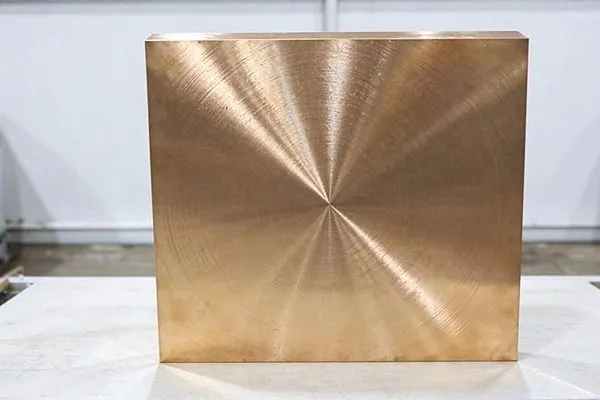
How C17200 Beryllium Copper Plate Improves Mold Cooling in Practice
Heat Flow from Hot Spot to Cooling Channel
The heat path is what gives the gain. A C17200 beryllium copper plate insert lets heat move faster than steel from the cavity surface to the coolant, at about 105 W/m·K. Since there is less difference in temperature across the mold face, the part freezes more evenly. The results still depend on the shape of the insert, how it contacts the steel around it, where the channels are placed, how the coolant flows, and the temper. A number for conductivity is never proof to me. The potential is shown by conductivity, and the result is shown by temperature mapping and cycle-time records from a test. That's why we give them a baseline to compare against.
Properties That Matter for Mold Inserts
That's what we check first on an aged C17200 beryllium copper plate. Between 1.8 and 2.0% of the material is beryllium, and at least 0.20% of it is cobalt and nickel. It has a tensile strength of 1,170 to 1,380 MPa and a yield strength of 1,000 to 1,275 MPa. Elongation is typically 1–8%. The electrical conductivity is between 22 and 28% IACS. To be accepted, the hardness must be between 36 and 42 HRC. Internal mill readings may occasionally reach 42 HRC. The alloy doesn't spark or magnetize either. In order to keep track of each batch, we write down the hardness and conductivity.
Solution-Annealed Delivery, Then Machine and Age
Most mold shops buy the C17200 beryllium copper plate in the solution-annealed state (TB00), make the insert rough and mostly smooth, and then let it age. Cutting tools made of carbide work well in the soft state. After some time, the hardness goes up to a range of 36–42 HRC. A small change in size happens with age, so leave finishing stock on important surfaces and grind or polish them after age. That keeps the face of a mirror from moving. Soak thick pieces for long enough for the core and surface to reach the same hardness. Check the hardness of large blocks at several points. We will look over the aging plan before you cut if you send us your geometry.
Choosing and Specifying the Right Plate
C17200 Compared with Mold Steel, Pure Copper, C17500 and C17510
In each choice, conductivity and strength are compared. Mold steel holds weight but doesn't conduct electricity well. Pure copper conducts electricity best, but it bends and wears down when clamped down. Both C17500 (CuCo2Be) and C17510 (CuNi2Be) conduct heat better than C17200, but they are softer, which makes them better for areas that don't get much use. In the middle is a C17200 beryllium copper plate. It is less conductive than the other two, but it is the strongest and hardest of the bunch. That works for cavity inserts and cores that get hit and slide around. We have all three alloys in stock, so we can match the duty to the right alloy. Look at alloys that are the same in terms of their hardness, shape, and test method.
What to Put in Your Purchase Specification
Clear requests prevent needless work . List alloy and standard ( C17200 to ASTM B194 ). Thickness, width, length, temper, hardness aim, flatness, parallelism, surface finish, amount, how smooth the surface is. Add the delivery location and inspections you require. We supply beryllium copper C17200 plates with thickness 5-200 mm, width 100-1000 mm and length 1000-3000 mm. We can also cut them to your exact specs. Core and cavity inserts are typically in the 20-100 mm range. Do you want to age the metal before or after you machine it? In addition, please tell us what UT and hardness reports your quality team wants.
Common Mistakes When Choosing Beryllium Copper
There are four common mistakes. C17200 beryllium copper plates are thought to be the same by buyers, but the temper influences the hardness, strength, conductivity and machinability. They just care about conductivity . Contact quality , channel layout and coolant flow are vital too . The completed sizes are inaccurate because they ignore how the parts move when they are being machined, honed and aged. They also go for the cheapest quotation without looking at test results or traceability, which can end up more expensive if a lot is turned down. Discuss steel compatibility, method of joining, and coolant chemistry early on. This is because when various metals touch they can corrode.
Machining, Finishing and Verifying Cooling Results
Machining and Fitting the Insert
When coolant is added to carbide tools, they can cut both soft and hard materials. With sound parameters and chip control, you can mill, drill, turn, grind, EDM, and polish. The machining process creates beryllium dust, so OSHA's beryllium standard (29 CFR 1910.1024) requires controls like wet cutting, HEPA filtration, ventilation, and safety gear. It is safe to handle solid plate; the danger comes from particles in the air. Fit changes how heat moves, so keep the gaps small and the surfaces that touch clean. When it gets hot, beryllium copper expands more than steel does, so make sure the fit is right at the right temperature. We don't think you should weld. Fix things mechanically or by brazing.
Mirror Polish and Internal Soundness
Molds for optics and medicine need SPI A-1 faces, and an insert with holes can't hold one. Our plate has a fine-grained, uniform structure, and before it is shipped, we use 100% ultrasonic flaw detection to find any internal holes or inclusions. That check also keeps heat flow safe, since a hole in a thick block blocks the path. Post your target Ra on the drawing so we can review the surface preparation requirements together. When you polish the final surface after aging it, you keep the heat-treated parts from moving.
Proving the Gain in a Mold Trial
Before you put the insert in, write down the following: the total cycle time, the cooling time, the part and mold temperatures, the variation in size, the rate of scrap, and the locations where defects show up. To make sure the temperature is uniform after installation, use thermal imaging, embedded sensors, or process monitoring. Then do the same checks again. You should compare any gain to the cost of machining, heat treatment, shipping, downtime, and the expected life of the insert. Keep track of the results, grade, temper, batch, and sizes. That record lets you standardize the specs for molds that are similar and lets you place repeat orders. Like most things, it goes like this: drawing, sample, mold trial, then project order.
Buying C17200 Beryllium Copper Plate from JYDS
Quality Control and Certificates
Each batch undergoes three inspections. We verify the composition by OES or XRF, check the temperature and rolling conditions, then test the hardness, tensile strength and conductivity of the material. We also examine for faults using 100% ultrasonography, and make sure the measurements are accurate. Each shipment is accompanied by an EN 10204 3.1 mill test certificate which may be used to track the history of each batch. Our goods comply with the regulations imposed by RoHS and REACH and our quality system is accredited to ISO 9001:2015. We melt our own metals in vacuum induction furnaces for minimal gas content and great consistency in the alloy. Ask to see the certificate before placing an order so that your quality team may have a look at it.
Stock, Custom Cutting and Response Time
We have more than 500 tons of standard profiles and raw materials on hand. Items in stock are sent out in 3–5 days, and custom orders take 15–20 days to arrive. We can band saw, waterjet cut, CNC mill, grind to thickness, and check the flatness of plates to your drawing in annealed, half-hard, or fully hardened tempers. Our team has worked with beryllium copper for more than 25 years, responds to questions within two hours, and offers free help with choosing materials and heat treating them. If a known problem with the part's quality or size shows up, we replace it or re-machine it.
Packaging, Shipping and Other Uses
We utilise export quality materials that do not rust and do not let water in. We are near the ports of Shenzhen and Hong Kong, therefore we can offer CIF, FOB or DDP via sea, air or international express. The same plate is not merely used for cooling moulds. It is also used for hot runner plates, blow mould pinch-offs and neck rings, resistance welding dies and electrodes, tool blanks and wear plates (non-sparking). Each use has its own documentation and temperature so when you ask be careful to tell us what you want to use it for.
Conclusion
Mould cooling reduces cycle time and part quality. Cores, ribs and corners constructed of steel only often have hot spots. Its thermal conductivity is about 105 W/m·K and its hardness after ageing is 36-42 HRC. C17200 beryllium copper plate speeds up heat flow, and resists clamp force. So you understand how the inserts fit and how channels are built out before you compare the alloy to C17500, C17510, pure copper and steel at the same temper. Tolerances and mirror finishes are protected by machining in the annealed condition, then ageing the metal and finishing it. The quality of the material is good as per UT reports, hardness data and certificates. You can bolster your case using conductivity data by comparing it to a baseline and then a trial.
FAQ
1. Is a C17200 beryllium copper plate strong enough for core and cavity inserts?
It gets to 36–42 HRC and 1,170–1,380 MPa tensile strength after being aged, which is strong enough to handle clamp force in many insert duties. Look at how much pressure, sliding contact, and wear there is in your mold.
2. Can I machine the plate after hardening?
Yes, if you use coolant and carbide tools. Most people machine it when it is annealed, let it age, and then finish it. Either way, dust controls and wet machining are still useful.
3. What sizes and certificates come with an order?
You can get it in thicknesses between 5 and 200 mm, widths between 100 and 1,000 mm, and lengths between 1,000 and 3,000 mm. Each batch comes with an EN 10204 3.1 certificate that lists the materials' make-up, hardness, and conductivity.
4. Can I weld the plate?
We don't think you should do it because welding can change the way things work and give off dangerous fumes. Joints that are brazed or mechanical work better.
Request a C17200 Beryllium Copper Plate Quote from JYDS
Are you making a mold insert and need a supplier of C17200 beryllium copper plate who has it in stock, can give you certificates, and responds quickly? Send JYDS your drawing, thickness, temper, quantity, and use to js01@jstongcai.com.cn, and our technical team will get back to you in two hours. We have been working with beryllium copper for more than 25 years and come with EN 10204 3.1 certificates for every batch. Find out more about the product at becualloy.com.
References
1. ASTM International, ASTM B194 Standard Specification for Copper-Beryllium Alloy Plate, Sheet, Strip, and Rolled Bar, 2015
2. Occupational Safety and Health Administration, Occupational Exposure to Beryllium, 29 CFR 1910.1024, 2017
3. Menges, Michaeli, and Mohren, How to Make Injection Molds, Hanser, 2001
4. Rosato and Rosato, Injection Molding Handbook, Springer, 2000
5. ASM International, ASM Specialty Handbook: Copper and Copper Alloys, 2001
6. Kazmer, Injection Mold Design Engineering, Hanser, 2007
Online Message