
Nov 25, 2026
How C17200 Beryllium Copper Strip Achieves High Spring Strength
C17200 beryllium copper strip acquires its high spring strength through three controlled procedures. The beryllium is dissolved into the copper by solution annealing , leaving a soft strip that can be formed . Cold rolled items get stronger from work hardening. After a given time , age hardening produces tiny particles which restrict dislocations from moving . In the TF00 condition, this boosts the tensile strength to 1,140–1,380 MPa (165-200 ksi) and the conductivity to 22-28% IACS. The strip has an elastic modulus of 131 GPa, which means it will spring back reliably after being bent. Design teams and stamping plants have put this guide together because they need to know how to temper the metal appropriately before they manufacture the die.
Why C17200 Beryllium Copper Strip Is Used for High-Performance Springs
What Is in the Alloy
UNS C17200, also known as CuBe2, Alloy 25, CDA 172, DIN 2.1247, and CW101C, is a copper-beryllium alloy that hardens through precipitation. It has anything from 1.80 % to 2.00 % beryllium . It has a minimum of 0.20 % cobalt, nickel and copper to balance it out. Beryllium, without which hardening is not possible. It dissolves with copper at high temperature and then form particles that make it stronger with time. This C17200 beryllium copper strip fulfils the ASTM B194, AMS 4530/4532 and SAE J461 for individuals in USA. We check chemistry during entering and final inspection with OES and ICP-OES. In this method we can be sure that the beryllium level is up to standard before any coil ships.
Where the Strip Goes to Work
For springs, this alloy is used when the part needs to hold a lot of weight in a small space. Precision spring contacts, electrical connectors, micro-switches, relay blades, automotive sensors, diaphragm capsules, and flexible shielding bellows are some of the common things that C17200 beryllium copper strip is used for. A steady contact pressure is needed for the battery terminals and the EMI shielding gaskets. Connectors for telecoms and data centers have to be able to handle that much pressure over and over again. At 10^7 cycles, the alloy can reach a fatigue strength of up to 300 MPa. It's also not magnetic and won't spark, making it perfect for safety-critical tools and instruments used in space travel.
What to Weigh Beyond Hardness
Hardness alone doesn't tell you how a spring will behave. When you look at C17200 beryllium copper strip, you should look at its forming process, its conductivity, its fatigue life, and its spring force. A very tough strip might break at a sharp turn, and a soft strip might not be able to hold the force your contact needs. Stamping plants also keep an eye on die wear and burr control because if they change the material after making the die, they usually have to do new trials. Before you ask for samples, write down these limits. That way, the first test will be based on facts instead of guesses.
How C17200 Achieves High Spring Strength
Solution Annealing Sets the Starting Point
The mill warms the alloy until all the beryllium is blended with the copper. Then it cools off quickly. This solution annealing condition is TB00. The C17200 beryllium copper strip is still soft at this time. Its tensile strength is 410-550 Mpa, hardness is 110-140 HV and conductivity IACS is 15-19 %. Soft so it may be readily formed and drawn into deep shapes. We measure the grain size according to ASTM E112 to ensure it acts equally as it develops. The strength of the spring comes later, after the part has aged and attained its final shape.
Cold Rolling Adds Strength and Consistency
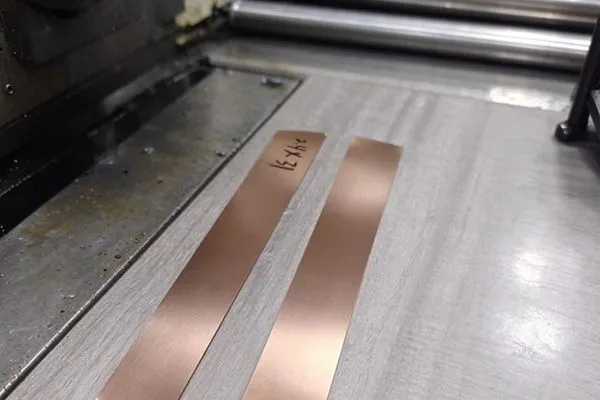
The strip is then rolled cold to make it the proper gauge and to work harden it to make it stronger. Cold worked temper TD01–TD04 can be up to 550–830 MPa and HV 180–240 . The rolled C17200 beryllium copper strip is available in widths from 0.05 mm to 2.5 mm, 0.002 in. to 0.098 in. ±0.005 mm tolerance. Strip 0.15 mm or greater can be supplied. The gauge is critical to control since a minor variation in thickness can shift the spring force in a bending contact. Tension levelling leaves the strip flat, straight and free of curvature so it feeds readily through high-speed presses.
Age Hardening Builds the Final Spring Strength
Ageing is the finest way to get stronger. At a certain temperature, the alloy generates tiny beryllium-rich particles that prevent the movement of dislocations. In the TF00 state, the C17200 beryllium copper strip has a strength of 1,140–1,380 MPa, a hardness of 36–42 HRC, and an IACS conductivity of 22–28 %. Because beryllium departs the copper lattice, conductivity rises above that achieved after annealing the metal. Customers can age stamp parts themselves and our research shows this can achieve TF00 strength without affecting the geometry of the parts. That’s the direction most spring contacts and precision connectors follow. Follow the directions in ASTM B194 for heat treating and check the results on your own pieces.
Why Aging Control Matters
The strength of strip that is under-aged is not fully developed, and the hardness and conductivity of strip that is over-aged change. What happens depends on the furnace temperature, the soak time, and the size of the load. For each aged lot, check the hardness and conductivity. Tests of tensile strength to ASTM E8 back up the numbers. Mill-hardened tempers come ready to stamp, so you don't have to do this step. With that option, you skip the furnace stage and the risk of distortion that comes with it. However, you lose some freedom in how you shape the metal. You should be able to find a cycle for every lot of C17200 beryllium copper strip that you age.
C17200 Beryllium Copper Strip Temper Types and Spring Properties
Choosing Among TB00, TD, TF00, and TM Tempers
The temper codes decide how the C17200 beryllium copper strip works in the die and in real life. Well, these are the main rules.
- TB00: Solution annealed and soft: 410–550 MPa, HV 110–140, and 15–19% IACS. Choose it for deep drawing and complex bends when you plan to age parts yourself after stamping. It gives the most forming freedom. Keep the code TB00 on every drawing and order so nobody confuses it with an H temper.
- TD01–TD04 and TF00: TD01–TD04 are cold-worked tempers at 550–830 MPa and HV 180–240. TF00 is the age-hardened condition, reached when the customer ages parts, at 1,140–1,380 MPa and HRC 36–42. Do not call an aged temper an H temper on paperwork: in ASTM naming, H means work hardening, while aging uses codes such as AT.
- TM00–TM08: Mill-hardened at the factory, 720–1,250 MPa, HV 225–380, and 22–28% IACS. These tempers arrive ready to stamp, so parts need no post-forming heat treatment. Harder grades such as TM06 and TM08 need larger bend radii to avoid cracking. List the exact TM code on drawings, since each step shifts strength and forming limits.
The first step in a clean die trial is to match the code to your forming sequence.
Mill-Hardened Strip or Age Hardening After Stamping
There are two ways to get to a part with springs. The TB00 route has you stamp soft strip, then age the parts to TF00, which gives them the most strength (1,140–1,380 MPa). When TM-temper C17200 beryllium copper strip is mill-hardened, it already has up to 1,250 MPa built in. You skip the furnace step, cut down on lead time, and avoid distortion from heat treatment. When geometry is complicated and peak strength is important, choose TB00. When stronger material can be bent and there aren't many steps to the process, choose a TM temper. The chemistry of the alloy is the same for both routes.
Properties That Shape Spring Design
The most common way to figure out the spring for C17200 beryllium copper strip is to use four values. Elastic modulus is 131 GPa, which is about 19 million psi, and it makes stamped parts consistently spring back. The yield strength tells you how far a contact can bend before it sets permanently. When used in warm conditions, stress relaxation is important. At 150°C (302°F), the alloy keeps more than 90% of its original contact force for 1,000 hours. At 10^7 cycles, fatigue strength reaches 300 MPa. It can transfer 105 W/m·K of heat, which helps move heat away from contact points when the metal is aged and mill-hardened. Make sure you check your part's plating, humidity, and salt exposure as well.
C17200 Beryllium Copper Strip vs. Alternatives and Quality Factors
Against Phosphor Bronze and C17500
A common spring material is phosphor bronze, but C17200 beryllium copper strip has higher spring strength, which lets it have thinner sections and better resistance to permanent set. Even at 150°C, most common copper alloys can't match its resistance to stress relaxation. We also sell C17500 and C17510. C17500 (CuCo2Be) is used when thermal performance or conductivity are more important than peak strength. Strip and sheet are also not the same. For continuous stamping, strip comes in coils with tight width and gage control. Sheet and plate, on the other hand, are better for machined parts. Check the certified properties, how easy it is to shape, how much plating it needs, and the total cost, not just the alloy name.
Slitting, Flatness, and Burr Control
The first thing your press sees is the border of the strip. The C17200 beryllium copper strip was cut with the width tolerance of 0.05 mm, which was able to be quickly and automatically stamped. Edges are smooth with few burrs keeping the faces secure and feeding steady. The annealed surface is smooth, lustrous and free from rust, scratches and roll marks. Tension levelling maintains a flat, straight, no-camber condition so continuous feeds don't get hung up. You can select a width between 5 mm and 400 mm, which is around 0.2 in to 15.7 in. Custom precision slitting is also available. For each RFQ you should specify the tolerance, edge condition and coil size.
Inspection, Documentation, and Safe Handling
Each batch of C17200 beryllium copper strip is checked three times. Incoming chemistry is checked by ICP-OES and the beryllium level is controlled between 1.80% and 2.00%. As the process progresses, we monitor rolling temperature and pressure and test hardness and microstructure for each batch. Final inspection comprises OES chemistry, Rockwell or Vickers hardness, tensile testing under ASTM E8, dimensions, and a glance at the full surface. All shipments have an EN 10204 3.1 mill test certificate. Our safety system is certified according to ISO 9001:2015 and our products meet RoHS and REACH. Solid strip is not hazardous. Take safety measures only when grinding, machining or welding creates dust or fumes.
How to Specify, Select, and Buy C17200 Beryllium Copper Strip
What a Complete RFQ Includes
A fully fleshed out RFQ for C17200 beryllium copper strip cuts down on the back and forth. Alloy, standard (such as ASTM B194, AMS 4530/4532, or SAE J461), temper code, thickness, width, slitting tolerance, surface condition, coil size and packing. Just include the required documentation like EN 10204 3.1 certificate, conductivity and mechanical goals. The price per kilogram is affected by the cost of the alloy, volume, temper, tolerance, slitting, packaging, goods, tariffs and Incoterms. We may quote CIF, FOB or DDP, and we ship by sea, air or international express. Stock products ship in 3-5 days. Custom orders arrive in 15-20 days.
A Five-Step Selection Process
Do things in a simple order. First, write down what the finished part needs in terms of force, deflection, a permanent limit, cycle life, temperature, and bend radius. Second, choose a temper that is strong enough to shape but not too strong. Third, decide what the acceptable levels of strength, hardness, conductivity, thickness, and flatness are. Fourth, do sample tests that include bending, springback, contact force, fatigue, and stress relaxation. Fifth, once the order has been approved, hold on to lot traceability, incoming inspection, and change control. When you choose this way to select the C17200 beryllium copper strip, the die trial answers real questions instead of making new ones.
Mistakes to Avoid
Four mistakes happen a lot. People choose the hardest option without checking the bend radius. Only the price per kilogram is used to compare suppliers; scrap, die wear, and rework are not taken into account. On the order, they only write "C17200 beryllium copper strip" and don't say anything about the temper, tolerance, surface condition, or test method. Also, the names of the tempers are mixed up between ASTM and supplier systems, which can cause the wrong batch to be sent to the line. Compare test results from the same method because they change depending on the direction of the sample and how it has been heated in the past. It takes time to try out new materials after a die has been built around one strip.
Conclusion
Solution heating, cold rolling, and controlled age hardening make C17200 beryllium copper strip very strong in a springy way. When TB00 strip is annealed, it's easy to shape. Aging TF00 increases its tensile strength to 1,140–1,380 MPa with 22–28% IACS conductivity. And mill-hardened TM tempers give them up to 1,250 MPa without the need for a post-forming furnace step. The 131 GPa modulus, stress relaxation resistance at 150°C, and fatigue strength are also used to design springs. As much as strength does, slitting tolerance, flatness, burr control, and batch documentation all have an effect on the results of stamping. There are times when the easiest condition is the best one. Temper is the right amount of heat, force, conductivity, and bend radius for the finished part.
FAQ
1. Why does precipitation hardening give C17200 beryllium copper strip high spring strength?
During solution annealing, beryllium breaks down into copper. Then, as things age, fine precipitates form that stop the dislocations from moving. The TF00 condition has an IACS conductivity of 22–28% and a tensile strength of 1,140–1,380 MPa.
2. What is the difference between TB00, TF00, and TM tempers?
TB00 has been solution-annealed and is easy to shape. After stamping, the customer is in TF00, which is the age-hardened state. This means that stamped parts made from TM00–TM08 don't need any more heat treatment.
3. How does C17200 compare with phosphor bronze?
The higher spring strength of C17200 allows for thinner sections and better resistance to permanent set. Its stress relaxation resistance at 150°C is also higher than that of most common copper alloys. Check them both out on your real part with real load and temperature.
4. What details do you need for an accurate quote?
Feel free to send the alloy, standard, temper, thickness, width, slitting tolerance, quantity, use, and delivery terms. We answer within two hours.
Request a C17200 Beryllium Copper Strip Quotation from JYDS
JYDS has been making C17200 beryllium copper strips for more than 25 years and has more than 500 tons of raw materials and standard profiles in stock. They can ship stock within 3–5 days. Our team will get back to you within two hours if you send your temper, thickness, width, and quantity to js01@jstongcai.com.cn. Becualloy.com has more information about the specs.
References
1. ASTM B194 Standard Specification for Copper-Beryllium Alloy Plate, Sheet, Strip, and Rolled Bar, ASTM International, 2015
2. ASM Handbook, Volume 2: Properties and Selection: Nonferrous Alloys and Special-Purpose Materials, ASM International, 1990
3. Copper and Copper Alloys (ASM Specialty Handbook), ASM International, 2001
4. Electrical Contacts: Principles and Applications, Second Edition, CRC Press, 2014
5. ASTM E8/E8M Standard Test Methods for Tension Testing of Metallic Materials, ASTM International, 2022
6. EN 10204 Metallic Products: Types of Inspection Documents, European Committee for Standardization, 2004
Online Message