
Nov 9, 2026
What Is CuCo2Be Plate Used for in Industrial Tooling?
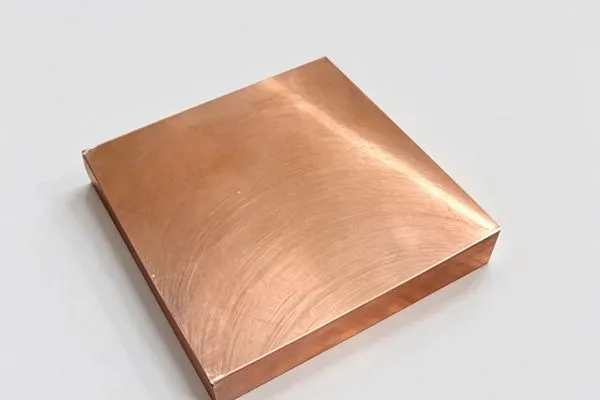
CuCo2Be plate — also registered as UNS C17500, DIN 2.1285, or EN CW104C — is a cobalt-beryllium copper alloy plate used across resistance welding, plastic injection molding, and heavy-duty electrical engineering. It delivers 45–60% IACS electrical conductivity and 200–240 W/m·K thermal conductivity, while holding RWMA Class 3 hardness (92–100 HRB) at service temperatures up to 550 °C. For electrode manufacturers and tooling shops that need both conductivity and wear resistance in a single material, CuCo2Be plate fills that gap better than most alternatives.
Understanding CuCo2Be Plate: Composition and Properties
Getting the chemistry right is what separates a long-running electrode from one that mushrooms after 500 weld cycles. CuCo2Be plate achieves its performance through a tightly controlled precipitation-hardened matrix.
Chemical Composition
Per ASTM B534 and EN CW104C specifications, CuCo2Be plate contains 2.40–2.70% cobalt, 0.40–0.70% beryllium, with copper making up the balance. This narrow compositional window is not accidental — cobalt replaces some beryllium relative to C17200, which is why conductivity rises sharply while hardness remains sufficient for tooling duty.
Mechanical and Thermal Properties
In the solution heat-treated and age-hardened condition (TF00/AT), CuCo2Be plate reaches tensile strength of 690–900 MPa, yield strength of 550–750 MPa, and hardness of 92–100 HRB. Thermal conductivity sits at 200–240 W/m·K. That combination is what electrode manufacturers need when their downstream customer runs a galvanized steel welding line and demands measurable electrode life data.
Regulatory and Sustainability Profile
CuCo2Be plate complies with RoHS and REACH environmental regulations. Each batch ships with an EN 10204 3.1 Mill Test Certificate (MTC) confirming chemical composition, hardness, and conductivity values — the document your technical director needs before signing off on a new material source. The solid alloy form does not generate beryllium dust during standard handling, though grinding and machining require proper ventilation controls per occupational safety guidelines.
Core Industrial Applications of CuCo2Be Plate
Because of its unique properties, the metal can be used in three clear places. Every one has different needs for the material, and Cuco2be plate meets all three without any problems.
Resistance Welding Electrodes and Dies
As of now, this is the most common way that Cuco2be plate is used in manufacturing. This type is used to make electrode caps, electrode shanks, seam welding wheels, and flash welding jaws. Both the RWMA Bulletin 16 and the AWS J1.3 list Class 3 materials that can be used for high-conductivity electrode service. With its softening temperature of 500–550 °C, Cuco2be plate meets the Class 3 floor (≥45% IACS, ≥90 HRB) with extra room to spare. This means that the electrode face keeps its shape through thousands of weld cycles on coated steel, which directly lowers the frequency of dressing.
Plastic Injection Mold Inserts and Blow Molding Components
The Cuco2be plate is cut by mold shops into core inserts, pinch-off blades for blow molding, core pins, and hot runner parts. The reason is that heat moves around easily. Cycle time goes down when a mold insert moves heat away from the part more quickly. Cuco2be plate removes heat about four times faster than P20 tool steel, at 200+ W/m·K. This means that the cooling phase is shorter and more parts can be made per shift. The 92–100 HRB hardness of the material also means that it doesn't wear down at parting lines like softer copper alloys do, which can cause galling problems.
High-Current Electrical Components
Busbars, platens, switchgear contact blocks, and current-carrying clamps in high-cycle electrical equipment are all made from Cuco2be plate. At 45–60% IACS, it moves current with a lot less resistive heating than most structural copper alloys. It also keeps its conductivity even after long periods of thermal cycling, which is something that lower cobalt grades can't consistently do.
CuCo2Be Plate Compared to Other Materials in Industrial Tooling
Honest comparisons are needed to make decisions about what to buy. This is how the Cuco2be plate fits next to the two alloys it tends to replace.
CuCo2Be Plate vs. C17200 (CuBe2)
The peak hardness of C17200 is higher (up to 40+ HRC in strip form), but it comes at a cost: it's usually only 22–28% IACS. The C17200 electrode gets too hot when used for resistance welding, where it needs to carry current and not bend. Cuco2be plate loses a few HRB points but almost doubles the conductivity. This keeps the electrode face cooler and makes galvanized and coated parts last longer.
CuCo2Be Plate vs. Chromium Zirconium Copper (CuCrZr / C18150)
A lot of people use CuCrZr for RWMA Class 2 electrode duty, and it costs less per kilogram. It conducts electricity better than Cuco2be plate (75–80% IACS), but it is not as hard (75–82 HRB) and doesn't soften at higher temperatures (400–450 °C). CuCrZr electrodes grow bigger faster on spot welders with a lot of force or when welding zinc-coated steel with a long contact time. In those conditions, the Cuco2be plate stays on its face longer, which cuts down on the number of cleaning rounds needed for each production run.
CuCo2Be Plate vs. Beryllium-Free Alternatives
C18000 (CuNiSiCr) is the better choice when downstream customers have a zero-beryllium policy. In the 80–85 HRB range, C18000 reaches 45–50% IACS, which is close to Class 3 but not quite as hard as Cuco2be plate's hardness ceiling. If electrode makers are selling to OEMs that have beryllium restrictions, it makes more business sense to keep both types in stock than to switch them out everyplace.
Procurement Guide for CuCo2Be Plates: What B2B Buyers Need to Know
When ordering a lot of Cuco2be plates, you need to pay attention to four real issues that are usually only fixed after the first batch runs into problems.
Certifications and Batch Traceability
An EN 10204 3.1 MTC should be included with every shipment. It should show the chemical composition, hardness test results (ASTM E18), tensile data, and eddy-current conductivity readings. The material can't be confirmed as RWMA Class 3 if the seller can't provide batch-level certificates that show both the hardness and IACS values. This is something that will come up in your customer's incoming review. Every time JYDS orders a Cuco2be plate, they send full 3.1 MTCs with it. These include chemical, mechanical, and electrical test data.
Size Range and Cut-to-Size Capability
JYDS sells standard Cuco2be plate with thicknesses ranging from 10 mm to 200 mm. You can have the width and length cut to your exact specifications or ground to a fine surface. Manufacturers of electrodes usually use mid-plates that are 10–40 mm thick and are cut to the size of the electrode blank. When you order custom widths, you don't have to worry about the extra scrap that comes with buying stock that is too big, which is important when the material costs more per kilogram than structural steel.
Lead Time and Stock Availability
JYDS has more than 500 tons of stock in C17200, CuCo2Be, and C17510 beryllium copper alloy. It takes 3–5 business days to ship stock Cuco2be plates. It takes 15–20 days for custom sizes or non-standard temper conditions (TH04 vs. TF00). The three to five day dispatch window is important for electrode shops that get emergency orders from auto welding lines because a stopped production line at a car plant costs a lot every minute.
Customs and Shipping
JYDS is close to the foreign ports of Shenzhen and Hong Kong. All Cuco2be plates are shipped in packing that meets export standards for keeping out moisture and rust. Shipping terms that are easy to change include CIF, FOB, and DDP by sea freight, air freight, or fast services like DHL, FedEx, and UPS. Along with the MTC, JYDS offers the full compliance declaration package for European electrode makers who need to meet the standards for RoHS and REACH import paperwork.
Why Choose CuCo2Be Plate for Your Industrial Tooling Needs?
The short answer is that Cuco2be plate's performance falls in a certain range that no other option fully covers. It gives companies that make electrodes a material that meets RWMA Class 3 requirements for both hardness and conductivity, not just one. This material also stays stable over hundreds of thermal cycles.
Here are the performance indicators that have been checked and back up that position:
- Electrical conductivity: 45–60% IACS, confirmed per-batch by eddy-current testing and reported on the MTC.
- Hardness after aging: 92–100 HRB, per ASTM E18, with TF00 and TH04 temper consistency controlled at the melt stage.
- Softening temperature: 500–550 °C, which extends electrode face life on galvanized steel lines compared to CuCrZr.
- Tensile strength: 690–900 MPa, sufficient for the clamping forces applied in flash welding and projection welding fixtures.
- Thermal conductivity: 200–240 W/m·K, which keeps the electrode shank and holder cool enough to reduce fixture distortion on high-cycle lines.
Conclusion
Because it solves a real problem, Cuco2be plate is used in industrial tools. Most high-conductivity copper alloys are too soft for heavy electrode or die duty, and most hard copper alloys don't conduct well enough. With 45–60% IACS conductivity, 92–100 HRB hardness, and a softening barrier near 550 °C, this metal fills that gap. All of these properties can be checked on an EN 10204 3.1 MTC. The ability to track purchases made in line with RWMA Class 3 or AWS J1.3 standards is required and cannot be skipped by buying teams. When both your technical director and buying manager need to say "yes," the easy way to move forward is to find a certified Cuco2be plate provider with stock on hand and data at the batch level.
FAQ
1.How does CuCo2Be plate differ from C17200?
C17200 reaches higher peak hardness but delivers only 22–28% IACS conductivity. CuCo2Be plate (C17500) provides 45–60% IACS at 92–100 HRB — better suited for resistance welding and heat-transfer tooling where conductivity matters as much as hardness.
2.Can CuCo2Be plate be machined in the aged condition?
Yes. In the TF00 or TH04 temper, it machines well with carbide tooling. The hardness is consistent enough to hold tight tolerances without the unpredictable work-hardening that softer copper alloys produce during CNC operations.
3.Does CuCo2Be plate comply with RoHS and REACH?
Yes. The solid alloy plate form is classified as safe for standard industrial handling. Grinding and dry machining require ventilation controls under occupational beryllium exposure regulations (EU CMD Annex III binding limit: 0.0002 mg/m³). JYDS provides a full Safety Data Sheet (SDS) and compliance declaration with each order.
4.What is the maximum operating temperature?
CuCo2Be plate maintains its mechanical properties up to approximately 500–550 °C before over-aging and softening begin. This is notably higher than CuCrZr (CuCrZr softens around 400–450 °C), which is why it is preferred for high-duty-cycle welding applications.
5.What certifications does each batch carry?
Every batch of CuCo2Be plate from JYDS ships with an EN 10204 3.1 Mill Test Certificate covering OES chemical analysis, ASTM E18 hardness, tensile data, and eddy-current conductivity readings. ISO 9001:2015 factory certification applies to all production.
Get a Quote from JYDS — Trusted CuCo2Be Plate Supplier
For more than 25 years, JYDS has sold Cuco2be plate to metalworking shops and companies that make electrodes on four continents. Over 500 tons are in stock, all of them have EN 10204 3.1 MTCs, and standard sizes can be sent out in 3–5 days. This means we can keep your production line moving. To get a cut-to-size quote and sample for inbound inspection, please email our technology team at js01@jstongcai.com.cn.
References
-
American Welding Society. AWS J1.3: Specification for Materials Used in Resistance Welding Electrodes and Tooling. AWS, 2016.
-
Resistance Welder Manufacturers' Association. RWMA Bulletin 16: Resistance Welding Equipment Standards. RWMA, 2014.
-
ASTM International. ASTM B534: Standard Specification for Copper-Cobalt-Beryllium Alloy Plate, Sheet, Strip, and Rolled Bar. ASTM International, 2020.
-
European Committee for Standardization. EN ISO 5182: Materials for Resistance Welding — Electrodes and Ancillary Equipment. CEN, 2008.
-
Copper Development Association. Beryllium Copper Alloys: Properties, Processing and Applications. CDA Publication TN44, 2018.
-
Davis, J.R. (ed.). Copper and Copper Alloys. ASM International, 2001.
Online Message