
Nov 10, 2026
Why Choose CuCo2Be Plate for Resistance Welding Dies?
If you manufacture resistance welding electrodes or welding fixture components, you already know that material selection directly determines electrode lifespan, weld consistency, and your customers' line uptime. The CuCo2Be plate — standardized as DIN 2.1285 / EN CW104C / UNS C17500 / RWMA Class 3 — sits at a specific performance point that neither chromium-zirconium copper nor high-beryllium C17200 can fully match. It delivers ≥45% IACS electrical conductivity alongside 92–100 HRB hardness in the aged condition, meeting both thresholds that RWMA Bulletin 16 and AWS J1.3 set for Class 3 electrode materials. This article explains why CuCo2Be plate earns that position and how to source it correctly.
Understanding CuCo2Be Plate: Composition, Properties, and Manufacturing Process
Chemical Composition and Metallurgical Logic
The balance of the plate of Cuco2be is copper. The plate contains from 2.40 to 2.70 percent cobalt and from 0.40 to 0.7 percent beryllium. A cobalt-beryllium precipitate arises as metals age and it binds the grain boundaries better than the chromium precipitates in CuCr1Zr. That is why this alloy does not soften at a temperature that makes CuCr1Zr electrodes sprout mushrooms. Precipitation hardening is controlled by ASTM B534 and ISO 5182. This allows engineers to know how the material will behave every time.
Mechanical and Electrical Properties After Aging
The CuCo2Be plate after solution heat treatment and ageing has a tensile strength of 690–900 MPa, a yield strength of **550–690 MPa** and a hardness of 92–100 HRB (approximately 195–275 HV). The thermal conductivity is 200-240 W/m-K and the electrical conductivity is 45-60% IACS. These figures are the bare minimum for Class 3 with enough space to spare. This allows your electrodes to operate cooler and hold their form for longer during production weld cycles.
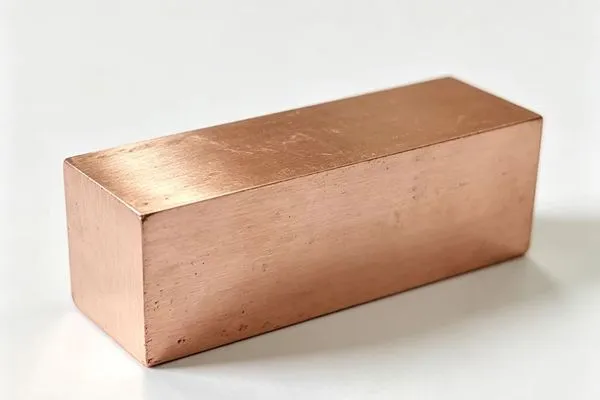
Quality Control at the Production Stage
Each batch of responsible Cuco2be plates is checked by Optical Emission Spectroscopy (OES) for amounts of beryllium and cobalt, ASTM E18 Rockwell hardness testing, eddy current conductivity measurement, and ultrasonic inspection (UT) for inclusions inside the plate. The study of grain size confirms the uniformity of the microstructure, which has a direct impact on how well the material can be machined and how long it will last under repeated thermal loading. Not just one or the other, but both should be written on the EN 10204 3.1 Mill Test Certificate (MTC) that goes with each batch.
Superior Performance of CuCo2Be Plate in Resistance Welding Dies
Electrode Lifespan and Mushrooming Resistance
People on your production floor are most upset about mushrooming as a failure mode. For a long time, the heat and pressure from the weld cause the electrode face to soften. The CuCo2Be plate stays hard up to approximately 500 °C, which is roughly 25–50 °C higher** than the softening resistance threshold of standard CuCr1Zr. In welding lines for car body-in-white galvanized steel, where electrode tip temperatures regularly rise above 400 °C per weld cycle, this difference means that there are fewer tip covers and longer periods of time between electrode changes.
Thermal and Electrical Stability Under Cyclic Load
Resistance welding uses heat that goes back and forth. When you weld, the electrode face gets hot and cool. Weld parameter drift happens when materials lose their ability to carry electricity as the temperature rises. This means that the current supply changes, spot nugget size changes, and the quality of the weld is hard to predict. As long as the operating temperature of the Cuco2be plate stays between 45 and 60% IACS, your welding parameters will stay the same from the first weld of a shift to the last. When car tier-one welding experts write material requirements into their electrode purchasing standards, they make sure that the electrodes are stable in this way.
Wear Performance on Zinc-Coated and High-Strength Steel
Because brass alloy forms at the contact face when welding zinc-coated steel, the electrode tips are put through a lot of stress. The cobalt-beryllium precipitate structure in Cuco2be plate is stronger against this alloying reaction than softer copper alloys. This makes tip face contamination happen more slowly. According to studies on resistance welding electrode wear (Gedeon & Eagar, 1986; AWS J1.3), harder, higher-conductivity electrodes always last longer than softer ones on coated steel surfaces.
Comparing CuCo2Be Plate with Alternative Metals for Welding Dies
CuCo2Be Plate vs. CuCr1Zr (RWMA Class 2)
CuCr1Zr (Class 2) is the most common type of resistance metal used for welding. It is a good conductor (≥75% IACS), but it is not very hard (usually 75–85 HRB old) and softens at temperatures around 450–475 °C. To fix electrode tips that soften and grow too soon on your customer's welded or dual-phase steel lines, most of the time you need to switch from Class 2 to Class 3. The Cuco2be plate fills that need. It gives up some conductivity compared to CuCr1Zr but gets about 8–15 HRB points harder and about 25–50 °C better at resisting softening.
CuCo2Be Plate vs. High-Strength C17200 (BeCu2)
The hardest that C17200 can be is 40–44 HRC, which is about 38–42 HRC in real life. However, it typically provides only around 22% IACS electrical conductivity. Because it doesn't carry electricity well, it takes more current to give the same weld energy. This makes the electrode face hotter, which is a problem for tight pitch spot weld schedules. At 45–60% IACS, the Cuco2be plate has almost twice the conductivity of C17200. This means that the electrodes can work at lower temperatures, there is less heat buildup at the secondary of the weld transformer, and the weld nuggets are more consistent.
CuCo2Be Plate vs. Brass Alloys
Because they are too weak for direct weld face contact (15–26% IACS) and don't carry electricity well, brass alloys like CuZn39Pb3 and CuZn40Pb2 are only used for electrode holders and fittings and not for the electrode faces. This comparison is important for electrode makers who buy a lot of different metals at the same time. Knowing where Cuco2be plate fits in relation to fixture-grade brass keeps expensive specification mistakes from happening.
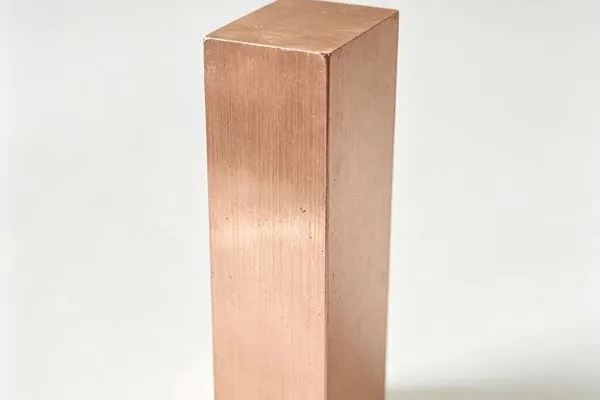
Procurement Guide: How to Source Quality CuCo2Be Plates for Your Welding Needs
To find the right Cuco2be plate, you need to do more than just find the cheapest price per kilogram. The points below show what experienced electrode makers check before a customer places an order.
Here are the main procurement checkpoints that will keep your production schedule and the quality of your welds safe:
- Batch-level MTC with conductivity and hardness data: The EN 10204 3.1 certificate must show both % IACS conductivity and HRB hardness for each heat. A certificate showing only hardness does not confirm Class 3 compliance. Suppliers who cannot produce this document have likely not tested conductivity independently.
- Temper consistency between TF00 and TH04 designations: Hardness scatter between plates in the same order causes inconsistent tip-dress cycles. Specify your required temper condition explicitly and ask for the hardness range across the batch, not just a single sample result.
- Plate thickness and width availability for your electrode blank sizes: CuCo2Be plate used for electrode caps, electrode shanks, and current-carrying blocks typically runs 10–40 mm thick. Confirm that the supplier stocks or saws to this range with precision ground surfaces, and ask about the surface flatness tolerance on larger plates.
- RoHS, REACH, and conflict minerals declarations: If your electrode customers are European automotive OEMs, they will request these documents. A CuCo2Be plate supplier with ISO 9001:2015 certification and RoHS compliance documentation saves you time during their supplier qualification audits.
- Stock availability and dispatch lead time: For electrode manufacturers who accept short-notice customer orders, a supplier carrying 500+ tons of stock with a 3–5 day dispatch commitment is a genuine operational asset, not just a marketing claim.
These ways of buying cut down on differences between batches and give your technical director and purchasing team the proof they need to approve a supplier.
Maximizing ROI: Application Best Practices and Future Trends
Correct Heat Treatment State Verification
The age-hardened Cuco2be plate has to be in the TF00/AT state that was given. If a plate hasn't been aged long enough, its hardness will be less than 92–100 HRB, and electrode blanks made from it won't work right when they're used. Ask the provider for records of the aging time and temperature, and then plan to compare the arriving hardness checks on a sample basis with the MTC values.
Efficient Blank Cutting to Reduce Material Waste
The Cuco2be plate, which is charged by weight, awards careful nesting. Sawn-to-size ordering, in which the supplier cuts plates to the size of your electrode blank before shipping, cuts down on waste and makes it easier to machine the parts in-house. When you buy from suppliers who offer water jet or precision band saw cutting to drawing dimensions and positive tolerance control per EN 12163, you can go straight from receiving stock to CNC turning without having to do any primary cutting.
Alignment with Emerging Welding Technology Requirements
More and more car body parts are being made from advanced high-strength steels (AHSS) and press-hardened steels. These materials need higher electrode face pressures and Class 3 electrodes' higher hardness often helps them. As projects to make cars lighter increase the amount of AHSS used, the need for Cuco2be plates in the production of electrodes is likely to rise. This means that building relationships with suppliers now is strategically useful.
Conclusion
The Cuco2be plate has a place in the manufacturing of resistance welding electrodes because it solves a clear and measurable issue: electrodes that expand and become soft too quickly on tough welding lines for cars and appliances. It has 45–60% IACS conductivity, 92–100 HRB aged hardness, and a softening resistance up to 500 °C. This makes it a material that meets both the needs of the technical director for Class 3 specifications and the needs of the production floor for consistent tip geometry. It's important to get it from the right place. A reliable supply chain has batch-level EN 10204 3.1 MTCs that show both conductivity and hardness, confirmed temper condition, and a supplier that can ship from stock in 3–5 days.
FAQ
1.How does CuCo2Be plate differ from C17200 beryllium copper?
C17200 prioritizes hardness over conductivity, reaching 22–28% IACS. CuCo2Be plate (C17500) delivers 45–60% IACS, making it the correct choice where heat extraction from the electrode face matters. For resistance welding dies, the higher conductivity of CuCo2Be plate directly reduces operating temperature and extends tip life.
2.What does RWMA Class 3 actually require?
RWMA Bulletin 16 sets minimum thresholds of ≥45% IACS electrical conductivity and ≥90 HRB hardness in the aged condition. The current formal specification is AWS J1.3. Both conductivity and hardness must be met simultaneously — hardness alone does not confirm Class 3 compliance.
3.Does the solid CuCo2Be plate pose a handling safety risk?
In solid plate or bar form, CuCo2Be presents no beryllium inhalation risk during routine handling. Risk arises only during dry grinding or machining without controls. Suppliers should provide a current Safety Data Sheet (SDS) and written guidance confirming safe handling protocols for solid stock.
4.What plate thicknesses are standard for electrode manufacturing?
Most electrode caps, shanks, and current-carrying blocks are cut from 10–40 mm thick plates. Reputable CuCo2Be plate suppliers stock or saw this range with precision ground surfaces and can supply custom widths and lengths per drawing.
5.How quickly can stock CuCo2Be plate be dispatched?
Suppliers maintaining 500+ tons of standing stock can typically dispatch standard sizes within 3–5 business days. Custom sawn sizes generally ship within 15–20 days. Confirm this capability directly before placing an order tied to a customer deadline.
Partner with JYDS for Certified CuCo2Be Plate Supply
JYDS has been making beryllium copper alloys for more than 25 years and can help electrode manufacturers who need a reliable CuCo2Be plate supplier. We have our own vacuum induction melting plant where we control the metal chemistry from the raw melt. Each batch ships with a full EN 10204 3.1 Mill Test Certificate that shows both conductivity and hardness according to ASTM B534 and RWMA Class 3 standards. Standard plates are sent out in 3–5 days because we keep more than 500 tons in stock. To get a quote or sample, email our technical team at js01@jstongcai.com.cn.
References
1. American Welding Society. AWS J1.3: Specification for Materials Used in Resistance Welding Electrodes and Tooling. AWS, 2016.
2. Resistance Welding Manufacturing Alliance. RWMA Bulletin 16: Resistance Welding Equipment Standards. RWMA, 2003.
3. Gedeon, S. A., & Eagar, T. W. “Resistance Spot Welding of Galvanized Steel: Part II. Mechanisms of Spot Weld Nugget Formation.” Metallurgical Transactions B, Vol. 17, No. 4, 1986, pp. 887–901.
4. ASTM International. ASTM B534: Standard Specification for Copper-Cobalt-Beryllium Alloy Plate and Strip. ASTM International, 2020.
5. European Committee for Standardization. EN ISO 5182: Resistance Welding — Materials for Electrodes and Ancillary Equipment. CEN, 2009.
6. Davis, J. R. (Ed.). Copper and Copper Alloys. ASM International, 2001.
Online Message