
Nov 9, 2026
CuBe2 Strip vs Phosphor Bronze: Which Spring Material Wins?
If you operate in the precision stamping business for connector terminals, relay blades or battery spring contacts, you know that material selection directly influences your die life, springback uniformity and line uptime. In genuine stamping situations, comparing both alloys, CuBe2 strip (UNS C17200 / EN CW101C) wins for applications where contact pressure stability, fatigue life and miniaturisation are the most critical. Phosphor bronze is used when cost is the main concern and thermal loads are modest. Continue reading for a detailed technical explanation.
Understanding Spring Material Basics: CuBe2 Strip and Phosphor Bronze
What Is CuBe2 Strip?
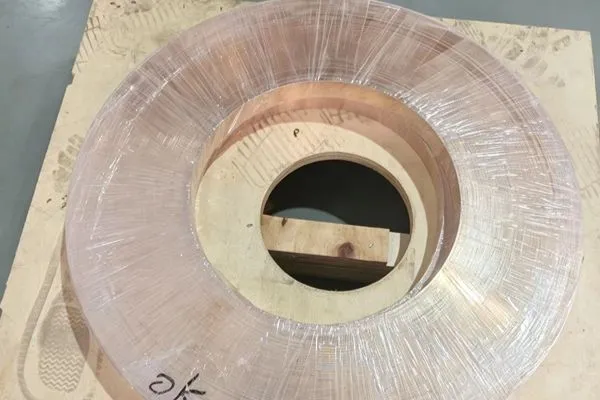
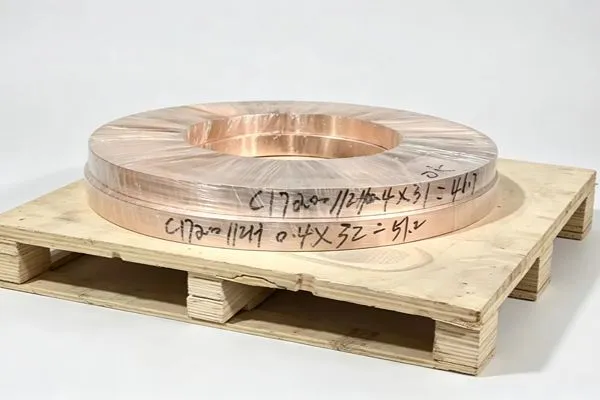
As per DIN EN 1654 standards, CuBe2 strip is a copper alloy that hardens through precipitation. It has 1.80 to 2.00% beryllium, Co+Ni ≥ 0.20%, and Co+Ni+Fe ≤ 0.60%.It gets tensile strength of 1,110–1,320 MPa and yield strength of 950–1,150 MPa over time, which are about the same as high-grade spring steels. It also stays electrically conductive at 22–25% IACS. Precision slit coil or cut strip is what it comes in, with thicknesses ranging from 0.05 mm to 3.0 mm and widths up to 300 mm. It can be annealed R200/TB00, cold-rolled R410, R510, or aged.
What Is Phosphor Bronze?
Phosphor bronze is made of copper, tin, and phosphorus. In common grades, there is 94–96% copper, 4–8% tin, and a small amount of phosphorus to make the grains smoother. It has a tensile strength of 500–900 MPa in strip form and an electrical conductivity of 10–20% IACS, based on the temper. For many years, it has been used to make switch blades, PCB contacts, and connector springs. This is mostly because the raw material is cheap, it doesn't rust, and it can be worked on regular pressing lines.
How Their Compositions Differ in Practice
The main difference between the two metals is the amount of beryllium in CuBe2 strip. When alloy is aged at about 315°C for two to three hours, beryllium crystals form a crystalline structure that makes the steel 36 to 42 HRC hard. Phosphor bronze only gets its spring temper through cold work; there is no precipitation reaction. This means that its ceiling is lower, and it loses its ability to hold up under long-term thermal and mechanical stress more quickly. This difference in metals has direct effects on production for stamping shops that use fine-pitch connector terminals and must keep die consistency from batch to batch.
Performance Comparison: CuBe2 Strip vs Phosphor Bronze
Tensile Strength and Spring Memory
When CuBe2 strip is age-hardened (aged), its tensile strength is 1,110–1,320 MPa and its yield strength is 950–1,150 MPa. When phosphorus bronze is in its spring state, it usually has a tensile strength of 700–900 MPa and a yield strength of 600–800 MPa. Only CuBe2 strip has the extra stretch that connection makers need to make cross-sections smaller without losing contact force. Because it has a higher yield-to-tensile ratio, it also doesn't set as strongly after being bent over and over again. This is what stamping engineers call "spring memory."
Stress Relaxation and Fatigue Resistance
In production, this is where the performance gap is most clear. Over a long period of time, CuBe2 strip keeps more than 90% of its initial contact stress at 150°C. Phosphor bronze starts to relax its stress after 100°C. This difference can mean the difference between a 10-year contact life and a 2-year warranty claim for relay blades and battery spring contacts that work in warm areas or under the hood of a car. CuBe2 strip also has better fatigue resistance when folding at high frequencies, which is important for microswitch blades that are supposed to last 10 million processes or more.
Edge Quality, Die Wear, and Maintenance Considerations
When compared to poorly slit material with burrs or thickness variations, precision slit CuBe2 strip with a tight thickness tolerance (±0.005 mm achievable) has less die wear. When buying CuBe2 strip, people should ask for EN 10204 3.1 Mill Test Certificates that show the chemical make-up and mechanical properties of each batch. One useful thing to know: CuBe2 strip stamping makes dust with beryllium in it, so the workshop needs to have good airflow and follow PPE rules. Along with the MTC, you should ask the seller for an SDS and a safe handling guide.
Procurement Decision Factors for B2B Buyers
Temper Code Accuracy and Standard Compliance
When buying things in Europe, teams need EN 1654 temper names like R200 (annealed/soft), R410 (quarter-hard), R510 (half-hard), and so on, to be exactly matched to their ASTM counterparts TB00, TD02, and TD04. If you get a data sheet with mechanical values that are not in the normal range or get these codes mixed up, your tooling parameters are set for the wrong material state. Before you approve a CuBe2 strip supplier, make sure that their MTC shows that the exact Be content is between 1.80 and 2.00%, the Co+Ni+Fe content is less than 0.50%, and the force values are within the DIN EN 1654 / ASTM B194 windows.
Supplier Reliability and Batch Consistency
Batch-to-batch hardness drift is a risk for stamping lines that make a lot of parts. Even a ±2 HRC difference in hardness between coils means that the die has to be readjusted, which takes time and money. A supplier quality control system certified to ISO 9001:2015 and the ability to track lots should be on the buying plan. Suppliers who do their own vacuum induction melting can control the purity of the metal from the melt stage on. This lowers the variation in makeup between production runs, which makes a big difference for shops that need to restock between 6 and 20 times a year.
MOQ, Lead Time, and Logistics
Stamping shops usually need 10–100 kg of test samples to make sure a new heat code works before agreeing to a monthly supply contract. Standard stock items can be shipped within 3–5 days from a source with 500 tons or more of stock. Custom slit widths or temper combinations, on the other hand, usually take 15–20 days. When coil material is exported, it needs to be protected from rust and moisture. This is especially important for sea freight transit times to the US, Mexico, or Southeast Asia. The qualification process is easier because shipping terms like FOB, CIF, and DDP are flexible, and small trial orders can be sent by express courier.
When to Choose CuBe2 Strip Over Phosphor Bronze: Use Case Scenarios
Connector Terminals and Relay Blades
That's the only way to get safe contact pressure in a smaller cross-section when connection designs get smaller than 2 mm pitch and the mating force specification stays the same. The material needs to have a yield strength of 950 MPa or more. CuBe2 strip in the R750–R1200 temper can be stamped right to the final shape without being aged first, which speeds up the production process. At the same thickness, phosphor bronze just can't hold the spring force over the needed range of deflection. Because of its fatigue endurance gap, CuBe2 strip is the standard way to make precision relay blades that can handle millions of switching cycles.
EV Battery Spring Contacts and High-Voltage Terminals
The 22–25% IACS plus 1,100 MPa combination of CuBe2 strip meets the needs of both high conductivity and high yield strength in new energy vehicle connector designs. When high current loads are put on phosphor bronze at 10–15% IACS, it makes more resistive heat, which raises the thermal risk in battery packs. IATF 16949 alignment, PPAP paperwork, and material change notification (PCN) procedures are also needed for automotive-grade buying. A approved CuBe2 strip provider should be able to support these features from the very first sample submission.
Aerospace and Industrial Sensor Applications
The non-magnetic permeability (<1.001) and spark-resistant properties of CuBe2 strip make it ideal for use in aircraft applications as EMI protection diaphragms, pressure sensor membranes, and ruggedized multi-pin connectors. Phosphor bronze doesn't have these qualities, and most aircraft connector standards don't say anything about them either. For industrial sensor springs that work in harsh chemical environments, the beryllium copper matrix is better at resisting corrosion than tin-phosphor bronze in damp or mildly acidic environments.
How to Maximize Value: Installation, Troubleshooting, and Maintenance Guide
Stamping and Forming Best Practices
CuBe2 strip in annealed condition (R200/TB00) provides the best formability for complex deep-draw geometries. For direct stamping without post-aging, cold-rolled tempers R410–R510 deliver ready-to-use spring properties while still accommodating moderate bending radii. Always confirm the minimum bend radius for the specific temper from the supplier's MTC before setting die clearance. Using annealed strip followed by batch aging at 315°C for 2–3 hours after forming allows the most complex geometries and the highest post-age strength.
Troubleshooting Common Stamping Issues
Springback inconsistency between coil lots is almost always traceable to hardness variation within the incoming material. Request hardness spot checks across coil width and length as an incoming inspection step. Burrs on slit edges that cause die scoring typically result from slit quality, not alloy hardness — specify edge burr height limits in your purchase order. If cracking occurs at tight bend radii in cold-rolled temper, switching to annealed CuBe2 strip and aging post-form resolves the issue in most cases.
Ongoing Maintenance and Shelf Life
CuBe2 strip coils stored in original export packaging — moisture-proof film with desiccant — maintain surface quality for 12–18 months without oxidation affecting solderability or plating adhesion. Avoid storing coils in direct contact with concrete floors, which can introduce moisture. For production lots with gold, nickel, or tin plating planned downstream, ensure that the beryllium oxide surface layer is properly activated before plating to achieve adequate adhesion. This is a standard process step; inform your plating shop that the substrate is beryllium copper.
Conclusion
When it comes to precision connection terminals, relay spring blades, battery contacts, and aircraft diaphragms, CuBe2 strip works better than the other material in terms of its strength-to-size ratio, contact stability, and long-term fatigue life. Phosphor bronze is still a good choice for low-stress, low-cost uses where the temperature doesn't go above 100°C. When stamping shops have customers further down the line who expect tight tolerances and long service lives, CuBe2 strip is the best material to protect both the quality of the product and the investment in the die.
FAQ
Q1: What is the chemical composition difference between CuBe2 and C17200 under ASTM B194?
In DIN EN 1654 for CuBe2 (CW101C), Be is set at 1.80–2.10%. As per ASTM B194 and B196, C17200 says that Be should be between 1.80% and 2.00%. The upper limit for beryllium is different in the two standards. For customers using the ASTM system, the limit is between 1.80 and 2.00% according to B194 and B196. The maximum for Co, Ni, and Fe is 0.60%, not 0.50%.
Q2: Can CuBe2 strip be stamped and aged after forming?
Yes. Annealed CuBe2 strip (R200/TB00) is stamped when it is soft and then age-hardened at about 315°C for two to three hours to reach its highest hardness of 36 to 42 HRC and tensile strength of 1,110 to 1,320 MPa. This two-step process works best for complicated shapes that can't handle the higher springback of tempers that have already been stiffened.
Q3: How does CuBe2 strip compare to phosphor bronze in stress relaxation?
At 150°C, CuBe2 strip keeps more than 90% of its original stress over a long period of time. When temperatures rise above 100°C, phosphor bronze starts to relax a lot. This means that it loses its contact force in warm working conditions. This difference is very important for car and industrial relay uses.
Q4: What safety documents should I request when ordering CuBe2 strip?
Ask for the EN 10204 3.1 Mill Test Certificate, the Safety Data Sheet (SDS), and a guide on how to safely handle beryllium. Beryllium dust that is made when grinding or pressing is known to be harmful to workers' health. OSHA rules say that the right technical controls and PPE must be used.
Q5: What are standard plating options for CuBe2 strip connectors?
CuBe2 strip can be used with nickel, gold, or tin finishing. Because beryllium copper forms a stable surface oxide layer that can hinder adhesion, the surface needs to be properly activated before plating to ensure a strong bond. Talk to your plating provider about the base material before you start production.
Request Your CuBe2 Strip Sample from JYDS Today
JYDS has been making beryllium copper for more than 25 years and currently has more than 500 tons of stock that ranges in thickness from 0.05 mm to 3.0 mm and in width from 0.05 mm to 300 mm in a number of different temper conditions. Every batch that ships comes with an EN 10204 3.1 MTC, a RoHS compliance declaration, and a way to track the whole lot. We can make and supply CuBe2 strips directly, and we can do trial amounts starting at 10 kg. We also answer all questions within 2 hours. You can email our team at js01@jstongcai.com.cn to get details and a price that fits your stamping needs.
References
1. Copper Development Association — Beryllium Copper Alloys, Copper Development Association, 2019.
2. ASTM B194: Standard Specification for Copper-Beryllium Alloy Plate, Sheet, Strip, and Rolled Bar, ASTM International, 2021.
3. DIN EN 1654: Copper and Copper Alloys — Strip for Springs and Connectors, European Committee for Standardization, 2020.
4. ASM Handbook, Volume 2: Properties and Selection: Nonferrous Alloys and Special-Purpose Materials, ASM International, 1990.
5. Materion Technical Tidbits: Stress Relaxation in Beryllium Copper Alloys, Materion Corporation, 2018.
6. Journal of Materials Engineering and Performance: Fatigue Behavior of Precipitation-Hardened Copper-Beryllium Alloys, Springer, 2017.
Online Message
YOU MAY LIKE