
Nov 26, 2026
C63000 Aluminum Bronze Plate vs C95400: Which Is Stronger?
Compare the minimums for casting and common wrought plate and you will find that C63000 aluminum bronze plate is stronger than std cast c95400. Here is how our C63000 aluminum bronze plate compares. Tensile Strength: 700–850 MPa (102–123 ksi); Yield Strength: 350–450 MPa (51–65 ksi) ASTM B148 indicates that C95400 has a lowest strength of 515 MPa when cast and 620 MPa when heated. C95400 is a solid choice for cast parts with many details, valves, pumps and lesser budgets. Please read this advice before placing your purchase to ensure you are selecting the proper grade for your drawing, load and certification needs.
C63000 Aluminum Bronze Plate Composition and Material Characteristics
C63000 vs C95400 at a Glance
Both grades are aluminium bronze, but are supplied to you in distinct forms. C63000 is a wrought nickel aluminium bronze (NAB) plate. C95400 is an aluminum bronze casting covered by ASTM B148. Chemistry is as significant as the difference. You can’t truly appreciate a strength number until you know what kind of shape, temper and thickness the product is. So I look at tensile strength, yield strength, hardness, wear resistance, corrosion resistance, certification, availability and delivered cost all at once. C63000 is ideal for difficult plate work such as rudder bearing parts and slideways, but C95400 is better for intricate cast housings, valves and pumps.
Chemistry: What Each Element Does
The C63000 aluminium bronze plate is an alloy of copper containing 9.0–11.0% aluminium, 4.0–5.5% nickel, a few percent iron, and up to 1.5% manganese. Aluminium strengthens things and generates a thin film of oxide that keeps water out. Nickel smooths the grain, cements the tiny particles, and improves resistance to corrosion and fatigue. Iron gives a smoother and stronger grain. C95400 likewise has an iron and aluminium base, however the nickel content is 1.5% or less. Please double-check that the designation CuAl10Ni5Fe4 corresponds to UNS C63000, EN CW307G and DIN 2.0966. It is not the same as EN CW306G, it is CuAl10Fe3Mn2. Therefore, I never use both names on the same drawing.
Why Wrought Plate and Castings Behave Differently
Because hot rolling fills in small holes and smooths out the grain, wrought plate tends to have more stable properties from one lot to the next. There are different types of pores, grain sizes, and section thickness that affect the finished part after it hardens in a mold. Heavy parts cool more slowly, so the middle and the outside can be different. This is well controlled by good foundries. Heating C95400 makes it stronger, but there is usually a bigger difference between castings. For thick plates, I tell buyers to ask for ultrasonic testing. Our inspection includes optical emission spectroscopy for chemistry, ASTM E2375 ultrasonic testing for inclusions and pores inside the material, mechanical testing, laser dimensional checks, and a review of the microstructure. An EN 10204 3.1 mill test certificate is sent with every shipment of C63000 aluminum bronze plate from JYDS.
C63000 Aluminum Bronze Plate vs C95400: Strength and Hardness Comparison
Tensile and Yield Strength
These are the numbers I use. In general, C63000 aluminum bronze plate has a tensile strength of 700–850 MPa and a yield strength of 350–450 MPa. The minimums for C95400 castings are given by ASTM B148. They are 515 MPa tensile and 205 MPa yield as cast, and 620 MPa tensile and 310 MPa yield after heat treatment. You should be careful reading this comparison because I'm putting average plate data next to casting minimums, and real castings often go above their floor. Still, the lowest point of the heat-treated C95400 is below the lowest point of the plate range, and the yield gap is bigger. That yield margin is important for slideways, mooring fittings, and bearing blocks. Always check the values on the lot certificate.
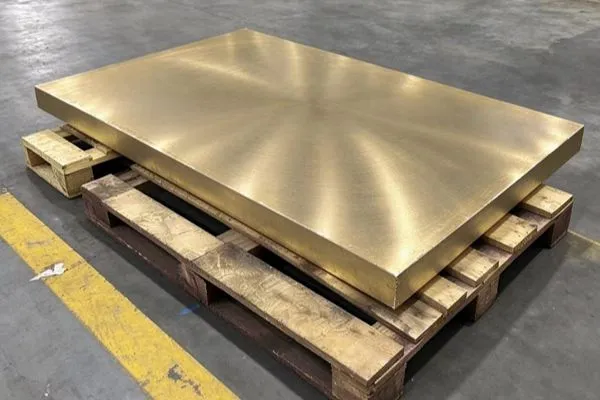
Hardness and Elongation
Our C63000 aluminum bronze plate has a range of 180 to 240 HB. Cast C95400 typically has a hardness of around 170 HB as cast, but that number goes up after heat treatment. The story of elongation is similar. Plate runs 12–18%, but ASTM B148 says that C95400 should be at least 12% as cast and at least 6% after heat treatment. This means that the extra strength comes at the cost of some flexibility. Hardness tells you about wear and machining effort, but not about how things will react to impact or fatigue. When they are hit with shock, two parts with the same hardness can react in different ways. If you need to recheck the hardness of your drawing, just let us know where and how the test was done, and we'll match it to the certificate.
Fatigue, Shock, and Lot Consistency
Strength at rest is not the whole story. Here are three good things about C63000 aluminum bronze plate when it comes to sudden or repeated loads.
- Corrosion fatigue: Nickel alloying improves corrosion fatigue resistance in seawater, where cyclic stress and salt attack work together. That gives your design engineer more margin on rudder bearings, slideways, and mooring parts that carry thousands of repeated load cycles while wet in salt water, something a static tensile number alone cannot show.
- Shock and galling resistance: The multiphase microstructure resists adhesive wear and galling under high contact pressure. Thrust washers, wear plates, and sliding surfaces suit it where standard bearing bronzes would score or deform. It also pairs well with steel mating parts, a classic match for heavy worm wheel blanks.
- Lot consistency: Rolled plate has a dense, uniform structure, and ultrasonic inspection checks thick sections for pores and inclusions. With a 3.1 certificate, you receive chemistry and mechanical results for that lot and can compare them against your drawing before machining starts, instead of relying on a published typical value.
The things that buyers worry about the most are fatigue cracks, scored surfaces, and differences between lots.
Corrosion Resistance and Wear Performance in Service
Seawater and Brackish Water
When aluminum bronzes are scratched, they change back into a thin, tightly bound film that is high in alumina. There is a link between this film and the alloy's phase structure and its low corrosion rate in nickel aluminum bronze in seawater, as shown in work in Corrosion Science. The C63000 aluminum bronze plate can stand up to seawater, brackish water, salt spray, and weak acids that don't oxidize. It also doesn't lose its zinc like brass does. C95400 also makes a film like this and can be used in salt water. Nickel is the main chemical difference, so before you decide, I suggest you look at service data for your water conditions. If the material hasn't been treated properly, dealuminification can still happen. That's why our microstructure check looks for networks with continuous alpha-phase, which make that attack easy.
Cavitation, Crevices, and Galvanic Contact
Copper alloys will be more rapidly destroyed by cavitation, fissures, filthy water, high flow rates and galvanic contact. The C63000 aluminium bronze plate is used for marine valve seats and pump wear plates because it resists erosion and bubbling in moving seawater. Ensure joints are open and drainable, since corrosion can still occur in gaps behind gaskets and bolt heads. Water polluted with sulphides can damage copper alloys. Check the chemistry of the water immediately. The galvanic contact is also of importance. Aluminium bronze is nobler than carbon steel in salt water therefore any steel part in contact with it will rust faster. For that pair consider insulation, coatings or sacrificial anodes.
Wear and Galling Behavior
Both alloys don't wear away easily or form galls. Contact pressure, sliding speed, lubrication, surface finish, mating material, and temperature can all affect how long something lasts, so make sure you test each application before assuming that one grade will always work. More weight is put on the stronger plate. A steel worm running against an aluminum bronze worm wheel is a classic combination that doesn't seize up. For a dense, cut-to-size starting point, use a C63000 aluminum bronze plate blank. Before you start machining, you should know about two risks. On the purchase order, write down the temper so that hot-rolled, annealed, and quenched-and-tempered stock don't mix. Also, ask for ultrasonic testing to see if the blank has any shrinkage porosity.
C63000 vs C95400: Machining, Welding, and Application-Based Selection
Machining
C63000 aluminum bronze plate has a machinability rating of about 20–30% compared to free-cutting brass, so expect slower removal rates. Setups should be rigid, feed should be steady, and coolant should run all the time. To protect the finish, keep the tool cutting and not rubbing to stop chips from building up. We saw plate or precision-grind it to your width and length, and it can be 10 mm to 150 mm thick. This saves you time in the shop. Planning for C95400 castings is different. Leave stock for the casting skin, expect differences in size, and check for holes that are revealed by machining. Different parts of a casting can have different hardnesses, so change the tools when you see this.
Welding and Repair
You can use either GTAW or GMAW to weld C63000 aluminum bronze plate, but you need to use aluminum bronze filler metal to protect the joint from rusting. Follow an approved procedure for preheat and interpass control, clean the surface, shield the weld, and check it afterward. Parts that are safety-critical or hold a lot of pressure need qualified procedures and tests. You can use the same rule for both brazing and repair. Some valve and pump users can fix a worn gate or body by welding on a new overlay or a bolted aluminum bronze liner. This may cost less than replacing the whole part. Before you order the plate, I think you should check with your quality team to make sure they understand how to weld it.
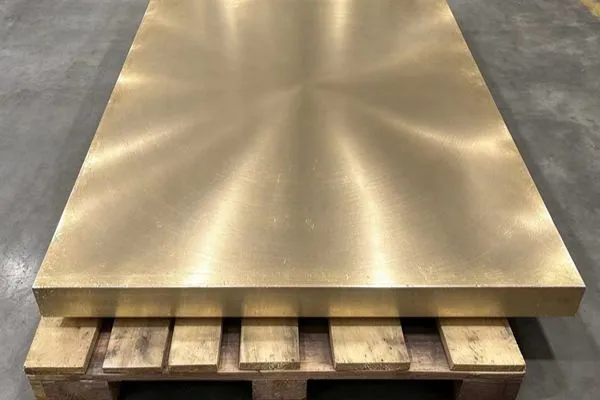
Where Each Grade Fits
If you need wrought-plate properties that you can count on, high mechanical loading, impact resistance, fatigue performance, or blanks that can be cut to size, choose C63000 aluminum bronze plate. Marine structural plates, rudder bearing parts, slideways, pump and valve wear plates, and heavy gear blanks are all common jobs. The alloy doesn't spark and doesn't let magnets pass through it easily. C95400 works with parts with complex shapes, cast housings, wear rings, and parts that are almost a net shape. You should also take a look at other materials. Nickel-aluminum bronze C95500 is stronger because it has more nickel. Bearing bronze C93200 is for lighter loads. It works well with some fluids, but chlorides can make it pit. The final choice should be based on pressure, temperature, fluid chemistry, speed, and the route of production.
Procurement Guide: Buying C63000 Aluminum Bronze Plate
What to Put on Your Purchase Order
Most disagreements can be avoided with a clear purchase order. In order to place an order for C63000 aluminum bronze plate, you must specify the temper, thickness, width, length, flatness, chemical analysis, mechanical tests, hardness checks, and ultrasonic testing needs. The plate must also be ASTM B171 or ASME SB171. Ask to see an EN 10204 3.1 certificate and to be able to track each batch. EN 12163 doesn't cover plates; it only covers rods. Also, ISO 4287 doesn't cover materials; it only talks about surface texture. The thicknesses we offer are between 10 mm and 150 mm. Send us the drawing if you need a thicker plate, and we'll let you know what we can do. Tell us where and which way your class reviewer wants the test to be taken, because thick plates can be different across the section.
Total Delivered Cost, Not Price per Kilogram
The price per kilogram for a C63000 aluminum bronze plate doesn’t tell you everything you need to know. You need to add sawing or grinding costs in addition to certification, packaging, freight, Incoterms, export documentation, and lead time. JYDS has been manufacturing copper alloys for more than 25 years and always has more than 500 tonnes of standard profiles and raw materials in stock. Ships in 3-5 days for in-stock goods, 15-20 days for custom orders. Our headquarters is near the ports of Shenzhen and Hong Kong so we can easily export and we pack plates in export packing which does not corrode and keeps out moisture. We can offer you CIF, FOB or DDP quotes via air, sea or express courier. So get your specs in early, as marine buyers typically schedule two to four months from the time they review the drawings to the time they ship the order.
Final Decision Guide: Which Grade Should You Choose?
If you value strength, consistency, resilience to fatigue, marine performance, traceability and availability of wrought plate, then select C63000 aluminium bronze plate. If cost, complex casting shape, less machining, output close to net shape or near-net shape are more significant, use C95400. A weighted decision matrix is useful. List the following: strength, corrosion resistance, wear, ease of manufacture, cost, lead time, certification. Then, give each of them a weight from 1 to 5 based on your drawing and provide both grades. The drawing, operational conditions, standards, certified test results and the supplier's capacity to provide the specified product form should be considered before final approval. JYDS provides free technical assistance in selecting the proper material, traceability of batches and the replacement/re-machining of parts that do not meet quality or sizing requirements.
Conclusion
It is better to choose C63000 aluminum bronze plate over standard cast C95400 because it is stronger and more consistent. Plate values of 700–850 MPa for tensile and 350–450 MPa for yield are above the ASTM B148 casting minimums. However, real castings often go above those floors, and heat treatment closes the tensile gap. Higher nickel content, rolling, and ultrasonic inspection help with service in salt water, resistance to fatigue, and thick sections that are all the same thickness. C95400 is still useful for designs that need to be cost-effective, have complex cast shapes, or use valves and pumps. The decision can be tracked thanks to the right names (UNS C63000, CuAl10Ni5Fe4, EN CW307G, DIN 2.0966), ASTM B171 callouts, a stated temper, and 3.1 certificates. The final grade should be based on the shape, loading, environment, machining, and cost of delivery.
FAQ
1. Is C63000 aluminum bronze plate stronger than C95400?
Most of the time, yes. A typical plate's tensile strength is between 700 and 850 MPa. ASTM B148 says that C95400's minimum strength is 515 MPa when it is cast and 620 MPa when it is heated. Compare lot data because real castings often go above and beyond minimums.
2. What separates wrought C63000 from cast C95400?
C63000 is rolled plate that has nickel levels between 4% and 5.5%. C95400 is poured into a mold and has a lot less nickel in it. Most of the time, rolling makes the structure denser and more uniform.
3. Is C63000 suitable for marine use?
Yes. It can stand up to cavitation, seawater, and brackish water. To stop galvanic attack, make sure there are no cracks and keep it away from steel parts.
4. Can I order cut-to-size plate?
Yes. We can cut plate from 10 mm to 150 mm thick to the length and width you want.
5. Which documents come with each order?
An EN 10204 3.1 mill test certificate with chemical and mechanical results is sent with every shipment. We are certified by ISO 9001:2015, and the plate meets RoHS standards.
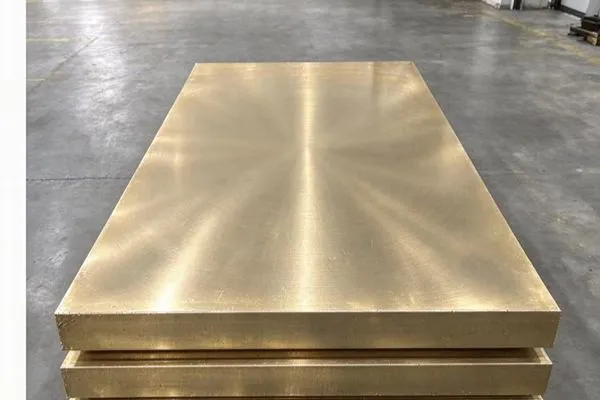
Request a C63000 Aluminum Bronze Plate Recommendation or Quote
Send JYDS your drawing, the number of pieces you need, and the temper. Our technical sales team will get back to you with a quote and grade suggestions. We are a supplier of C63000 aluminum bronze plate and keep over 500 tons of raw materials and standard profiles in stock. We can ship stock items in 3–5 days and answer questions within 2 hours. For more information, email js01@jstongcai.com.cn or go to becualloy.com.
References
1. ASTM International, Standard Specification for Copper-Alloy Plate and Sheet for Pressure Vessels, Condensers, and Heat Exchangers (ASTM B171/B171M), 2018.
2. ASTM International, Standard Specification for Aluminum-Bronze Sand Castings (ASTM B148), 2018.
3. Meigh, H. J., Cast and Wrought Aluminium Bronzes: Properties, Processes and Structure, Maney Publishing for the Institute of Materials, 2000.
4. ASM International, ASM Handbook, Volume 2: Properties and Selection: Nonferrous Alloys and Special-Purpose Materials, 1990.
5. Corrosion Science, "The Corrosion of Nickel-Aluminium Bronzes in Seawater—I. Protective Layer Formation and the Passivation Mechanism" (Schüssler and Exner), 1993.
6. European Committee for Standardization, EN 10204: Metallic Products — Types of Inspection Documents, 2004.
Online Message