
Nov 20, 2026
C95400 Aluminum Bronze Plate: Properties and Industrial Applications
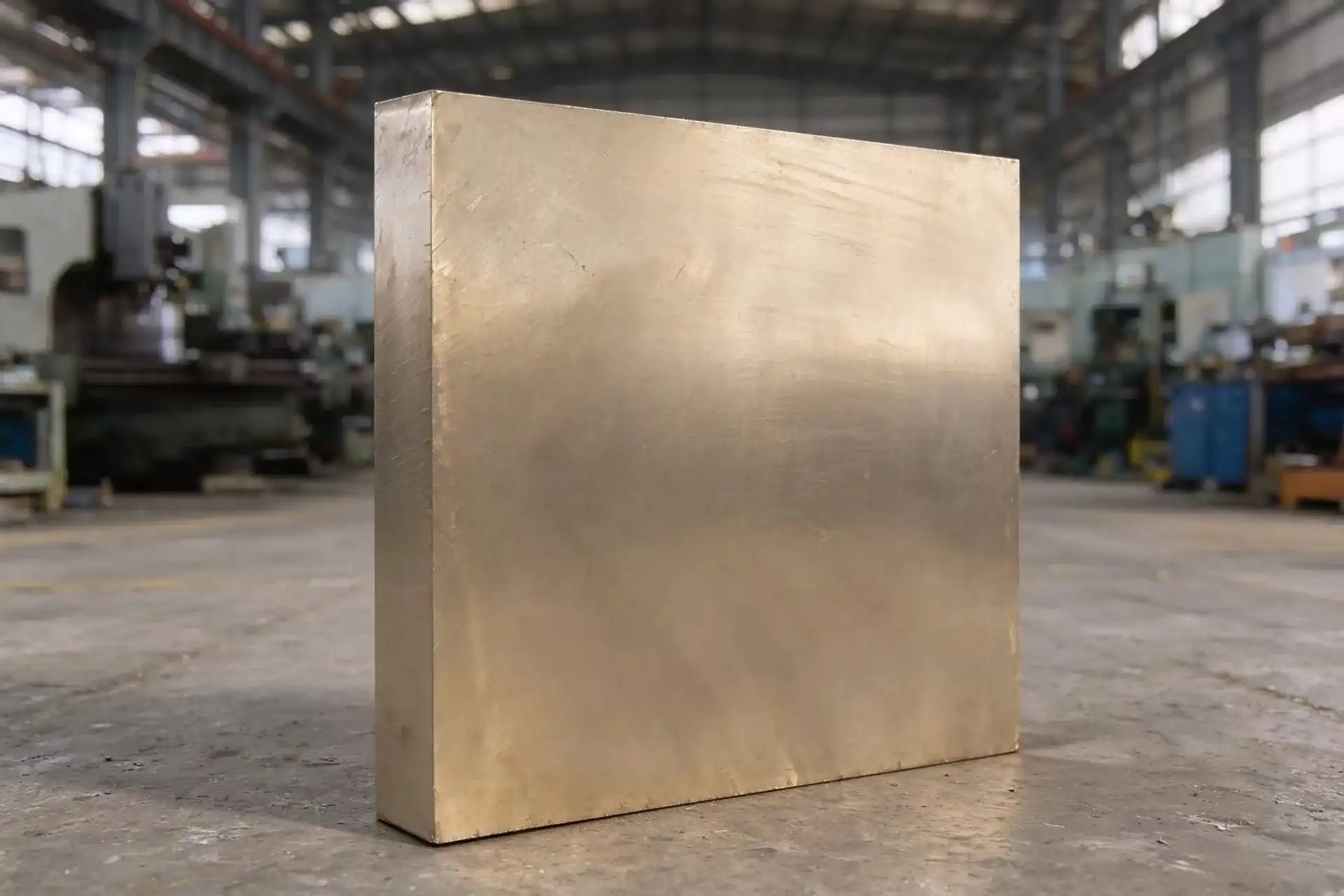
C95400 aluminum bronze plate is a non-lead copper-aluminum-iron alloy. Typical tensile strength is 517-586 MPa and hardness is 170-190 HBW. It resists sliding wear, galling, and damage by saltwater. It is used for wear plates in heavy equipment, sliding guides, stamping die inserts, gear blanks, marine liners, and certain portions of bridge bearings. For more than 25 years, JYDS has been producing quality copper alloy plate. I'll go into chemistry, mechanical data, corrosion limitations, applications, and the purchasing checks that matter for plate from 10mm to 200mm thick.
C95400 Aluminum Bronze Plate Chemical Composition and Material Characteristics
Designation and Standards
Buyers see this alloy under many names, so I begin with the labeling. It is an alloy called UNS C95400. ASTM B148 and ASME SB148 are for aluminum-bronze sand castings. ASTM B505 is for continuous castings. The alloy is often cross-referenced to EN CC331G in Europe under DIN EN 1982, the standard for copper alloy ingots and castings, and CuAl11Fe4. Shops also state “9C” or “C954”, but these are nicknames, not specs. Your purchase order should provide the UNS number, product standard, and delivery condition. Verify the precise chemical limitations against the standard you are citing. Cross references are close, but not necessarily the same.
Chemical Composition
All the properties that follow are driven by chemistry. Typical specifications for C95400 aluminum bronze plate require a minimum of 83.0% copper, aluminum between 10.0 and 11.5%, iron between 3.0 and 5.0%, and nickel up to 1.5%, manganese up to 0.50 per cent, silicon up to 0.25 per cent, and other elements up to 0.50 per cent. Aluminum hardens and creates the protective oxide coating. Iron gives strength and hardens the grain. Consider these numbers to be average, since the binding restrictions depend on the standard of your order. Incoming material is checked by OES or ICP analysis, and the MTC 3.1 for each shipment reflects the real chemistry. Ask for the heat analysis, not a general range.
Microstructure and Casting Quality
The alloy is cast, and its structure is of solidification origin. The microstructure is an alpha copper matrix with hard kappa phases. This combination is what gives the plate its hardness and wear resistance. The thick plate brings up the question every customer asks: Is the middle good? Slow cooling of heavier sections may lead to shrinkage porosity near the core. The danger is greater with thicker sections. For this reason, I advocate ultrasonic testing (UT) of thick C95400 aluminum bronze plate and of any item that is to be machined to a tight tolerance. Our final plate is subject to tensile, hardness, ultrasonic, and liquid penetrant examination. But agree on the UT acceptance criteria before ordering and ask for the report with the MTC.
C95400 Aluminum Bronze Plate Properties, Mechanical Performance, and Corrosion Resistance
Strength, Hardness, and Typical Values
Typical values for this alloy are a minimum tensile strength of 586 MPa (85 ksi), a minimum yield strength of 221 MPa (32 ksi), elongation of at least 12%, and a hardness range of 170-195 HBW. Density 7.45 g/cm³. These I call normal unless minimums are specified in your purchase. Thick parts cool slowly; thus, hardness may vary with thickness. Thus, I advise that each batch be tested, and the findings be noted on the MTC. The common procedure is Brinell testing, ASTM E10. For a buying director, batch-level hardness and tensile data provide an objective acceptance gate that a catalog figure cannot.
Wear, Friction, and the Quenched-and-Tempered Condition
Hard kappa phase is resistant to abrasion and sliding wear, and aluminum bronze is resistant to galling on steel. This makes C95400 aluminum bronze plate a feasible solution for slideways, guide plates, and worn strips under high strain at moderate speeds. Lubrication, surface finish, alignment, and dirt still have a role in service life, so I suggest trying one before you fully commit. We provide plates as cast or quenched and tempered (Q&T). Q&T Adds Hardness and Tensile Strength for heavy-duty applications. The danger is combined labeling where as-cast and heat-treated values are on one data sheet. The MTC must specify the condition of delivery and the data measured in that condition. If your drawing specifies a hardness limit, ensure it is clearly stated on the purchase order.
Seawater Resistance and Service Limits
The aluminum concentration provides a protective oxide coating which is resistant to seawater, brackish water, and many industrial pollutants. The alloy also has resistance to cavitation and erosion in pumps and valves. Still, it may not fit every service. Strong acids, ammonia, and sulfide-rich water need special consideration. Fast flow, fissures and low-oxygen zones may accelerate attack. Also, galvanic contact is important. If you combine the plate with steel, stainless steel or aluminum in saltwater, make provision for insulation, drainage and appropriate fasteners. If the component has to be approved by the class society, inquire about that early. A 3.1 MTC records the results of testing but does not substitute class certification.
C95400 Aluminum Bronze Plate Industrial Applications and Comparisons
Heavy Machinery Wear Plates and Bridge Bearings
C95400 aluminum bronze plate is used in earthmoving and mining equipment as wear plates, bushings, and landing gear parts that are subjected to impact and abrasive dust. Used for load capacity in machine tool gibs and sliding guides. Particular attention is needed for bridge bearings. The project specification and engineer of record will dictate what sliding material is approved; therefore, make sure C95400 is acceptable before you offer the work. When permitted, the reduced friction of a lubricated surface and corrosion resistance may reduce maintenance compared to hardened steel. "I don't guarantee no maintenance since lubrication, alignment, and movement all impact performance. A trial cut and a field sample are the best evidence for a first project.
Stamping Die Inserts, Marine Parts, and Other Uses
Shops utilize C95400 aluminum bronze plate for wear inserts, guide plates, and backing plates in drawing and forming dies. Aluminum bronze does not gall against steel sheet. The machinability rating is approximately 60 (with free-cutting brass at 100); thus, expect to use carbide tooling at reduced speeds. Longer die service life between die servicing intervals may counterbalance the additional machining time. You may see pores or shrinkage on a die face after final machining. Ask for a sample beforehand, and ask for UT. Marine builders utilize the plate for seawater liners and rudder fittings. Used in steel mills for pickling-line guide plates and slippers. For safety, non-sparking behavior is appreciated by oil and gas purchasers.
Comparison with Other Alloys
C93200 bearing bronze is for lesser loads at greater speed, while C95400 is for heavy loads at low speed with increased strength and hardness. C95500 adds nickel and normally provides greater strength, so use it if your design requires a little extra margin or some specialized corrosion performance. C86300 is a high-strength manganese bronze for gradual heavy wear with poor ductility. While stainless steel may be a winner in certain chemical applications, C95400 generally has excellent anti-galling and marine wear performance. Naval brass machines and shapes readily, although it is softer. See real data confirmed for your thickness and condition, not just the grade designations.
How to Buy C95400 Aluminum Bronze Plate for Global B2B Projects
Build a Clear Specification
Alloy and standard: UNS C95400 with ASTM B148, ASTM B505, or DIN EN 1982. Then specify thickness, width, length, tolerances, hardness and tensile requirements, delivery condition (as-cast or Q&T), surface (sawn or precision ground), UT requirements, quantity, and destination. Check the thickness. Our plate range is 10mm to 200mm and we cut width and length to your design. All catalogs and websites have different thickness ranges. I validate the precise range and tolerance for each design in the written quote before cutting starts. Let us know whether you need conventional plate, cast slab, custom-size plate, or semi-finished blanks, since each has a different allowance and cost.
Estimate Weight and Total Cost
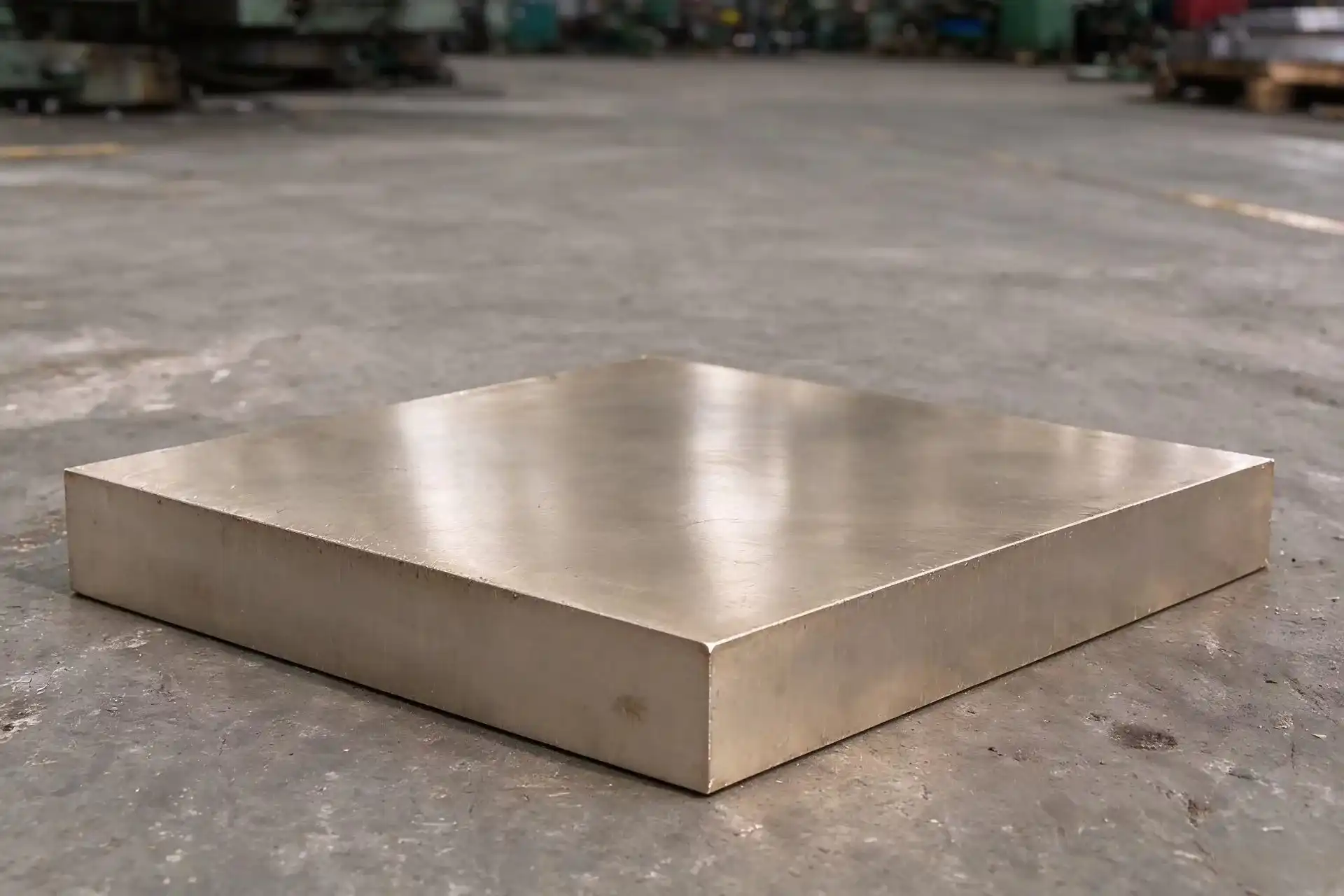
Rough estimation: Multiply Length x Width x Thickness x Density. A chunk of 500 mm × 300 mm × 50 mm has a volume of 0.0075 m3 and weighs about 55.9 kg. Don’t forget to include cutting loss and machining allowance when comparing estimates. Unit pricing is merely one line in the budget. Factor in heat treatment, UT, inspection, packing, freight, duties, and insurance. A cut-to-size blank may cost more per kilogram than complete plate, but it may save money by minimizing scrap and shop hours. Ask about tiered pricing that reflects your yearly volume and verify MOQ and partial shipments.
Lead Time, Packaging, and Shipping
Standard stock items may ship in 3–5 days. After I see your design, I include the wait time in the quote for custom-cut orders. Many project purchasers will start with a trial cut and then place a batch order timed to the building or build timetable. Pack for export with anti-rust and moisture-proof protection. Ship by sea or air. We also provide customs declarations for North America, Europe, and Southeast Asia clients, and we quote CIF, FOB, or DDP terms. We are close to the Shenzhen and Hong Kong ports, which assists in marine freight planning. We provide quotations within 24 hours.
How to Evaluate a C95400 Aluminum Bronze Plate Supplier and Decide
Documents and Inspection
Evaluate a supplier on documentation and procedure, not just pricing. Ask who casts the plate and who cuts it, since foundries, merchants and shareholders provide varied degrees of authority. Provide an EN 10204 3.1 MTC for each batch, including chemical, mechanical testing, and dimensional data, as well as heat figures, UT results, and surface inspection records. We operate in accordance with ISO 9001: 2015, and the product is RoHS compliant. For US buyers: Please validate conformity with ASTM and UNS. For European buyers: Please check compatibility with DIN EN 1982. You may check your own arriving hardness test against the MTC to validate an easy approach to make sure the paperwork fits the metal.
Red Flags to Watch For
Reviewing bids for C95400 aluminum bronze plate often reveals several red flags. "Bronze plate" without a UNS number is too vague and might represent a lesser alloy. Missing heat numbers breaks traceability. Identical test values being replicated across several batches. The data being copied across batches implies that the data is coming from someplace else. Tolerance not defined, pricing line not described, and thickness range varying between quotation and drawing all create problems at the saw. Watch for combined as-cast and Q&T attributes on one certificate and equivalency claims with no standard stated. A provider that normally deals with difficulties in the same manner responds to these concerns in writing directly.
Trial Order and Decision Checklist
C95400 is used for jobs requiring high strength, hardness, wear resistance, and corrosion resistance in a nonferrous plate. See additional materials for severe acid exposure, extreme temperature, great electrical conductivity, or extremely high rigidity. If you weld, both TIG and MIG are fine. If you have plates thicker than 25 mm, I suggest preheating them to reduce the danger of cracking. Before you make a batch order, do a trial run. Cut one plate to your design. Look at the MTC and UT report. When it arrives, test hardness, check dimensions, and put a sample into service. Then scale up confident in the data.
Conclusion
The C95400 aluminum bronze plate has a tensile strength of 517-586 MPa, hardness of 170-190 HBW, strong sliding wear resistance, and good saltwater resistance. These properties are suited to wear parts for heavy equipment, die inserts, marine liners and, when requirements permit, bridge bearing components. Its cast construction means thick section soundness is the key quality risk; therefore, UT and batch hardness data are important. Also, the state of delivery is important, because as-cast and quenched and tempered qualities are different and have to be labeled individually. The thickness, standard, and tolerance should be confirmed in writing to avoid cutting mistakes, and the weight and overall cost estimates should include machining allowance and inspection. The most reliable foundation for a bigger transaction is a trial order run against the MTC.
FAQ
1. What is C95400 aluminum bronze plate used for?
It serves heavy machinery wear plates, sliding guides, stamping die inserts, gear blanks, marine liners, and valve and pump wear plates. Project specifications determine where it is allowed, such as in bridge bearings.
2. What are typical strength and hardness values?
Typical tensile strength is 517–586 MPa, yield strength is 207–241 MPa, and hardness is 170–190 HBW. Your order should state minimums, and the MTC should show measured results.
3. Can I weld it?
Yes, TIG and MIG both work. Preheat plates thicker than 25 mm to lower the cracking risk.
4. Does it need heat treatment?
No, it performs in the as-cast condition. Quenching and tempering raise hardness and tensile strength for demanding duty, so confirm the delivery condition on the order.
5. Which documents come with the plate?
Each order includes an EN 10204 3.1 MTC with chemistry, mechanical tests, and dimensional data. Ask for the UT report when you request the quotation.
Request a C95400 Aluminum Bronze Plate Quote
Send your drawing, thickness, quantity, delivery condition, and destination to JYDS at js01@jstongcai.com.cn. As a C95400 aluminum bronze plate supplier with more than 25 years of experience, we confirm your thickness range, provide a quote within 24 hours, and ship standard stock products within 3–5 days. Every shipment includes an MTC 3.1.
References
1. ASTM International, Standard Specification for Aluminum-Bronze Sand Castings (ASTM B148), 2018
2. ASTM International, Standard Specification for Copper-Base Alloy Continuous Castings (ASTM B505/B505M), 2018
3. European Committee for Standardization, Copper and Copper Alloys – Ingots and Castings (EN 1982), 2017
4. European Committee for Standardization, Metallic Products – Types of Inspection Documents (EN 10204), 2004
5. ASM International, ASM Handbook, Volume 2: Properties and Selection: Nonferrous Alloys and Special-Purpose Materials, 1990
6. ASM International, ASM Specialty Handbook: Copper and Copper Alloys, 2001
Online Message