
Nov 10, 2026
Cube2 Bushing for Aerospace: Load Capacity and Reliability
When an aircraft sits grounded waiting for a replacement landing gear pivot bushing, every hour counts. The CuBe2 bushing — machined from UNS C17200 copper-beryllium alloy — answers that pressure directly. With tensile strength reaching 1,400 MPa after age hardening and hardness in the 36–42 HRC range, this CuBe2 bushing handles the shock loads, oscillating motion, and tight dimensional tolerances that aerospace MRO procurement demands. This guide covers material performance, procurement checkpoints, installation practice, and documentation requirements so your engineering and buying team can qualify a supplier with confidence.
Understanding CuBe2 Bushing and Its Role in Aerospace
What Is a CuBe2 Bushing?
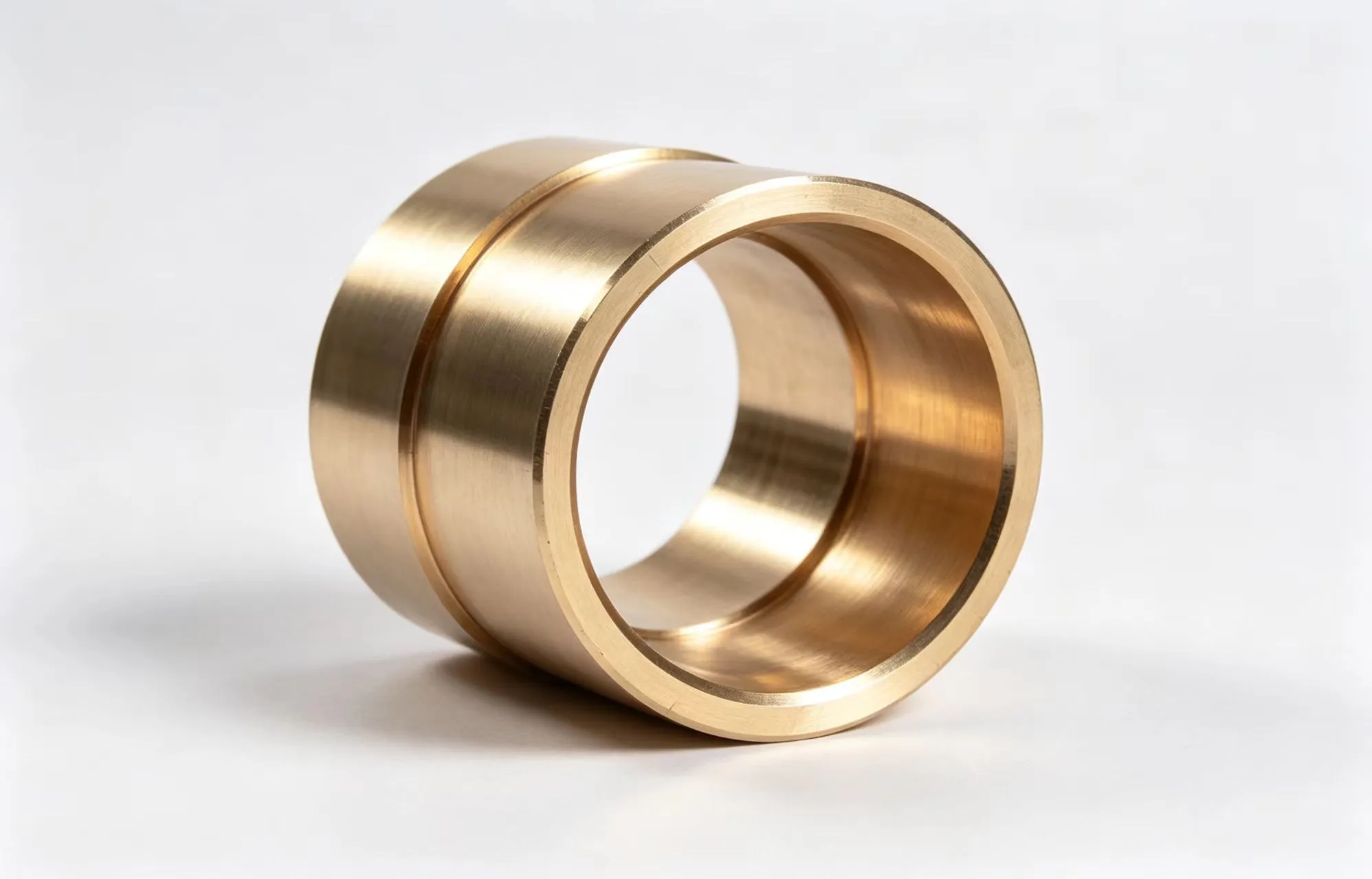
The CuBe2 bushing is a bearing liner constructed from the copper-beryllium alloy C17200 (Alloy 25, DIN 2.1247, EN CW101C or RWMA Class 4). The alloy is available in rod or bar form in accordance with ASTM B196. The bushing is machined, not cast, therefore certificates of the specifications can be linked to the source material. Before an aircraft component passes incoming inspection, there must be an exact match between the part number, drawing revision, and material temper statement.
Primary Functions in Aircraft Structures
Bushings in CuBe2 are mostly used in actuator bores, landing gear pivot pins and as wear liners for hydraulic parts. These locations experience comparable loading conditions: high static preload, low amplitude vibration, little or no lubrication, and no galling potential against titanium or steel mating pins. The alloy is inherently resistant to galling due to its face-centered cubic lattice and precipitation-hardened matrix. This makes it a favourite for these interfaces.
Material Temper and Traceability Requirements
When aerospace procurement buys things, they are very careful to tell the difference between the solution-annealed condition (TB00/A), which is used for cutting, and the age-hardened condition (AT/TF00), which is the final service temper. You can't say that a finished bushing is fully compliant with AMS 4650. Instead, you should say that the part was made from parent material that is compliant with AMS 4650 or ASTM B196 and then aged to the AT state. During document review, it is a red flag when a supplier labels finished tube bushings as "AMS 4650 compliant" without making that clear.
Load Capacity and Reliability: Technical Insights
Mechanical Performance Data
The tensile strength of a CuBe2 bushing aged by thermal precipitation is 1170–1400 MPa and yield strength is 980–1200 MPa. For the AT/TF00 temper specified here, the acceptance hardness range is 36–42 HRC (approximately 350–415 HV), consistent with ASTM B196 and industry data for the age-hardened condition of C17200. Do not apply the TH04 hardness window to an AT/TF00 part. If a drawing instead calls for TH04 (cold-worked + aged), the correct acceptance range for rod and bar is approximately 37–45 HRC, depending on section size and product form. A Rockwell reading above 42 HRC on a TH04 part is not, by itself, a rejection criterion; it may simply fall within the upper half of the TH04 range. The incoming inspection plan must anchor hardness limits to the temper actually specified on the drawing.
Fatigue Resistance and Thermal Behavior
CuBe2 has an electrical conductivity of 22–25 % IACS and conducts heat better than most stainless or nickel alloys. The heat created by friction at the contact bore is dissipated more rapidly, which has a direct positive impact on the service life of the grease in actuators. This thermal characteristic is not a trivial aspect in oscillating pivot joints when grease change is not frequent; it decides whether the bushing will survive for the time it was supposed to or has to be replaced prematurely.
Troubleshooting Common Wear Patterns
Beryllium copper pivot bushings often fail due to fretting corrosion at the OD press-fit surface and bore scoring at the chamfer entrance. I think both have to do with fitting, not a shortage of materials. If the OD is fretting, the interference fit is not adequate, or the surface polish is not up to par. If scoring occurs in the bore, the pin was not properly fitted. Incoming inspection may discover any dimensional issues before installation, with a full-size CMM report assessing ID, OD, perpendicularity and surface finish at 20 ± 2 °C.
CuBe2 Bushing vs. Other Aerospace Bushing Solutions
Comparison With Aluminum Bronze and Phosphor Bronze
Aluminum bronze and phosphor bronze joints work well in situations with mild loads. Aluminum bronze usually gives 250–400 MPa when loaded with the same landing gear hinge force as a CuBe2 bushing. This is a lot less than the 980 MPa yield floor of aged C17200. In situations where cyclic shock loads are higher than 600 MPa, that difference in yield strength means that the lower-grade material will deform and last less long.
Comparison With PTFE-Lined Composite Bushings
When there is little load and oscillation, composite self-lubricating bushings work well. Their lowest compressive strength is usually less than 300 MPa, which means they can't be used for the main landing gear pivot. A CuBe2 bushing can handle the same environment without being affected by temperature changes like PTFE liners do at high hydraulic fluid temperatures. It can also withstand the cleaning solvents used in MRO overhaul without changing its size.
Matching Product Form to Application Load
When it comes to light actuation and control surface pivots, an OD bushing that is smaller (10–50 mm) and machined to a tighter tolerance band works best. An experienced quality engineer will need to see tolerance segmentation by diameter on the inspection plan for main gear pivots and heavy actuator sleeves in the 100–500 mm OD range. They will not just need to see a claim of ±0.005 mm across the whole range. Suppliers who break down tolerance statements by size bracket and list measurement conditions show that they have a good CMM.
Procurement Guidance for CuBe2 Bushings in Aerospace
Certification Checkpoints Before Approval
Procurement needs to confirm that each CuBe2 bushing supplier possesses: an AS9100 certificate with a valid scope and expiry date (certificate number, not a verbal statement); EN 10204 3.1 mill test certificates aligned by heat number to the delivered parts; and complete CMM inspection reports against the drawing. Additionally, the NADCAP scope for material testing, heat treatment or non-destructive testing must be current and on file for this item.
Lead Times and AOG Response
Most scheduled repair orders are stocked and will ship within 3-5 business days. In an AOG scenario you need a supplier that has C17200 rod in the correct diameter range, and has CNC capability available for rapid processing. For an authorised supplier with over 500 tonnes of raw materials in stock, a small batch rush order may normally be dispatched in 72 hours for conventional forms. This is something the procurement teams should validate when certifying vendors, not in the middle of an active AOG.
Logistics and Documentation for North American and European Buyers
Buyers in North America will require country-of-origin certifications, export control statements and the AS9100 licence. European purchasers also expect the material certificate to include EN standard cross referencing and EASA aligned documentation language. The cargo is packed with export-standard anti-rust and moisture-proof materials to maintain its excellent condition throughout transportation by sea freight, air freight, DHL, FedEx or UPS. The CIF, FOB and DDP incoterms enable each distributor to choose the landed cost structure that best fits their needs.
Ensuring Optimal Performance: Installation and Maintenance Best Practices
Installation Procedure and Fit Verification
Before putting the parts together in a press-fit installation, the bushing OD and housing bore must be cleaned, measured, and made sure they are within the drawing tolerance. When installing in tight housings, the risk of bore distortion is lower when the bushing is chilled in dry ice instead of being pressed at room temperature. This is called thermal expansion fitting. Once the part has been seated, it is measured to make sure that the interference fit has not closed the hole too much, which is what the finish specification allows.
Maintenance Intervals and Replacement Criteria
Radial clearance growth beyond the drawing's wear limit, which is usually set in the overhaul manual, is the main sign that a CuBe2 bushing needs to be replaced in a pivot application. Other signs are obvious fretting debris at the OD splitting line or an increase in surface roughness that can be measured at the hole. If you can hear noise when the pins are turning in an assembly that has been cleaned and oiled, it means that the gap has grown too far for the part to work.
Quality Verification at Incoming Inspection
There should be a full-size CMM inspection report, a hardness test result, an EN 10204 3.1 material certificate that lists the specific heat, and heat treatment records that show the time and temperature for the age cycle for each shipping lot. For supply chains that are regulated by AS9100, it is required to be able to track each batch from the melt to the finished part. Any break in that chain, like a certificate that lists a different heat number, is reason enough to hold and reject at incoming inspection.
Conclusion
To buy an aerospace MRO part, the CuBe2 bushing made from UNS C17200 alloy, machined from ASTM B196 or AMS 4650 parent stock, and aged to the AT/TF00 condition is a good option. It has a known load capacity, a hardness range of 36–42 HRC, and a full certification chain from melt to finished part. There are three things that set a qualified aerospace CuBe2 bushing supplier apart from one that will cause problems during incoming inspection. They are understanding the difference between parent-material standards and finished-part declarations, making sure that AS9100 is valid and its scope is confirmed, and demanding segmented tolerance reporting by diameter range.
FAQ
1.What standards govern the parent material for an aerospace CuBe2 bushing?
ASTM B196 covers rod and bar forms of C17200 copper-beryllium. AMS 4650 covers rod, bar, and forgings in the solution-annealed condition. A finished bushing is machined from these forms and then age-hardened to the AT or TF00 temper. The finished part is declared as machined from that parent material — it does not carry a standalone AMS 4650 conformance claim.
2.What hardness should a CuBe2 bushing reach after aging?
For AT/TF00, the standard hardness is 36–42 HRC. For TH04, the range is higher (approx. 37–45 HRC). A TH04 reading above 42 HRC is compliant and should not be rejected. Always match hardness limits to the temper specified on the drawing.
3.What documentation must accompany each delivery lot?
A complete delivery package includes an EN 10204 3.1 mill test certificate tied to the heat number, a full-size CMM inspection report measured at 20 ± 2 °C, heat treatment records, and the supplier's AS9100 certificate with valid scope. For North American buyers, a country-of-origin declaration is also required.
4.Can a CuBe2 bushing be customized to a specific part number and drawing?
Yes. OD range 10–500 mm and ID range 5–450 mm cover the majority of aerospace pivot and actuator geometries. Precision CNC turning and grinding to custom drawings, with full-size inspection reports, is standard practice for AS9100-certified machining operations.
5.What is the typical lead time for a non-stock part number?
Standard custom orders machine and ship within 15–20 business days. AOG-priority orders against stocked raw material diameter ranges can dispatch significantly faster. Confirm the specific diameter and length against the supplier's standing stock list before quoting a lead time to your customer.
Request a Certified CuBe2 Bushing Quote from JYDS
For more than 25 years, JYDS has provided CuBe2 bushing stock and custom-machined parts. They have AS9100 certification, EN 10204 3.1 mill certificates, and more than 500 tons of C17200 raw material that is ready to be sent out right away. As a direct manufacturer of CuBe2 bushings, we can handle AOG requests, small-batch qualification orders, and paperwork packages that are tailored to each part number. You can email your drawing and part number to js01@jstongcai.com.cn to find out more about the product and send an inquiry.
References
-
ASTM International. ASTM B196/B196M: Standard Specification for Copper-Beryllium Alloy Rod and Bar. ASTM International, 2022.
-
SAE International. AMS 4650: Copper-Beryllium Alloy Rod, Bar, and Forgings — Solution Heat Treated. SAE International, 2020.
-
International Organization for Standardization. ISO 9001:2015: Quality Management Systems — Requirements. ISO, 2015.
-
SAE International. AS9100 Rev D: Quality Management Systems — Requirements for Aviation, Space, and Defense Organizations. SAE International, 2016.
-
European Committee for Standardization. EN 10204:2004: Metallic Products — Types of Inspection Documents. CEN, 2004.
-
Copper Development Association. Beryllium Copper Alloys: Engineering Properties and Applications. Copper Development Association Publication, 2019.
Online Message