
Nov 9, 2026
How to Specify Cube2 Bushing for Precision CNC Machining
Specifying a CuBe2 bushing correctly is one of those steps that separates a smooth production run from a costly rework loop. A CuBe2 bushing — also known as UNS C17200, Alloy 25, or DIN 2.1247 — is a copper-beryllium wear component precision-machined to exact drawing dimensions. When you specify this cube2 bushing for aviation landing gear pivots, downhole tools, or hydraulic pump bearings, every parameter on your drawing matters: temper condition, hardness range, AMS material declaration, and inspection certificate format. Get any one of these wrong, and your incoming inspection team will reject the shipment.
Understanding CuBe2 Bushing: Function, Design, and Materials
What Does a CuBe2 Bushing Actually Do?
A Cube2 bushing fits between two surfaces that need to be matched, usually a hardened steel pin and a housing hole. It stops metal-to-metal galling and absorbs rotating loads. It spreads contact stress across the whole bore area, unlike rolling-element bearings. This makes it the best choice for pivots with a lot of load and low speed, where a needle bearing would break when hi
Design Geometry and Dimensional Range
ID sizes range from 5 mm to 450 mm and OD sizes range from 10 mm to 500 mm. Based on sketches from the customer, CNC machines cut the wall thickness, chamfer shape, and lube hole designs. For a correctly specified cube2 bushing, tolerances should be given by diameter band, not as a blanket ±0.005 mm across the whole size range. Also, measurement conditions should be given as 20 ± 2 °C using a CMM or air gage.
Material Grade and Temper State
The alloy's structure is CuBe2: 1.80 to 2.0% beryllium, cobalt, nickel, and iron; cobalt, nickel, and iron up to 0.50%; and copper the rest. You should say that the finished bushing is made from machined from ASTM B196 or AMS 4650 rod/bar stock, then age-hardened to AT (TF00) temper. Do not say that the finished part "conforms to AMS 4650" as a whole; AMS 4650 only covers the rod, bar, and worked stock that has been solution-annealed (TB00/A), not the final part.
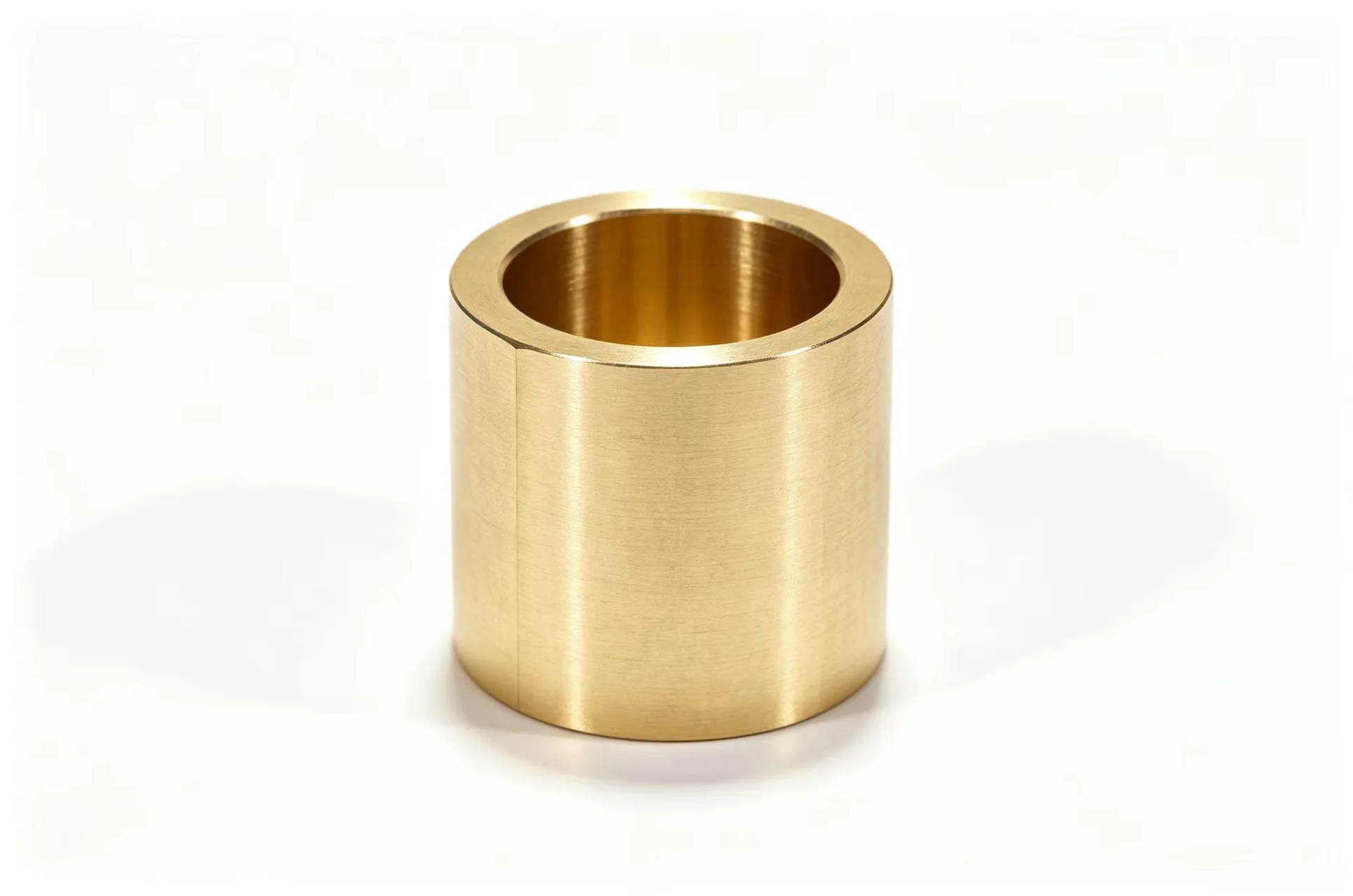
How to Specify CuBe2 Bushings for Your Precision CNC Machining Needs
Define Your Material Declaration Precisely
What should be written in the material call-out for a cube2 bushing in a procurement specification or purchase order line? "CuBe2 / UNS C17200 per ASTM B196, machined from solution-annealed stock, aged to AT/TF00 condition."The hardness must be given in the range 36–42 HRC, which has been tested and is correct for C17200 TH04. If you set an upper limit of 44 HRC, you might fail incoming Rockwell checks, since ASTM B196 TH04 data sheets always show 42 HRC as the realistic top.
Specify the Inspection Document Package
For aerospace MRO purchases, the minimum set of documents that must be sent with every cube2 bushing shipment is:
- EN 10204 3.1 Mill Test Certificate (MTC) covering chemical composition and mechanical properties of the parent stock
- Full-size CMM inspection report confirming all drawing dimensions against tolerances, at 20 ± 2 °C
- Heat treatment record showing solution anneal and aging cycle times and temperatures
- AS9100 certificate number and expiry date from the machining supplier — not just a self-declaration
European buyers should also ask for an EASA-aligned document package if one is available.
Installation and Maintenance Protocols
Press-fit interference values for a Cube2 bushing are usually H7/p6 or tighter, but this can change based on the material of the case. To keep the bore from warping, don't use impact installation. Instead, use a hydraulic press with alignment guides. When the machine is in service, check the horizontal distance at regular times. A noticeable rise above the drawing wear limit, which is usually given as a maximum diametral clearance, is the main sign that the bearing needs to be replaced. Depending on the use, lubrication intervals are different. For example, aerospace pivots that oscillate without oil and hydraulic bushings that are actively oiled have very different service cycles.
Comparing CuBe2 Bushings with Other Bushing Types
CuBe2 vs. Phosphor Bronze
Phosphor bronze (C54400 or C51000) is softer (usually 70–100 HRB) and works well when there isn't much load and the bearings are well oiled. A cube2 bushing with an old hardness of 36–42 HRC can handle shock loads and oscillations that would quickly wear a bronze bushing down. Bronze costs less when it's enough. CuBe2 is the right material for applications where landing gear pivots need to move back and forth under the weight of an airplane.
CuBe2 vs. Copper-Nickel-Tin Alloys
Alloys made of spinodal copper, nickel, and tin, like C72900, are strong and don't magnetize. However, their tensile strength is lower than that of a peak-aged Cube2 bushing, which is between 1,170 and 1,400 MPa. CuBe2 is still the best non-magnetic wear material for downhole MWD/LWD tools that need to keep their magnetic permeability below 1.001 µr and handle heavy axial loads.
CuBe2 vs. Steel-Backed PTFE Composite
It is fine for PTFE composite bushings to run dry and handle light radial loads at room temperature. They break quickly when hit or loaded on the edges. A cube2 bushing made from C17200 stock that is aerospace-grade can handle both impact and abrasion, while composite liners would separate.
Procurement Guide: Sourcing CuBe2 Bushings for Bulk Orders
Qualifying a Supplier Before You Issue a PO
There is a clear order to the steps needed to become qualified for aviation MRO procurement: drawing and part-number alignment → first-article and document review → supplier audit → trial batch → entry into the approved vendor list (AVL). Usually, this cycle lasts between 6 and 12 months. The most important steps in verifying are finding out the supplier's AS9100 certificate number and when it expires, looking over the actual NADCAP scope (materials testing, NDT, and heat treatment), and making sure the MTC has the right AMS material declaration.
Pricing Variables in Bulk Orders
The unit price for a precision cube2 bushing is based on its volume, wall thickness, and the range of heat treatments that can be used. Thin-wall large-diameter parts take longer to cycle and need more stock to be removed. Age-hardening adds a heating cycle and two to five days to the wait time. Ask for itemized prices for 50, 200, and 500 pieces to find the places where your program will stop.
Lead Time and AOG Response
Items in stock that are solution-annealed rod can be sent out in 3–5 days. Orders for custom-machined, aged, and approved cube2 bushings usually take 15 to 20 days. For AOG situations, find out ahead of time if the supplier has old stock or can quickly schedule a furnace run. Any seller on an aircraft AVL is expected to respond to questions within two hours and be available 24 hours a day, seven days a week.
Trustworthy CuBe2 Bushing Sources and Supplier Verification
What to Look for in a Qualified Supplier
As9100 and ISO 9001:2015 certifications (with a current, valid certificate number) are signs of a reliable cube2 bushing provider. They also have CNC turning and grinding cells in-house and give out EN 10204 3.1 MTCs for every batch. When a supplier has their own vacuum induction melting furnaces, it is easier to track the material because the chemistry is controlled at the melt stage instead of being bought from a third party.
Red Flags in Supplier Documentation
Some things to look out for in a document review are hardness claims above 42 HRC for C17200 TH04, saying that a finished bushing "conforms to AMS 4650" instead of "machined from AMS 4650 stock", using ISO 5182 (a standard for resistance welding electrodes) as an aerospace wear-component specification, and claims about tolerances that don't specify the measurement temperature or instrument type. Any one of these will lead to rejection at the incoming inspection.
JYDS Production and Verification Credentials
JYDS has been making CuBe2 alloys for more than 25 years, is certified by ISO 9001:2015, follows AS9100 guidelines for manufacturing, and keeps more than 500 tons of standard bars and plates in stock at all times. There is a full EN 10204 3.1 MTC on every batch that ships. Custom-machined cube2 bushing parts are made from drawings provided by the customer. Full-size CMM results and heat treatment records are included as normal.
Conclusion
There are four things that are necessary to properly specify a Cube2 bushing: a correct material declaration (ASTM B196 / AMS 4650 parent stock, aged AT/TF00); a hardness within the verified 36–42 HRC range; a full set of documents (EN 10204 3.1 MTC, CMM report, heat treatment record, AS9100 certificate); and a supplier whose certifications are up-to-date and can be checked by a third party. If you skip any of these steps, the incoming inspection will fail, the AVL will reject it, and the AOG will be delayed. Being able to write correct specifications from the start and work with a qualified cube2 bushing maker speeds up the approval process and keeps the supply chain stable.
FAQ
1.Why can't the finished bushing be declared as conforming to AMS 4650?
AMS 4650 is a standard for buying materials that covers rod, bar, and wrought shapes that have been solution-annealed. It controls the stock before it is machined. A finished cube2 bushing is made from stock that meets AMS 4650 standards and then aged. The correct call-out shows both the parent specification and the temper that was added after the machining.
2.What hardness should I specify for C17200 in the aged AT condition?
ASTM B196 says that the range for C17200 TH04 is 36–42 HRC. If you set the upper limit above 42 HRC, you run the chance of getting Rockwell rejects at MRO inspections all the time.
3.How should I state tolerances on a cube2 bushing drawing?
For example, ±0.005 mm for bores less than 50 mm and ±0.008 mm for bores 50–150 mm are two different diameter bands. Always write down the measurement conditions, which are 20 ± 2 °C, a CMM, or an air gage.
4.What is the standard lead time for a precision-machined CuBe2 bushing?
It takes 3–5 days to send stock materials. Orders for custom-machined, aged, and certified items usually take 15–20 days from the approval of the picture.
5.Does a CuBe2 bushing meet non-magnetic requirements for downhole tools?
Yes, C17200 doesn't have a relative magnetic permeability greater than 1.001 µr, so it can be used for MWD/LWD and sensor-adjacent downhole tasks without being magnetic.
Request a Quote for CuBe2 Bushing — Contact JYDS Today
Precision-machined cube2 bushing parts are sold by JYDS to aircraft MRO wholesalers, downhole tool makers, and hydraulic equipment makers in Southeast Asia, Europe, and North America. We have more than 25 years of experience making CuBe2, more than 500 tons of stock on hand, quality standards that are in line with AS9100, and EN 10204 3.1 MTCs on every batch. This means that we can help you with your plan review, first-article submission, and AVL approval. You can send your drawing and ask for a cube2 bushing supplier quote today by emailing our technical team at js01@jstongcai.com.cn.
References
1. ASTM International. ASTM B196/B196M: Standard Specification for Copper-Beryllium Alloy Rod and Bar. ASTM International, 2023.
2. SAE International. AMS4650P: Copper-Beryllium Alloy, Bars, Rods, Shapes, and Forgings, 98Cu - 1.9Be, Solution Heat Treated (TB00). SAE International, 2026.
3. European Committee for Standardization. EN 10204: Metallic Products — Types of Inspection Documents. CEN, 2004.
4. SAE International. AS9100 Rev D: Quality Management Systems — Requirements for Aviation, Space, and Defense Organizations. SAE International, 2016.
5. Davis, J.R. Copper and Copper Alloys. ASM International, 2001.
6. Kutz, Myer. Handbook of Materials Selection. John Wiley & Sons, 2002.
Online Message