
Nov 25, 2026
Inside the Strength of C63000 Aluminum Bronze Plate: Ni and Fe
Nickel and iron make C63000 aluminum bronze plate strong, resistant to wear, and long-lasting in salt water. Nickel, in amounts between 4% and 5.5%, smooths out the grain and helps make small κ-phase particles. Up to 5% iron makes things harder and more resistant to wear. They make a wrought plate with 9.0–11.0% aluminum that has a tensile strength of 700–850 MPa and a hardness of 180–200 HB. These traits work well for rudder bearing parts, slideways, wear plates, and parts of pumps or valves. You can trust this guide to help you understand how the alloy works and what to look for on the certificate.
What Is C63000 Aluminum Bronze Plate?
Grade Names and Designations
Nickel aluminum bronze, or NAB, is what UNS C63000 is. CuAl10Ni5Fe4, EN CW307G, and DIN 2.0966 are the names that match. I list all four because older datasheets sometimes put the C63000 with other names. A classification society drawing review can be held up by a name that doesn't match. Before you place your order, make sure that the UNS number, the ASTM B171 or ASME SB171 specification, and the name on the mill certificate all match. That one check keeps your approval schedule safe. It is wrought plate, and each certificate lists the delivery conditions. Our C63000 aluminum bronze plate is that.
Why Nickel Matters in C63000 Aluminum Bronze Plate
It has between 4% and 5.5% of nickel. It gives the grain a smoother appearance and promotes the precipitation of the fine κ-phase. Based on our product data, unlike simpler aluminium bronzes, this gives it stronger tensile strength without sacrificing flexibility. Thus, the C63000 aluminium bronze plate can support higher bearing and compressive loads than the C95400 at equal thickness. Nickel also reduces the risk of rust and wear in seawater. That is good for parts that get wet and have to take cyclic loads, such as guide plates and parts for rudder bearings. Aluminum at 9.0 to 11.0% gives the alloy its strength, while iron and nickel further strengthen the copper matrix.
The Role of Iron and the Wrought Advantage
Iron is 2.0 to 4.0 percent, manganese is 1.5 percent maximum, and the rest is copper. Iron makes things tougher and more resistant to wear . Particles that are rich in iron help to smooth out the grain . It is rolled, not cast like C95400, therefore the plate is stronger, denser and more uniform in size from lot to lot. The governing specification dictates the final chemistry for your order, and the specific heat analysis is on the MTC.
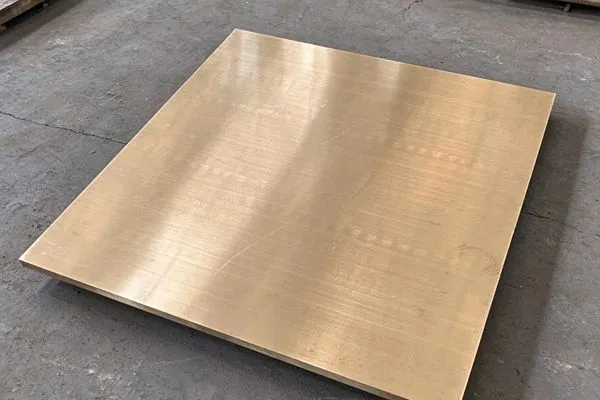
C63000 Aluminum Bronze Plate Mechanical Properties and Corrosion Performance
Strength and Hardness Numbers
Our C63000 aluminium bronze plate has a tensile strength of 690 to 800 MPa (100 to 116 ksi) and a yield strength of 320 to 450 MPa (46 to 65 ksi). It has an elongation of 12-18% and a hardness of 180-200HB (90-100 HRB). These figures vary with thickness, temper and test location. The thick plate may not be the same as the thin plate. I think the test location and direction should be indicated on the PO for heavier parts. Ask for readings of how hard something is in more than one place. Published ranges are a good initial screening tool, but the single most crucial document is the MTC for your specific heat.
Seawater, Cavitation, and Dealuminification
The C63000 aluminum bronze plate contains a thin coating of alumina on its surface which develops again when it is scratched. Film is resistant to salt water, brackish water and weak non-oxidizing acids. The product data also indicates it works effectively against cavitation and erosion in moving seawater. Selective phase corrosion, or de-aluminification, is a serious challenge in maritime design. With that risk, our microstructure assessment is looking for networks that are consistently in the alpha phase. How long it lasts still depends on how fast the water is moving, how much oxygen and chlorides it contains and how it comes in contact with other metals. If you require corrosion test data for your project, please advise us before ordering so we can ensure it is provided.
Wear, Galling, and Non-Sparking Behavior
In case of high contact pressure the multiphase microstructure does not wear or gall. The plate is effective in applications where ordinary bearing bronzes could score or deflect such as thrust washers, wear plates and sliding surfaces. It does not spark, and magnets do not travel easily through it, which is advantageous around combustible places or sensitive devices. Hardness alone can not tell you how long something will last. Before you select a thickness, you should look at all of these together: load, lubrication, mating material, sliding speed and surface finish.
C63000 Aluminum Bronze Plate Applications and Comparison with Alternative Materials
Marine and Offshore Uses
Common marine and offshore uses include slideways, mooring hardware, rudder bearing parts, and shipbuilding fittings. It is the same plate that is used to make heat exchanger tube sheets and plates for oil and gas sites offshore. You can saw, mill, or precision grind plates to any size between 10 mm and 150 mm (0.4 in. to 5.9 in.). These parts are good because they don't let seawater in, are strong, and don't let magnets pass through them. Before you cut, compare the plate to what your classification society says you need. First there is approval, then there is production.
Gears, Pumps, and Valves
For heavy gears, aluminum bronze plate is used to make worm wheel blanks because it doesn't damage steel worms. When you buy wheel blanks, you should ask for an ultrasonic report because holes in the tooth area can shorten their life. The plate is used to make wear plates and rings for pumps. People who make valves weld or bolt it in place for seats, gate facings, and wear liners. Change the facing that is worn out instead of the whole valve body if possible to save money. When you use aluminum bronze filler metal, both GTAW and GMAW will work.
How C63000 Compares with C95400, Stainless Steel, and Others
As a casting alloy, C95400 can be used to make complicated shapes. Our data shows that wrought C63000 plate has a higher density and fatigue strength, making it a good choice for flat machined parts. Stainless steel can pit when it comes into contact with chloride, but it might be better for some chemical or hygiene jobs. C54400 is better suited for spring and electrical work than for heavy sliding duty. Not just grade names, but also certified supplier data and your real operating conditions can help you decide which candidates to hire.
C63000 Aluminum Bronze Plate Standards, Testing, and Quality Control
ASTM B171 and ASME SB171
Plates and sheets made of copper alloy that are used in pressure vessels, condensers, and heat exchangers are covered by ASTM B171. For code work, ASME SB171 is the right choice. On your drawing, write down the thickness, the UNS number, and the specification. EN 12163 or ISO 4287 are mentioned on some plate pages. EN 12163 covers rods, and ISO 4287 defines surface texture terms. Neither can be used to describe a plate material. To use a European standard in your drawing, use the names CuAl10Ni5Fe4 and CW307G along with the plate standard.
EN 10204 3.1 Certificates
A certificate called EN 10204 3.1 is sent with every batch of C63000 aluminum bronze plate. A type 3.1 document is checked by an authorized representative of the manufacturer who does not work for the production department. Our certificate has information about the heat number, chemistry, tensile strength, yield strength, elongation, hardness, delivery condition, and how the material can be tracked. The plate is safe for use and meets RoHS standards; our quality system is certified by ISO 9001:2015. Send us your requirements early, and I'll check the content of the certificate before you place your order.
Inspection Steps Behind the Certificate
Each C63000 aluminium bronze plate is subject to five checks. The alloy composition was validated by optical emission spectrometry. Ultrasonic testing per ASTM E2375 looks for holes and other things in the material. Mechanical testing verifies strength and elongation. Dimensions and flatness are checked by laser measurements. The microstructure examination looks for networks that are constantly in the alpha state. The ultrasonic and microstructure inspections immediately address concerns of holes and uneven structure in the thick portions. If your project needs a UT report or a third party witness, include it on the order.
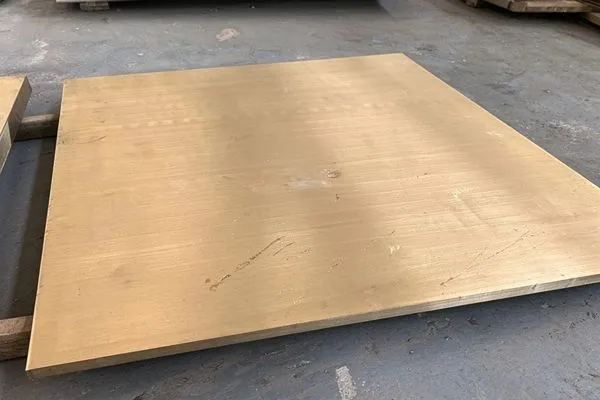
How to Buy and Evaluate a C63000 Aluminum Bronze Plate Supplier
Build a Complete Requirement
A full investigation saves weeks of time. This is what I think you should include:
- Material and standard: State UNS C63000 and ASTM B171 or ASME SB171. Add the CuAl10Ni5Fe4, EN CW307G, and DIN 2.0966 names for cross-reference. Require an EN 10204 3.1 certificate with chemistry, tensile strength, yield strength, elongation, and hardness for each heat in the lot.
- Size and condition: Give thickness from 10 mm to 150 mm, plus width, length, and whether you want sawn or precision ground faces. Name one delivery condition per lot, such as hot rolled HR50, annealed, quenched and tempered, or stress relieved TQ50, so mixed conditions never reach your shop.
- Testing and schedule: Specify the hardness recheck, test location and direction for thick plate, ASTM E2375 ultrasonic testing, and any third-party witness. Add your drawing approval date and the delivery date, so we can plan sampling, testing, and shipment together.
The sample can be approved faster when there is a clear list like this.
Tempers, Machining, and Welding
Hot rolled (HR50) is standard in the wrought condition. Annealed plate is easy to form. Quenched and tempered plate is stronger and harder thus it can take more weight . Stress-relieved (TQ50) plate keeps its shape better for precision parts. Machining takes longer, so. It will cut slower than brass so use carbide tools and constant coolant. If you wish to preserve the joint from corrosion, you should use GTAW or GMAW with an aluminium bronze filler metal for welding. Before cutting your part, ask us what condition it suits.
Evaluating the Supplier and Delivery
When I look at different suppliers of C63000 aluminium bronze plate, I look at their credentials, their capacity to trace items, their packaging, and their experience in exporting. For more than 25 years, JYDS has been engaged in manufacturing. JYDS is ISO 9001:2015 certified. Our plates are packed in export quality packaging that will not corrode and keeps moisture out. We ship by boat, air or express with CIF, FOB or DDP conditions from a place close to Hong Kong and Shenzhen ports. Stock goods ship in 3-5 days, bespoke orders ship in 15-20 days. We'll get back to you with an answer in two hours. Price per kilo is not the only thing to look at, but the overall landed cost. That’s because the final number is changed by cutting, certification, goods and insurance. If the thickness is greater than 150 mm please inform us immediately.
Conclusion
The nickel and iron make C63000 aluminum bronze plate sturdy for heavy, wet sliding use. The addition of 4.0 to 5.5% nickel refines the grain structure and reinforces it with fine κ-phase particles. Iron, however, hardens it and makes it more resistant to wear. The tensile strength is normally in the range of 700 to 850 MPa and hardness in the range of 180 to 200 HB. The alumina-rich layer on the surface keeps off seawater, cavitation or galling. Wrought plate is superior to cast C95400 for marine buildings, worm wheel blanks, and valve and pump liners when strength and longevity are critical. Plates are approved when they have the correct designations, an EN 10204 3.1 certificate, the correct ASTM B171 or ASME SB171 certificate, and ultrasonic and hardness tests. Most delays in approvals can be avoided by checking these things before you cut.
FAQ
1. Is C63000 aluminum bronze plate the same as CuAl10Ni5Fe4?
Yes. CuAl10Ni5Fe4, EN CW307G, and DIN 2.0966 are all the same as UNS C63000. Before you order, make sure the name on the MTC is correct.
2. Can C63000 be welded?
Yes. If you want to protect the weld from corrosion, use GTAW or GMAW with aluminum bronze filler metal.
3. What thickness range do you supply?
From 10 mm to 150 mm thick, and the width and length can be custom sawn or precisely ground. Come talk to us about bigger sizes.
4. Which documents come with each lot?
There are ISO 9001:2015 documents and RoHS compliance with each lot, as well as an EN 10204 3.1 certificate with chemical and mechanical results. You can get an ultrasound report if you ask for one.
5. Is the alloy non-sparking?
Yes. It doesn't spark, so it can be used for parts that are near places where there is a risk of fire or explosion.
Request a C63000 Aluminum Bronze Plate Quote from JYDS
Email JYDS at js01@jstongcai.com.cn with your drawing, thickness, quantity, and desired ship date. Our team will get back to you within two hours. We are a supplier of C63000 aluminum bronze plate and have been in business for more than 25 years. For every order, we offer EN 10204 3.1 MTCs, ISO 9001:2015 quality control, and packaging that is ready for export. Find out more about the product at becualloy.com, and before you buy, ask for a sample MTC.
References
1. ASTM International, ASTM B171/B171M, Standard Specification for Copper-Alloy Plate and Sheet for Pressure Vessels, Condensers, and Heat Exchangers, 2018
2. Meigh, H., Cast and Wrought Aluminium Bronzes: Properties, Processes and Structure, 2000
3. Wharton, J.A., et al., The Corrosion of Nickel–Aluminium Bronze in Seawater, Corrosion Science, 2005
4. ASM International, ASM Handbook, Volume 2: Properties and Selection: Nonferrous Alloys and Special-Purpose Materials, 1990
5. European Committee for Standardization, EN 10204, Metallic Products: Types of Inspection Documents, 2004
6. ASTM International, ASTM E2375, Standard Practice for Ultrasonic Testing of Wrought Products, 2016
Online Message