
Nov 12, 2026
Top Reasons to Choose Aluminum Bronze Rods
If you are sourcing material for marine shafts, valve stems, or bearing bushings, aluminum bronze rod deserves a serious look. This copper-based alloy — with aluminum as the primary addition, often reinforced by iron, nickel, and manganese — delivers tensile strength up to 800 MPa alongside a self-healing aluminum oxide surface film that resists seawater corrosion without any coating. Grades such as UNS C63000, C63200, and C61400 comply with ASTM B150 and EN 12163, giving procurement teams the documented standard traceability they need before a single component ships.
Understanding Aluminum Bronze Rods and Their Key Properties
The first choice that every buying manager has to make is how to get the alloy formula right. If you look at different grades of aluminum bronze rod, you can see that they perform very differently. This is because they are all made of wrought copper alloys.
Chemical Composition and Grade Differences
The amount of aluminum is between 8.5% and 11.0%, with iron at 2% to 5%, nickel at 4% to 5.5%, manganese at 0.5 to 1.5%, and copper to keep everything in balance. The nickel and manganese windows for UNS C63000 and C63200 are smaller than those for C61400. This is why combining their chemical ranges into a single certificate fails initial inspections at major metal service centers. Each grade has to be given on its own, element by element.
Mechanical and Physical Data
C61400: density ~7.89 g/cm³, thermal conductivity ~67 W/m·K, electrical conductivity ~14% IACS. C63000/C63200: density ~8.2–8.3 g/cm³, thermal conductivity ~35–46 W/m·K, electrical conductivity ~7% IACS. These exact values must be verified against the per-batch EN 10204 3.1 MTC to ensure there is no discrepancy. The material can withstand short-term exposure up to 500 °C, but continuous service should not exceed 400 °C.
Dimensional Tolerance and Cross-Section Options
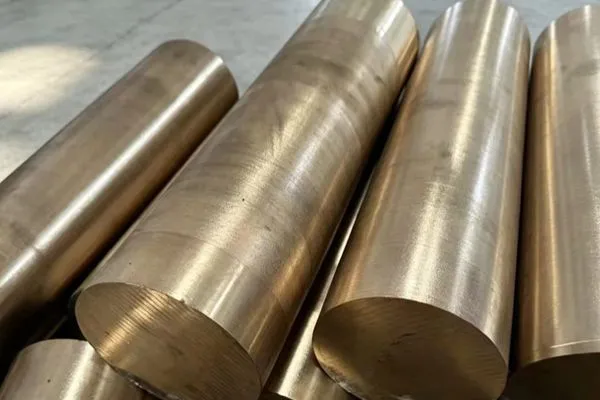
The stock sizes range from 5 mm to 300 mm, and the lengths can be cut to order. Most of the time, ASTM B249/EN 12163 tolerance classes h8, h9, and h10 are used. In addition to round bars, hexagonal and square shapes are also available. This means that wrench-flat valve stems and anti-rotation shafts don't need to be machined again.
Top 5 Reasons to Choose Aluminum Bronze Rods for Industrial Applications
Procurement teams put 4-5 Chinese vendors on the same spreadsheet. Here are the technological and financial factors that keep putting aluminium bronze rod on that short list.
Reason 1 — Seawater and Cavitation Resistance
The aluminium bronze rod has a continuous wrought construction that eliminates porosity routes seen in cast components. If damaged the surface of the aluminium oxide coating will rebuild itself. It is resistant to biofouling, chlorine assault and cavitation erosion. That quality is essential in marine applications (propeller shafts, rudder stocks, stern tubes, pump rods) where service life is measured in decades, not seasons.
Reason 2 — High Strength With Controlled Machinability
The aluminium bronze rod can resist enormous mechanical loads without deformation, with tensile strength over 680 MPa and hardness above 80 HRB. CNC turning, threading and grooving provide surface finishes of Ra 0.8-3.2 μm straight from bar material, minimising additional processes. You need carbide tooling and rigorous setups but once you have the process dialled in, cycle durations are predictable and chip control is consistent.
Reason 3 — Non-Sparking Character for Hazardous Zones
The alloy’s high thermal conductivity rapidly dissipates frictional and impact heat, preventing the localized hot spots that generate ignitable sparks. Combined with its near-carbon-free composition, this makes aluminum bronze the standard choice for non-sparking tools in explosive atmospheres. It is widely specified for drill bit bushings, non-sparking tool handles, and subsea fasteners where operational safety is critical.
Reason 4 — Multi-Grade Inventory Filling Niche Gaps
Not all distributors carry C61400 (density ~7.89 g/cm3) and C63200 (Mn lower limit 1.2%) grades. A supplier with true wrought bar inventory in these grades – not cast billet masquerading as ASTM B150 rod – provides a regional metal service center the rare-grade coverage that drives profit.
Reason 5 — Complete Documentation Chain
Shift quality responsibility upstream: EN 10204 3.1 mill test certifications with heat-number traceability, per-batch chemical and mechanical data, and ASTM B150/EN 12163 conformance. Incoming inspection teams may release goods against the MTC rather than doing complete re-tests on every consignment and therefore save holding expenses.
These five attributes cover the most prevalent rejection areas in distributor inbound inspection and end-user design assessments. Combined, they account for the aluminium bronze rod’s staying power throughout buying cycles in the maritime, industrial and oil and gas sectors.
How to Select the Right Aluminum Bronze Rod for Your Project
It's not hard to choose the right grade of aluminum bronze rod when you ask about how it will be used instead of just price.
Match Grade to Environment
The lower cost of the metal C61400 makes it a good choice for moderately loaded freshwater pump shafts. C63000 can handle more mechanical force and some contact to salt water. C63200 adds manganese to make it more resistant to dezincification, and it works best when it is immersed in seawater all the time. If they mix up their MTCs during incoming inspection, they will be flagged right away.
Confirm Wrought vs. Cast Origin
ASTM B150 only talks about wrought (worked) bar. A continuous-cast billet that is sold as a B150 rod will have a different surface finish, grain structure, and length. Make sure you get more than just the grade stamp. Ask about the production method, like hot extrusion or hot rolling.
Verify Supplier Stock Depth and Lead Time
For a regional distributor to be able to offer next-day service to their own customers, their upstream provider has to actually have stock. Stock items should be sent out within 3–5 days, and custom-cut lengths should be sent out within 15–20 days. Before making a decision, make sure that the machine can cut to length at Ø25, 40, 50, 60, and 80 mm in 1,000 mm and 3,000 mm set lengths.
Common Challenges and How Aluminum Bronze Rods Address Them
When you work with unique copper alloys, you run into problems that keep coming up during the buying cycle. Several of them are fixed at their base by the aluminum bronze rod shape.
Cast Substitution Risk
Getting cast billet that looks like worked iron is the worst quality failure in this group. Wrought aluminum bronze rod made to ASTM B150 has consistent fine grains, elongation of at least 15%, and a surface quality that can't be achieved with cast material. The only reliable way to check is to compare batch-level heat numbers on the MTC to the mill's production records.
Batch-to-Batch Chemistry Drift
There is a 1.2% manganese lower limit for C63200. If a supplier blends different heats without testing each batch separately, they will eventually send out material that doesn't meet this limit. This is caught before the stock gets to a machine shop floor by asking for individual heat MTCs instead of composite certificates.
Logistics and Packaging for Direct Warehousing
Export-standard packaging that doesn't rust or get wet and lets items go straight from the bin to the shelf without having to be repackaged saves time at the receiving dock. When one mixed container has different grades and cut lengths for a distributor order, it's important to have flexible shipping terms like FOB, CIF, or DDP via sea, air, or express courier.
Conclusion
Aluminum bronze rod is used in strict procurement programs because the material data can be checked by a third party. The rod's chemistry, mechanical properties, dimensional tolerance, and documentation all point in the same direction. As long as they meet ASTM B150/EN 12163 standards, grades C63000, C63200, and C61400 meet the most marine, industrial, and oil and gas needs. If you choose a seller that keeps real wrought bar in stock, gives out per-batch EN 10204 3.1 certificates, and ships cut-to-length stock within days, you get rid of the biggest risks in the buying process, such as cast substitution, chemistry drift, and paperwork gaps.
FAQ
1.What grades of aluminum bronze rod are most commonly stocked?
UNS C63000 and C63200 meet the most shipping and manufacturing needs. The C61400 can be used for freshwater pumps and bearings. All three of them are wrought products that meet ASTM B150.
2.How do I verify that a rod is wrought, not cast?
Request the production route documentation along with the MTC. A macro-etch test on a wrought bar shows elongation of at least 15% and fine, uniform grain. It is common for cast materials to have shorter elasticity and a columnar grain structure.
3.What tolerances are available?
We offer h8, h9, and h10 pipes in diameters from 5 mm to 300 mm in line with ASTM B249 and EN 12163.
4.Can small mixed orders be shipped without high minimum quantities?
Orders of different grades and sizes that are less than one ton can be put together into a single export shipment. Before you place a trial order, talk to the supplier directly about the minimum order weight and minimums for each grade.
5.What documents come with each shipment?
Every batch that ships comes with an EN 10204 3.1 MTC that includes information about the chemical make-up, mechanical test results, packing lists, and proof of where the goods came from. If you ask, you can get more third-party review records.
Request a Quote From JYDS — Your Aluminum Bronze Rod Supplier
For more than 25 years, JYDS has been making special copper alloys. They currently have more than 500 tons of aluminum bronze rod in stock in grades C63000, C63200, and C61400. Items in stock are sent out within 3–5 days. Each batch comes with EN 10204 3.1 MTC paperwork. Bar profiles come in round, hex, and square shapes and can be cut to lengths from 5 mm to 300 mm in diameter. Our team will get back to you within two hours if you send your grade, width, and number to js01@jstongcai.com.cn.
References
1. ASTM International. ASTM B150/B150M: Standard Specification for Aluminum Bronze Rod, Bar, and Shapes. ASTM International, 2023.
2. European Committee for Standardization. EN 12163: Copper and Copper Alloys — Rod for General Purposes. CEN, 2021.
3. Copper Development Association. Aluminum Bronzes: Properties, Processes and Structure. CDA Publication No. 31, 2016.
4. ASM International. ASM Handbook Volume 2: Properties and Selection — Nonferrous Alloys and Special-Purpose Materials. ASM International, 2018.
5. Smallman, R.E., and Ngan, A.H.W. Modern Physical Metallurgy. 8th ed., Butterworth-Heinemann, 2014.
6. European Copper Institute. Wrought Copper Alloys: Rods, Bars, and Sections — Technical Guidelines for Procurement. ECI, 2020.
Online Message