
Nov 23, 2026
What Makes C63000 Aluminum Bronze Plate Wear Resistant?
C63000 aluminum bronze plate resists wear because its chemistry and structure work together. About 10% aluminum and about 5% nickel build a strong copper matrix, while iron and nickel form hard kappa particles that carry contact load. A thin aluminum-rich oxide film forms on the surface and reforms after light scratching. That film helps limit galling against steel and attack from seawater. Our product data lists tensile strength of 700–850 MPa and hardness of 180–240 HB. Actual wear life still depends on lubrication, surface finish, contact pressure, and the mating metal.
I wrote this guide for material engineers, purchasing teams, and OEM buyers who must approve C63000 aluminum bronze plate for rudder bearings, slideways, worm wheel blanks, and valve wear liners. Each section tells you what to check before you place an order.
How the Chemical Composition Creates Wear Resistance in C63000 Aluminum Bronze Plate?
What Each Alloying Element Does
Copper forms the tough base. Aluminum, at 9.0–11.0%, raises strength and hardness and builds the protective oxide film. Nickel, at 4.0–5.0%, refines the grain and supports fine hard particles. Iron, in the 2–4% range on our product data, strengthens the matrix, and manganese stays at 1.5% maximum. UNS C63000 is the same alloy as CuAl10Ni5Fe4, EN CW307G, and DIN 2.0966. Use that set of names on every drawing and quote. Mixed names, such as CuAl10Fe3Mn2 printed beside C63000, can draw questions during classification society drawing review.
Microstructure: Alpha, Beta, and Kappa Phases
Nickel aluminum bronze does not have one uniform structure. A tough, copper-rich alpha phase surrounds harder kappa particles. Published metallurgical studies describe iron-rich kappa II and kappa IV particles and a nickel-aluminum kappa III phase. These particles act like hard islands in a tough matrix. They resist scratching and indentation, while the matrix absorbs shock. Cooling rate and heat treatment change the phase mix, so temper matters as much as chemistry. Poorly controlled phases can reduce ductility and raise dealuminification risk in corrosive service, so our quality process includes microstructure examination.
How These Features Resist Wear in Service?
C63000 aluminum bronze plate fights three kinds of wear. Against galling, the oxide film and multiphase structure keep the plate from welding to a steel counterface under high pressure. Against abrasion, hard kappa particles resist scratching from grit. Against impact and repeated loading, the tough matrix resists cracking and permanent deformation. This mix explains why designers use the alloy for rudder bearings, slideways, and worm wheel blanks paired with steel worms. Good design still matters. Lubrication, surface finish, contact pressure, and speed decide how long a part lasts.
C63000 Aluminum Bronze Plate Properties and Corrosion Performance Engineers Should Verify
Strength and Hardness Numbers to Confirm
Our product data for C63000 aluminum bronze plate lists tensile strength of 690–800 MPa (about 100–116 ksi), yield strength of 320–450 MPa, elongation of 12–18%, and hardness of 180–240 HB. Treat these as typical values, because thickness, temper, and processing shift the results. Ask for the actual numbers on an EN 10204 3.1 certificate, and request a hardness recheck on the delivered plate. Hardness is one indicator, not a prediction of service life. Our data puts machinability at about 30% of free-cutting brass, so plan on carbide tools and steady coolant.
Thickness Uniformity, Ultrasonic Testing, and Directional Properties
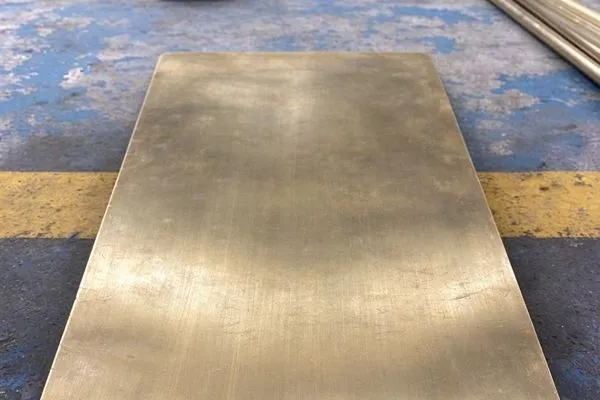
Thick plate cools more slowly at the center than at the surface, so structure and hardness can differ through the thickness. Our standard range runs from 10 mm to 150 mm (about 0.4 to 6 in.). Ask your supplier to report hardness at the surface and mid-thickness, and to state where and in which direction the test coupons were cut. That addresses questions about directional properties in rolled plate. For internal soundness, ultrasonic testing per ASTM E2375 looks for porosity and inclusions. Gear makers need that report most, because a hidden void under a worm wheel tooth can show up as surface damage later.
Seawater Corrosion and Cavitation Behavior of C63000 Aluminum Bronze Plate
The alumina-rich surface film gives C63000 aluminum bronze plate its resistance to seawater, brackish water, and cavitation-erosion in flowing seawater. Laboratory studies of nickel aluminum bronze describe how this film forms and how certain phases can corrode selectively when the film breaks down. Service results depend on flow velocity, chlorides, sulfides, crevices, deposits, temperature, and galvanic contact. Scratches, burrs, rolling marks, weld zones, and poor machining can start local damage. Inspect the finished surface and use compatible fasteners. No single corrosion figure fits every environment, so ask for test data that matches your temper and exposure.
C63000 Aluminum Bronze Plate vs. Other Aluminum Bronze and Copper Alloys
C63000 Aluminum Bronze Plate vs. Cast C95400 and C95500
C95400 and C95500 are casting alloys, while C63000 plate is rolled, so compare each in its real product form. Castings can carry shrinkage porosity, and a gear or bearing surface cut from a casting may expose it. Rolled plate usually has a denser, more uniform structure, and ultrasonic testing can verify it. Our product data indicates that C63000 plate carries higher bearing and compressive loads than C95400 at the same section thickness. C95500 has more nickel and iron than C95400 and is usually stronger, so ask for certified data on both. Castings still make sense for complex shapes.
C63000 Plate vs. C62400
C62400 is another high-aluminum bronze, but it has no deliberate nickel addition. The roughly 5% nickel in C63000 refines the grain, supports fine kappa-phase precipitation, and improves corrosion fatigue resistance in seawater. For parts that see saltwater plus repeated loading, such as rudder components and offshore hardware, that nickel content is the main reason to specify C63000. C62400 can suit mild wear service where seawater fatigue is not a concern. Whichever alloy you consider, compare certificates for the same product form, thickness, and temper instead of comparing catalog numbers.
C63000 Plate vs. Naval Brass
Naval brass costs less and machines more easily, which suits lighter duty and low-load fittings. It contains zinc, so it can suffer dezincification in seawater unless the specific alloy is inhibited, and it usually wears faster under heavy sliding contact and impact. C63000 aluminum bronze plate has no zinc, so dezincification does not apply, and its strength and galling resistance suit thrust washers, wear plates, and slideways. Dealuminification remains the failure mode to watch, which is why microstructure and temper control matter. Judge the choice on lifecycle cost, including machining time, downtime, and replacement frequency, not price per kilogram alone.
How to Select C63000 Aluminum Bronze Plate for a Specific Application
Define Service Conditions First
Good selection starts with data. Before you request a quote, collect contact pressure, applied load, sliding or impact behavior, speed, lubrication, fluid chemistry, temperature, and expected service life. Marine OEMs making rudder bearings, slideways, and mooring parts usually add seawater exposure and classification society requirements. Gear makers add the mating metal, since aluminum bronze worm wheels pair with steel worms without galling. Valve and pump shops add fluid velocity and particle content. Valve makers often weld or bolt aluminum bronze liners onto bodies and gates, which can cost less than replacing the whole part.
Match Temper, Machining, and Welding to the Part
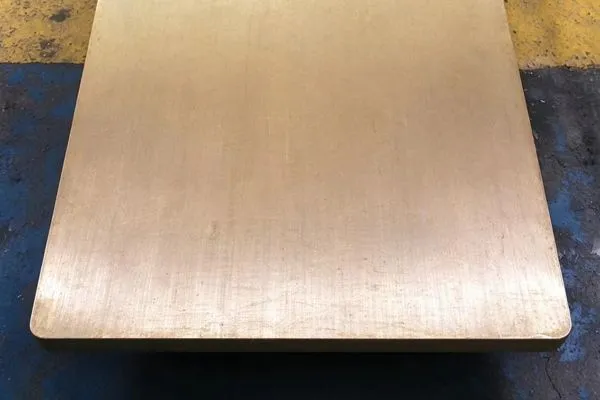
We offer C63000 aluminum bronze plate in hot rolled, annealed, stress relieved, and quenched and tempered conditions. Hot rolled is the standard wrought state. Annealed improves ductility for forming. Quenched and tempered raises hardness and strength for heavy loads. Stress relieved keeps precision parts dimensionally stable. Name the temper on the purchase order and on the certificate, so mixed tempers never arrive in one shipment. Machine with carbide tools and continuous coolant. Weld by GTAW or GMAW with aluminum bronze filler metal, then inspect the weld zone, because it can wear and corrode differently from the plate.
Common Mistakes That Shorten Wear Life
Even a correct alloy fails when the system is wrong. The most common mistakes are choosing by UNS number without confirming temper, assuming corrosion resistance means no maintenance, and ignoring galvanic contact or fluid contamination. Others include a poor mating material, insufficient lubrication, misalignment, rough surface finish, and overheating during machining. For critical parts, run a production trial, inspect the finished surface, and set a maintenance schedule. A trial also shows machining behavior, scrap rate, and finish quality before you commit to a full order, and it costs little compared with an unplanned replacement.
Buying C63000 Aluminum Bronze Plate: Specifications, Supplier, and Pricing
Write a Complete RFQ and Specification
A grade name alone does not make a quote. Specify C63000 aluminum bronze plate to ASTM B171 or ASME SB171, which cover plate, and list the alloy as UNS C63000 with its CuAl10Ni5Fe4, EN CW307G, and DIN 2.0966 equivalents. Standards written for bar, such as EN 12163, and surface-texture standards, such as ISO 4287, do not define plate material, so keep them off a plate drawing. Add thickness, width, length, tolerance, flatness, temper, ultrasonic testing, certificate type, destination, quantity, and delivery date. We cut plate from 10–150 mm thick to custom length and width, sawn or precision ground. Tell us if your design needs thicker stock.
What to Check in a Supplier
Ask whether you are dealing with a producer or a trading company, and request proof. JYDS brings 25+ years of copper alloy production experience, an ISO 9001:2015 quality system, and RoHS and REACH compliance. Every batch ships with an EN 10204 3.1 certificate showing chemical and mechanical test data, and we keep batch-level traceability. Our inspection covers OES chemical analysis, ultrasonic testing per ASTM E2375, mechanical testing, laser dimensional checks, and microstructure examination. We replace or re-machine material after a verified quality or dimension problem. A C63000 aluminum bronze plate supplier should also answer technical questions quickly, and our team replies to inquiries within 2 hours.
Stock, Lead Time, Logistics, and Pricing
The price of C63000 aluminum bronze plate depends on copper market conditions, thickness, order volume, cutting, certification, packaging, and freight. Compare quotes on total cost, including machining and scrap, not per kilogram. We hold over 500 tons of raw materials and standard profiles. Stock items dispatch in 3–5 days, and custom orders ship in 15–20 days. Please confirm current C63000 availability when you inquire. We sit near the Shenzhen and Hong Kong ports, pack in anti-rust, moisture-proof export packaging, and quote CIF, FOB, or DDP by sea, air, or DHL, FedEx, and UPS. Marine projects often run 2–4 months from drawing review to order, so send your specification early.
Conclusion
C63000 aluminum bronze plate resists wear because aluminum, nickel, and iron create a strong matrix with hard kappa phases and a protective oxide film that limits galling, abrasion, and seawater attack. Those benefits depend on the delivered condition, so engineers should verify the alloy designation (UNS C63000, CuAl10Ni5Fe4, EN CW307G, DIN 2.0966), temper, tensile strength, hardness at the surface and mid-thickness, and ultrasonic results on the 3.1 certificate. Compared with cast C95400 and C95500, C62400, and naval brass, the wrought nickel-bearing plate suits heavy-load, seawater, and sliding service, while lighter duty may allow simpler alloys. Selection works best when service conditions, mating material, lubrication, fabrication route, and lifecycle cost are defined before purchase.
FAQ
1. What makes C63000 aluminum bronze plate wear resistant?
Its nickel-strengthened structure, hard kappa phases, and aluminum-rich oxide film resist galling, scratching, and seawater attack.
2. How does C63000 differ from C95400?
C63000 plate is wrought and rolled, while C95400 is a casting. Rolled plate usually has a denser, more uniform structure.
3. Can I weld C63000 plate?
Yes. Use GTAW or GMAW with aluminum bronze filler metal, then inspect the weld zone, because it can wear differently from the plate.
4. Which certificates come with an order?
Every batch ships with an EN 10204 3.1 certificate. ISO 9001:2015 and RoHS documents are available on request.
5. How fast can you ship?
Stock items dispatch within 3–5 days, and custom orders ship in 15–20 days. Please confirm current C63000 stock when you inquire.
Request a C63000 Aluminum Bronze Plate Quote
JYDS is a C63000 aluminum bronze plate supplier with 25+ years of copper alloy production experience, EN 10204 3.1 certificates with every batch, and inquiry replies within 2 hours. Send your drawing, thickness, quantity, temper, and destination to js01@jstongcai.com.cn, and our team will review your C63000 aluminum bronze plate requirements and confirm stock or lead time. Visit becualloy.com for more details.
References
1. ASM Handbook, Volume 18: Friction, Lubrication, and Wear Technology, ASM International, 1992.
2. ASM Handbook, Volume 2: Properties and Selection: Nonferrous Alloys and Special-Purpose Materials, ASM International, 1990.
3. Culpan, E.A., and Rose, G. "Microstructural Characterization of Cast Nickel Aluminium Bronze," Journal of Materials Science, 1978.
4. Hasan, F., et al. "The Morphology, Crystallography, and Chemistry of Phases in As-Cast Nickel-Aluminum Bronze," Metallurgical Transactions A, 1982.
5. Schüssler, A., and Exner, H.E. "The Corrosion of Nickel-Aluminium Bronzes in Seawater—I. Protective Layer Formation and the Passivation Mechanism," Corrosion Science, 1993.
6. Wharton, J.A., et al. "The Corrosion of Nickel-Aluminium Bronze in Seawater," Corrosion Science, 2005.
Online Message